TL;DR:
- Faded or outdated signage diminishes brand perception, reduces foot traffic, and risks non-compliance with regulations. Updating signs strategically—using digital options and regular inspections—can significantly boost sales, brand recall, and property value. A proactive, impact-driven approach ensures signage investments remain effective and compliant over time.
A fading sign doesn’t just look tired. It signals to every passerby that your business, property, or event might not be worth their time. Outdated or faded signs reduce perceived professionalism and drive potential customers straight to your competition. The difference between a fresh, well-designed sign and a sun-bleached relic can mean the difference between a sale and an empty parking lot. This guide walks you through the real costs of ignoring your signage, the data behind sign performance, and a clear action plan for making updates that actually move the needle.
Table of Contents
- How outdated signs hurt your brand and business
- The business impact: Sales, recall, and ROI data
- Regulatory requirements and compliance risks
- When and how to update your promotional signs
- Are frequent signage updates really worth it? A fresh perspective
- Take the next step: Unlock the value of updated signage
- Frequently asked questions
Key Takeaways
| Point | Details |
|---|---|
| Fresh signs build trust | Updating your promotional signs boosts customer confidence and draws more attention. |
| Sales and ROI increase | Modern, high-quality signage leads to higher sales, better recall, and measurable business returns. |
| Stay compliant easily | Updating signs regularly prevents costly fines or forced removals due to changing regulations. |
| Timing matters | Inspect and upgrade signs at least twice a year for optimal performance and appearance. |
How outdated signs hurt your brand and business
Your sign makes a first impression before a single word is spoken. Shoppers, clients, and event attendees form opinions about your operation within seconds of seeing your exterior. A cracked panel, a faded logo, or a message that references a promotion from two years ago tells people one thing: you don’t pay attention to details.
“Customers assume that if a business can’t maintain its signage, it probably can’t maintain its products or services either.”
That perception hits your bottom line fast. When why updating business signage matters is ignored, foot traffic drops gradually at first, then dramatically. Customers who might have walked in decide to keep driving. Event attendees miss your venue entirely. Real estate prospects form negative assumptions about a property before they even read the listing.
Here are the most common ways outdated signage actively costs you:
- Reduced foot traffic because passersby don’t recognize or trust the brand
- Lower perceived product or service quality tied directly to sign condition
- Missed promotional opportunities when outdated messaging runs past its relevance date
- Property devaluation when entrance signs look neglected or unmaintained
- Weaker brand recall because faded colors and worn fonts no longer match your brand identity
The numbers back this up. Research shows 34% of shoppers link the quality of a store’s sign to the quality of its products. That means one in three customers is making a judgment about your brand based purely on what your sign looks like, not your actual offerings. Keeping your signage sharp also ties directly to boosting property visibility and curb appeal, both of which affect property values and neighborhood credibility.
Pro Tip: Walk your property as a stranger would. Stand at the street and ask yourself: would I stop here based on what I see? That honest perspective often reveals signage problems that daily familiarity hides.
The business impact: Sales, recall, and ROI data
Numbers tell the clearest story. If you’ve ever questioned whether new signage is worth the investment, the data from digital signage ROI data makes the case in plain terms.
| Performance metric | Outdated or static sign | Updated or digital sign |
|---|---|---|
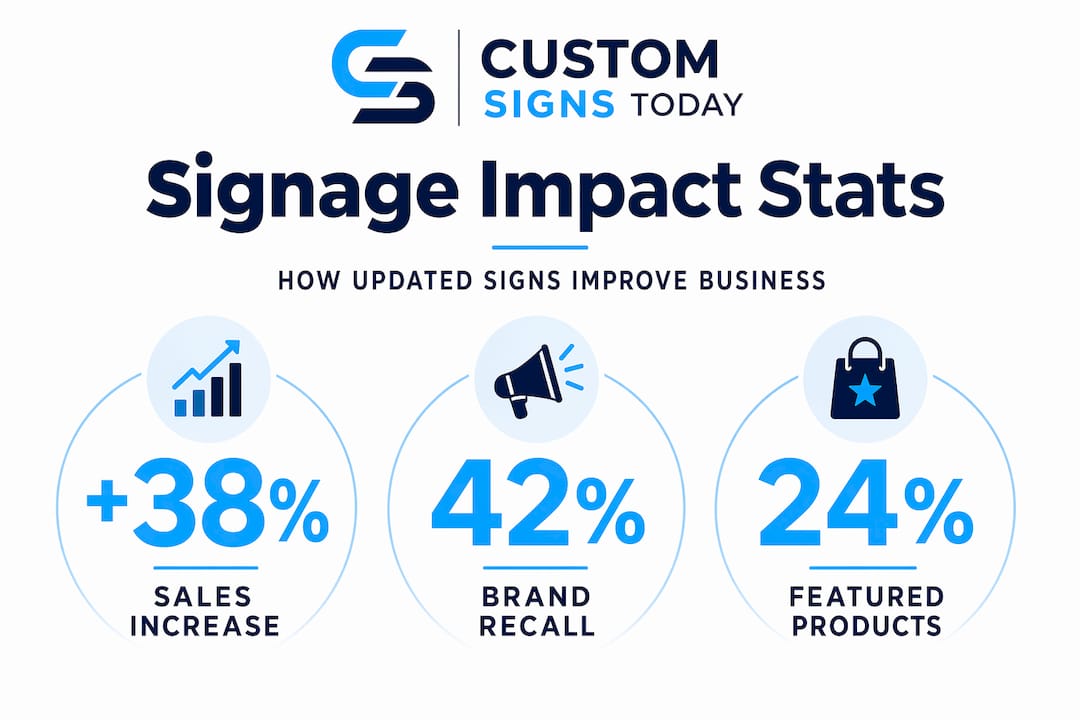
| Sales lift for featured products | Minimal or none | 24–38% increase |
| Views compared to static | Baseline | 400% more views |
| Customer recall rate | Below 30% | Up to 83% |
| Customer engagement | Low | Significantly higher |
| Compliance adaptability | Requires full replacement | Instant digital update |
Those figures aren’t marginal improvements. A 24 to 38 percent sales lift for featured products is the kind of number that changes quarterly revenue projections. And an 83 percent recall rate means customers who see your updated sign are far more likely to remember your brand when they’re ready to buy.

Understanding digital signage advantages helps explain why these numbers are so strong. Dynamic content catches the eye in ways that static printing simply cannot. Motion, color changes, and rotating messages hold attention longer and register more deeply in memory.
Here’s how a signage update translates into real business results, step by step:
- Fresh design and messaging attract attention where the old sign blended into the background.
- Increased foot traffic flows into your location as more people notice and engage with your storefront or venue.
- Clearer messaging converts browsers into buyers because your sign communicates value and urgency effectively.
- Positive brand associations build over time as customers connect your professional appearance with quality service.
- Repeat visits increase because customers remember your brand more accurately after multiple exposures to clean, consistent signage.
A smart signage strategy sequences these outcomes intentionally. Rather than replacing signs reactively when they break, forward-thinking businesses plan updates around seasonal promotions, rebrands, or local market shifts to maximize each investment.
Regulatory requirements and compliance risks
Brand perception and revenue aren’t the only reasons to update your signs. There’s a legal dimension that too many business owners discover too late. Sign codes at the city, county, and state levels change regularly. What was fully compliant five years ago may now violate local ordinances on brightness, size, language requirements, or placement.
Static signs risk regulatory non-compliance whenever codes change, because updating them requires physical labor, new materials, and often a permit process. A digital or face-change sign, by contrast, can be updated instantly without any of that overhead.
The areas where sign codes most commonly shift include:
- Brightness and luminance limits, especially for illuminated signs in residential-adjacent zones
- Maximum sign dimensions, which can change when a municipality revises its zoning ordinances
- Language and accessibility requirements, such as mandated bilingual text or ADA-compliant fonts
- Placement and setback rules, which often change with road improvement or development projects
- Content restrictions, including limits on animated or scrolling text near traffic signals
| Sign type | Compliance adaptability | Cost of change | Time to update |
|---|---|---|---|
| Static printed sign | Low, requires physical replacement | High (materials + labor) | Days to weeks |
| Face-change sign | Medium, panel replacement without full restructure | Moderate | Hours to days |
| Digital sign | High, content updated remotely | Minimal (software update) | Minutes |
Understanding your options before a code change forces your hand is critical. Reviewing regulatory signage requirements helps you stay ahead of enforcement actions rather than responding to them. A proactive signage review every year can catch potential violations before they become fines or forced removals.
Pro Tip: Ask your local permit office for a copy of the current sign ordinance for your zone. Compare it to your existing signs once a year. This 30-minute exercise can save you thousands in emergency replacement costs.
When and how to update your promotional signs
Knowing the risks and rewards is one thing. Acting on them strategically is another. Here’s a proven framework for timing and executing signage updates without wasting money or missing opportunities.
The most important starting point is inspection frequency. Faded signs reduce professionalism and lost customers accumulate gradually, which means problems often go unnoticed until they’re severe. A twice-yearly inspection routine catches issues early, before they reach the tipping point where customers are already walking away.
Follow these steps for a complete signage update process:
-
Evaluate your current signs thoroughly. Check every sign on your property, inside and out. Look for fading, peeling, outdated messaging, physical damage, and any mismatch with your current branding. Photograph each sign for your records and create a priority list based on visibility and condition.
-
Research current local sign codes. Before designing anything new, confirm what your municipality allows. Check size limits, material restrictions, lighting rules, and permit requirements. This protects your investment by ensuring your new signs won’t need to be removed or modified after installation.
-
Develop a replacement and update strategy. Not every sign needs to be replaced at once. Prioritize high-visibility exterior signs first since they create the most powerful first impressions. Interior and secondary signs can follow in the next phase. Reviewing best outdoor sign types helps you match sign formats to their intended purpose and location.
-
Choose materials appropriate for your climate and use case. UV-resistant inks, weatherproof substrates, and durable framing materials extend sign life significantly. A sign that lasts five years in your climate is a better investment than a cheaper option that needs replacing in two. Explore exterior signage solutions to understand what materials perform best for your specific environment.
-
Install and promote your update. New signage is a marketing moment. Use your new look to announce promotions, refresh your social media presence, or send an email to existing customers noting your updated location branding. A sign change is often a good excuse to re-engage your community.
-
Schedule your next review date. Build the next inspection into your calendar immediately. Signage maintenance is a continuous process, not a one-time fix.
Pro Tip: Collect feedback from customers and staff about your signs. Ask three or four regular visitors whether they noticed the signs, whether they could read them easily from a distance, and whether the message was clear. Real users often catch clarity and visibility problems that owners overlook.
Are frequent signage updates really worth it? A fresh perspective
Here’s where most signage guides lose the plot. They tell you to update constantly, invest in digital, and keep refreshing your look. But the businesses that get the best return from their signage are not the ones updating most often. They’re the ones updating most strategically.
We’ve seen clients who chased every trend, swapping out their signs every season, and ended up with a brand identity that felt inconsistent and cheap. And we’ve seen clients who went five years without touching a sign that was still in perfect condition, still on-brand, and still pulling customers in. Their sign wasn’t a problem. Updating it would have been a waste.
The honest framework is this: update for impact, not for novelty. Your signs need refreshing when they are physically degraded, when your brand has evolved, when your messaging is no longer relevant, or when regulations require it. Outside those triggers, a well-made, well-placed sign still does its job quietly and effectively every single day.
Building a smart signage strategy means setting clear criteria for when a sign update is genuinely warranted. Ask yourself three questions: Does this sign accurately represent my brand today? Is it still in strong visual condition? Is it compliant with current regulations? If the answer to all three is yes, your money is better spent elsewhere.
The uncomfortable truth is that some business owners update their signs to feel like they’re doing something, rather than because the sign is underperforming. That impulse is understandable but expensive. Track your signage performance the same way you track marketing metrics. When you see a measurable drop in foot traffic, brand recognition, or compliance standing, that’s your signal to act.
Take the next step: Unlock the value of updated signage
If this guide has made one thing clear, it’s that your signage is never passive. Every day your signs are up, they’re either working for your brand or quietly undermining it. Whether you’re managing a retail location, listing real estate properties, or organizing events, your signs are doing heavy lifting that deserves the right tools.
At Custom Signs Today, we make it simple to move from outdated to outstanding. You can explore face change signs for fast, affordable updates that let you keep your existing frames while refreshing the visible panels. If you’re uncertain about costs and options, a custom sign quote gives you a clear picture of your investment before you commit. Real estate professionals can get targeted guidance from our real estate signage guide to create signs that drive inquiries and close deals faster. The first step is just a conversation, and it costs you nothing to start.
Frequently asked questions
How often should promotional signs be updated?
Most signs should be inspected every 6 to 12 months and updated whenever fading or damage reduces their effectiveness or when local codes change.
Does updating signs really boost sales?
Yes. Research confirms that updated digital signage can increase sales of featured products by 24 to 38 percent and drives significantly more store visits than static alternatives.
What are the compliance risks of old signs?
Old signs can fall out of regulatory compliance as local codes evolve, and static signs risk fines or forced removal if they no longer meet current size, brightness, or language standards.
Are digital signs worth the investment for small businesses?
Absolutely. Digital signage ROI benchmarks show up to 83 percent recall rates and 400 percent more views than static signs, making them effective even for smaller operations with limited foot traffic.