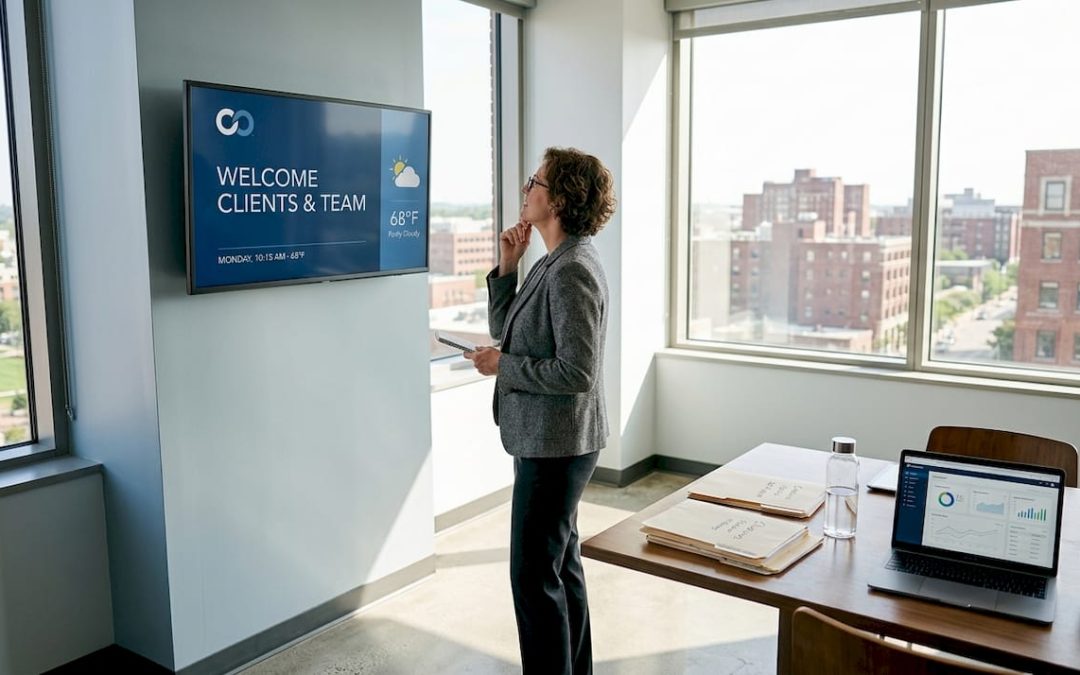
Businesses deploying digital signage see sales lifts of 25 to 40% and achieve ROI in under 18 months, yet many still view these systems as glorified TVs. Digital signage displays are commercial-grade screens engineered for continuous operation, integrated with content management systems to deliver dynamic, targeted messaging that drives measurable business outcomes. Understanding the technology, applications, and strategic deployment of digital signage empowers business owners and marketing professionals to enhance communication, strengthen branding, and capture attention in competitive environments. This guide clarifies what digital signage displays are, how they differ from consumer screens, the core technologies available, and proven practices to maximize impact and return on investment.
Table of Contents
- Key takeaways
- What sets digital signage displays apart from regular screens?
- Digital signage display technologies: Which type suits your business?
- How digital signage systems work and drive business results
- Best practices to maximize digital signage impact for your business
- Explore custom signage solutions to elevate your brand
- Frequently asked questions about digital signage displays
Key Takeaways
| Point | Details |
|---|---|
| Commercial grade durability | Commercial grade displays are built for 16/7 or 24/7 operation with extended warranties and rugged components. |
| High brightness levels | Brightness ranges from 350 to over 2500 nits, ensuring readability in sunlit storefronts and bright areas. |
| Integrated media players | Most digital signage includes built in media players or easy integration with external players to simplify deployments. |
| Data driven content | Success depends on personalized and data driven content along with strategic deployment beyond mere presence. |
What sets digital signage displays apart from regular screens?
Digital signage displays are commercial-grade screens engineered for continuous 16/7 or 24/7 operation, differing from TVs or monitors by featuring higher sustained brightness, thermal design for heat dissipation, remote control interfaces like RS-232 or LAN, and business warranties for uptime and service. Consumer televisions fail quickly under constant use because they lack thermal management and are rated for intermittent viewing. Commercial displays maintain consistent performance in demanding environments, from sunlit storefronts to 24-hour transit hubs.
Brightness levels in digital signage displays range from 350 nits for standard indoor use to over 2,500 nits for outdoor visibility, ensuring content remains legible under direct sunlight or bright ambient lighting. Consumer TVs typically max out at 300 nits, making them unsuitable for window-facing or outdoor applications. Higher brightness directly impacts message visibility and audience engagement, especially in high-traffic retail or public spaces.
Thermal design in commercial displays incorporates advanced heat sinks, ventilation systems, and temperature sensors that prevent overheating during extended operation. This engineering extends component lifespan and reduces maintenance costs. Remote control interfaces enable centralized diagnostics, power management, and troubleshooting across multiple locations, streamlining operations for businesses with distributed signage networks. Business warranties typically offer three to five years of coverage with rapid replacement or on-site service, minimizing downtime and protecting capital investments.
Pro Tip: When evaluating displays, prioritize models with industrial-grade components and verify the manufacturer’s thermal rating matches your operating environment to avoid premature failure.
Key differences between commercial digital signage and consumer TVs include:
- Commercial displays support portrait and landscape orientations with mounting flexibility for varied installation scenarios
- Built-in media players or seamless integration with external players reduce equipment complexity
- Extended input/output options accommodate diverse content sources and daisy-chaining for video walls
- Protective glass and ruggedized enclosures withstand public interaction and environmental stress
Understanding these distinctions helps businesses select appropriate hardware for their business signage installation process and ensures long-term reliability. Investing in commercial-grade displays aligned with your outdoor signage installation requirements delivers superior performance and lower total cost of ownership compared to repurposing consumer electronics.
Digital signage display technologies: Which type suits your business?
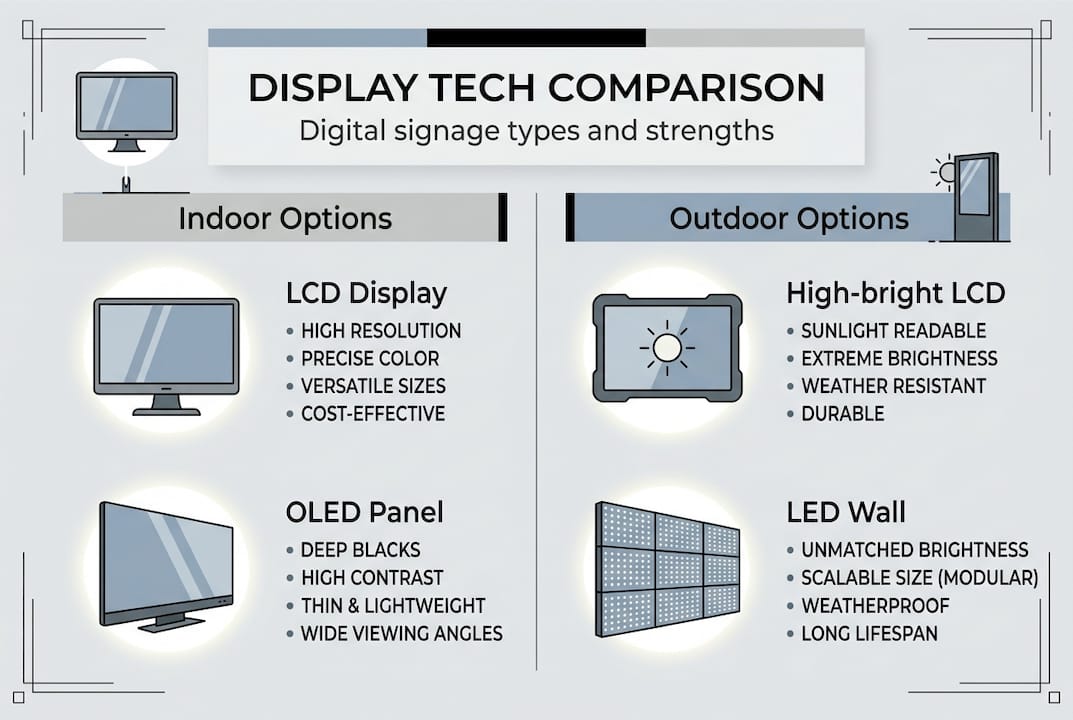
Key technologies include LCD for indoor use at 350 to 700 nits, high-bright LCD for windows or outdoor shaded areas, direct-view LED for large seamless canvases, OLED for premium interiors, and ePaper for low-power static displays. Each technology serves specific business needs based on environment, viewing distance, content type, and budget constraints. Selecting the right display type optimizes visibility, cost-efficiency, and audience impact.
LCD displays dominate indoor digital signage due to their balance of image quality, brightness, and affordability. Standard LCD panels work well in controlled lighting environments like retail stores, corporate lobbies, and restaurants where ambient light remains moderate. High-bright LCD variants push luminance to 1,500 to 2,500 nits, making them ideal for window-facing installations or semi-outdoor locations where direct sunlight challenges visibility. These displays maintain color accuracy and contrast while ensuring content cuts through glare.

Direct-view LED technology constructs large-format displays by tiling individual LED modules, creating seamless canvases without bezels. This approach suits outdoor billboards, stadium screens, and expansive indoor installations where viewing distances exceed six feet. LED displays offer exceptional brightness, often surpassing 5,000 nits, and withstand harsh weather conditions. Pixel pitch, the distance between LED clusters, determines image sharpness; finer pitches deliver crisper images for closer viewing.
OLED displays provide superior contrast ratios, true blacks, and vibrant colors, making them premium choices for luxury retail, hospitality, and corporate environments where image quality reinforces brand positioning. OLED panels consume less power than LCD when displaying darker content and offer wider viewing angles. However, they cost significantly more and have shorter lifespans under continuous bright content, limiting their use in 24/7 applications.
ePaper displays use electronic ink technology that requires power only during content changes, making them ideal for static or semi-static information like menus, schedules, or wayfinding. These displays remain readable in direct sunlight without backlighting, consume minimal energy, and suit applications where content updates occur infrequently.
| Technology | Brightness range | Best use case | Key advantage |
|---|---|---|---|
| Standard LCD | 350-700 nits | Indoor retail, corporate | Cost-effective, reliable |
| High-bright LCD | 1,500-2,500 nits | Window displays, semi-outdoor | Sunlight readability |
| Direct-view LED | 5,000+ nits | Outdoor, large-format | Seamless, weather-resistant |
| OLED | 400-800 nits | Premium interiors | Superior image quality |
| ePaper | N/A (reflective) | Static content, wayfinding | Ultra-low power |
Pro Tip: Match display brightness to ambient light conditions by measuring lux levels at installation sites; indoor spaces typically require 350 to 700 nits, while outdoor locations demand 2,500 nits or higher.
Choosing the right technology involves evaluating:
- Viewing distance and audience size to determine required screen size and pixel density
- Environmental factors including temperature extremes, humidity, and exposure to elements
- Content update frequency and whether dynamic video or static information predominates
- Budget constraints balanced against total cost of ownership including energy and maintenance
Businesses benefit from aligning display technology with their exterior signage basics and understanding indoor versus outdoor signs differences to make informed purchasing decisions that deliver long-term value.
How digital signage systems work and drive business results
A complete digital signage system includes displays, media players, content management systems for remote scheduling and updates, and cloud-based platforms for real-time control. Media players, whether embedded in displays or attached externally, retrieve and render content from the CMS, which serves as the central hub for creating, scheduling, and distributing messaging across single or multiple locations. Cloud platforms enable real-time adjustments, allowing businesses to respond instantly to market conditions, inventory changes, or promotional opportunities.
Content management systems provide intuitive interfaces for non-technical users to design layouts, schedule playlists, and assign content to specific displays or groups. Advanced CMS platforms support conditional logic, triggering content based on data inputs like weather, time of day, audience demographics detected by sensors, or integration with point-of-sale systems. This capability transforms digital signage from passive displays into responsive communication tools that deliver personalized experiences.
Empirical business results demonstrate digital signage’s impact across sectors. Retail sales per square foot increase 25 to 40%, quick-service restaurants see average order values rise 20 to 30%, and in-store digital ads boost purchase likelihood by 8.1%. Corporate environments report 37% employee engagement improvements, while property management companies experience 40% fewer routine inquiries after deploying digital directories and information displays. These gains translate to payback periods under 18 months for most deployments.
Specific sector applications include:
- Retail and QSR promotions driving sales lifts of 25 to 32% through targeted product highlighting and upselling
- Corporate employee engagement increasing 37% via internal communications, recognition programs, and real-time updates
- Convenience stores achieving 34% basket size increases by promoting impulse items and limited-time offers
- Property management reducing inquiries by 40% through digital directories, amenity schedules, and community announcements
- Banking improving foot traffic and service awareness by showcasing products and wait time management
Toyota achieved 314% ROI within 12 months by deploying digital signage in dealerships to educate customers on vehicle features and financing options, demonstrating how strategic content aligned with customer journey stages drives measurable outcomes. This case illustrates that success depends on content quality and smart data integration rather than simply installing screens.
| Metric | Benchmark | Sector |
|---|---|---|
| Sales lift | 25-40% | Retail |
| Purchase likelihood | +8.1% | In-store advertising |
| Average order value | +20-30% | Quick-service restaurants |
| Payback period | <18 months | Multi-sector average |
| Employee engagement | +37% | Corporate communications |
“Digital signage transforms passive viewing into active engagement when content responds to real-time data and audience context, delivering personalized experiences that generic loops cannot match.”
Pro Tip: Integrate your digital signage CMS with existing business systems like inventory management or CRM to automate content updates and ensure messaging reflects current product availability and customer preferences.
Businesses exploring digital signage can leverage outdoor event signage strategies and review outdoor event signage comparisons to understand deployment options. Applying outdoor signage tips ensures installations maximize visibility and impact.
Best practices to maximize digital signage impact for your business
Digital signage enhances branding and communication via dynamic, real-time content versus static print, delivering 30 to 50% cost savings with higher recall rates of 83% compared to 50% for traditional signage. Prioritizing personalization and AI-driven content optimization positions businesses to meet 2026 benchmarks where audience expectations demand relevance and timeliness. Generic content loops fail to engage modern consumers accustomed to personalized digital experiences across all touchpoints.
Dynamic and personalized content outperforms static messaging by adapting to viewer context, time of day, and environmental conditions. Success requires data integration like weather or time-based triggers over generic loops, with direct ROI measurement trumping vanity metrics such as impressions or dwell time. Businesses should focus on conversion rates, basket size increases, and customer acquisition costs to evaluate digital signage effectiveness accurately.
Integrating real-time data triggers keeps messaging relevant and actionable. Weather-based content promotes umbrellas during rain or cold beverages during heat waves. Time-based scheduling displays breakfast menus in morning hours and dinner options in evenings. Location-aware content tailors messaging to regional preferences or local events. These strategies increase engagement by ensuring content aligns with immediate viewer needs and circumstances.
Measuring direct ROI requires establishing clear KPIs before deployment, such as sales lift per display, customer conversion rates, or average transaction values. A/B testing different content approaches on similar displays isolates variables and identifies high-performing strategies. Tracking metrics over time reveals trends and informs content optimization, ensuring continuous improvement and sustained returns.
Leveraging AI and automation trends optimizes content delivery by analyzing audience behavior patterns, predicting peak engagement times, and dynamically adjusting messaging. Machine learning algorithms identify which content formats, colors, and calls-to-action drive desired outcomes, automating optimization without manual intervention. This approach scales personalization across large display networks while reducing management overhead.
Common pitfalls to avoid include:
- Ignoring content quality by prioritizing hardware over messaging strategy, resulting in expensive displays showing low-value content
- Failing to update content regularly, causing audience fatigue and diminishing returns as viewers tune out stale messaging
- Neglecting hardware maintenance, leading to display failures that damage brand perception and waste investment
- Measuring vanity metrics instead of business outcomes, obscuring true performance and preventing data-driven optimization
Pro Tip: Schedule quarterly content audits to refresh messaging, retire underperforming campaigns, and incorporate seasonal or trending topics that maintain audience interest and engagement.
Maintaining hardware properly extends lifespan and ensures consistent uptime. Regular cleaning prevents dust accumulation that impairs cooling systems. Firmware updates patch security vulnerabilities and add features. Monitoring display health through remote management tools enables proactive maintenance before failures occur. Following outdoor signage tips and adhering to business signage installation best practices ensures installations meet professional standards. Implementing outdoor sign maintenance protocols preserves investment value and sustains visual impact over years of operation.
Explore custom signage solutions to elevate your brand
Implementing effective digital signage requires expertise in hardware selection, content strategy, and installation best practices. Custom Signs Today offers tailored solutions that integrate traditional and digital signage to enhance your branding and marketing effectiveness across all customer touchpoints. Whether you need eye-catching custom signs for storefronts, high-visibility exterior lightbox signs for 24/7 impact, or flexible face change signs for seasonal messaging, professional guidance ensures your investment delivers measurable results.
Partnering with experienced signage providers streamlines the process from concept to installation, ensuring displays integrate seamlessly with your existing marketing infrastructure. Professional installation guarantees optimal placement, proper mounting, and reliable power and network connectivity. Ongoing support maintains system performance and helps you adapt content strategies as business needs evolve, maximizing long-term ROI and keeping your messaging fresh and relevant.
Frequently asked questions about digital signage displays
What are digital signage displays?
Digital signage displays are commercial-grade electronic screens designed for continuous operation in business environments, delivering dynamic visual content through integrated media players and content management systems. They differ from consumer electronics by offering higher brightness, thermal management, remote control capabilities, and business warranties that ensure reliable performance in demanding applications.
How do digital signage displays differ from TVs or monitors?
Commercial digital signage displays feature industrial-grade components rated for 16/7 or 24/7 operation, higher sustained brightness levels up to 2,500 nits or more, advanced thermal design preventing overheating, and remote management interfaces for centralized control. Consumer TVs lack these features and fail quickly under continuous use, making them unsuitable for business applications requiring reliability and longevity.
What types of digital signage display technologies are available?
Primary technologies include standard LCD for indoor use, high-bright LCD for window-facing or semi-outdoor locations, direct-view LED for large seamless outdoor installations, OLED for premium interior environments, and ePaper for low-power static content. Each technology serves specific needs based on ambient lighting, viewing distance, content type, and environmental conditions. Review exterior signage basics to understand outdoor technology requirements.
What businesses benefit most from digital signage?
Retail stores, quick-service restaurants, corporate offices, healthcare facilities, property management companies, banking institutions, and entertainment venues achieve significant ROI through digital signage. Applications range from promotional messaging and menu boards to wayfinding, employee communications, and customer education, with documented sales increases of 25 to 40% and payback periods under 18 months across sectors.
How do I ensure my digital signage content is effective?
Prioritize dynamic, personalized content that responds to real-time data like weather, time of day, or audience demographics rather than generic static loops. Measure direct business outcomes such as sales lift and conversion rates instead of vanity metrics. Regularly update content to prevent audience fatigue, and leverage AI-driven optimization to identify high-performing messaging strategies. Following business signage installation best practices ensures technical implementation supports content effectiveness.