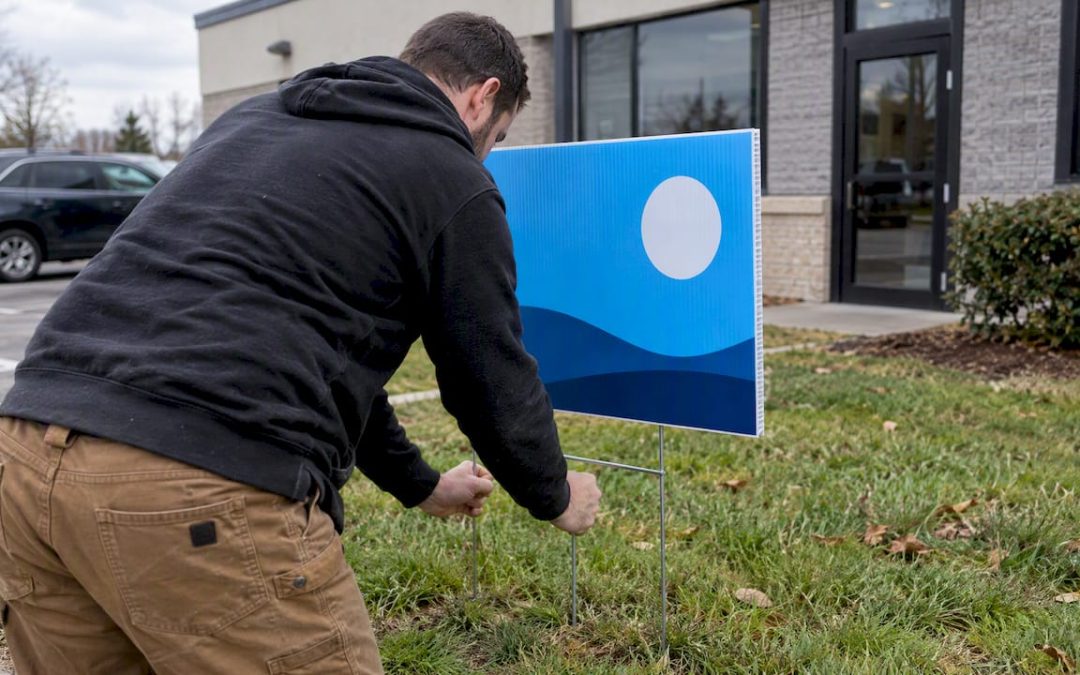
To print yard signs that survive weather and wind, print full-color artwork on 4 mm corrugated plastic (coroplast) with an outdoor-rated ink system, add H-stakes, and check your city’s sign rules before you order. You can print at home or on a desktop cutter for a one-off, but anything meant to stay outside for weeks, or to go in batches, is a job for a flatbed or UV print workflow. Below is the full process, the file specs, the mistakes that cost money, and when it makes sense to hand the job to a sign shop.
TL;DR
- Use corrugated polypropylene (coroplast). 4 mm is the common choice for economical temporary signs, and the manufacturer advises against UV printing below 4 mm.
- Build artwork at 300 dpi in CMYK, with bleed, and keep the message short enough to read from a moving car.
- Order the sign wider than tall with vertical flutes if you plan to use H-stakes, so the stake arms slide into the channels.
- Check right-of-way and zoning rules before printing. Size, height, permits and placement vary by city.
- Home printing on paper or stickers works for a short event. For a campaign, listing or business promotion, a professional print gives you durability and consistent color.
Table of Contents
- Start with where the sign will stand and how long it must last
- Choose the material: why coroplast is the standard
- Decide on single or double-sided printing
- Prepare artwork that prints correctly
- Plan the stakes and flutes before you print
- How yard signs are actually printed
- Check local sign rules before you print
- Proof everything, then inspect on delivery
- What to have ready before asking for a quote
- Our perspective: where DIY stops paying off
- Get yard signs printed by Custom Signs Today
- FAQ
- Sources
Start with where the sign will stand and how long it must last
Every later decision follows from two questions: where is the sign going, and for how long?
A sign for a Saturday open house needs to survive a day. A contractor’s job-site sign may sit through a season of sun, rain and sprinklers. A political or real estate sign may be out for weeks or months. Placement matters as much as duration: a sign staked in soft lawn behaves differently from one zip-tied to a chain-link fence or planted in a gravel median.
Write down:
- Location type: your own lawn, a customer’s property, a business frontage, a public right-of-way.
- Duration: one day, a few weeks, a full season.
- Audience: drivers at 35 mph, pedestrians, or neighbors. This sets how big and how simple the design must be.
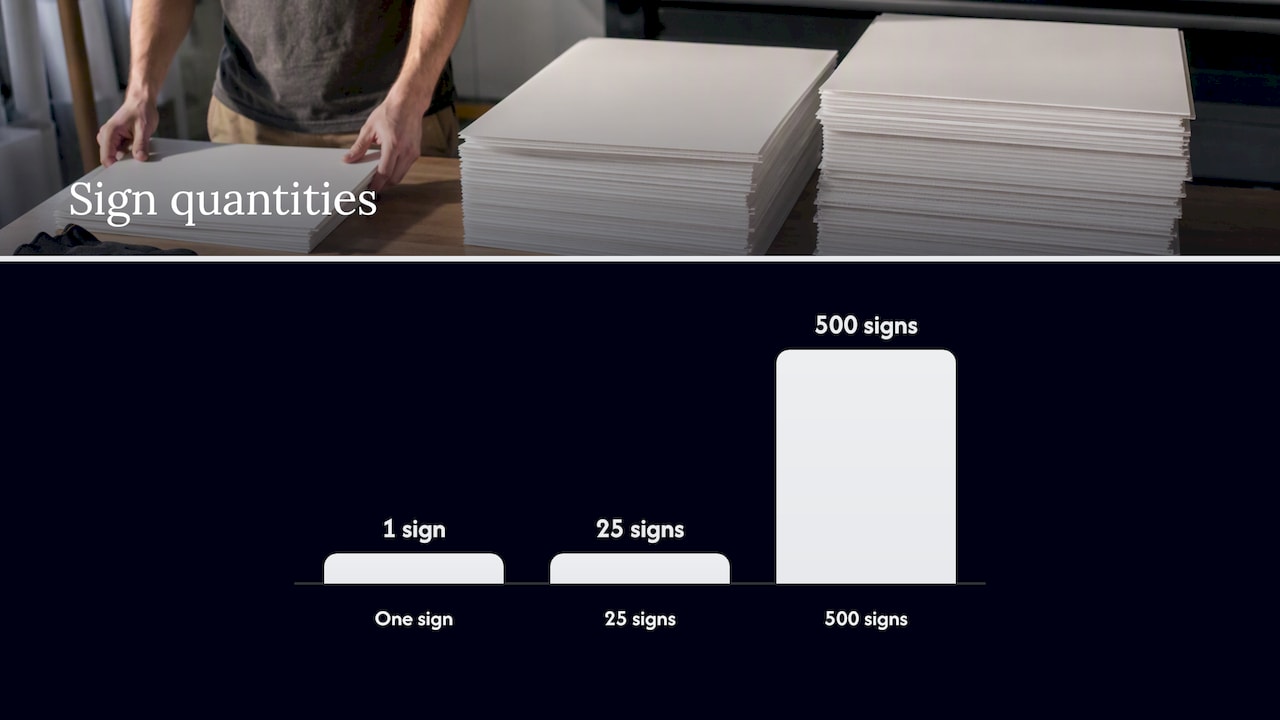
- Quantity: one sign, 25, or 500. Quantity changes the best print method and the cost per sign.
If you are still deciding on dimensions, our guide on how to select yard sign size walks through readability distance and common formats.
Choose the material: why coroplast is the standard
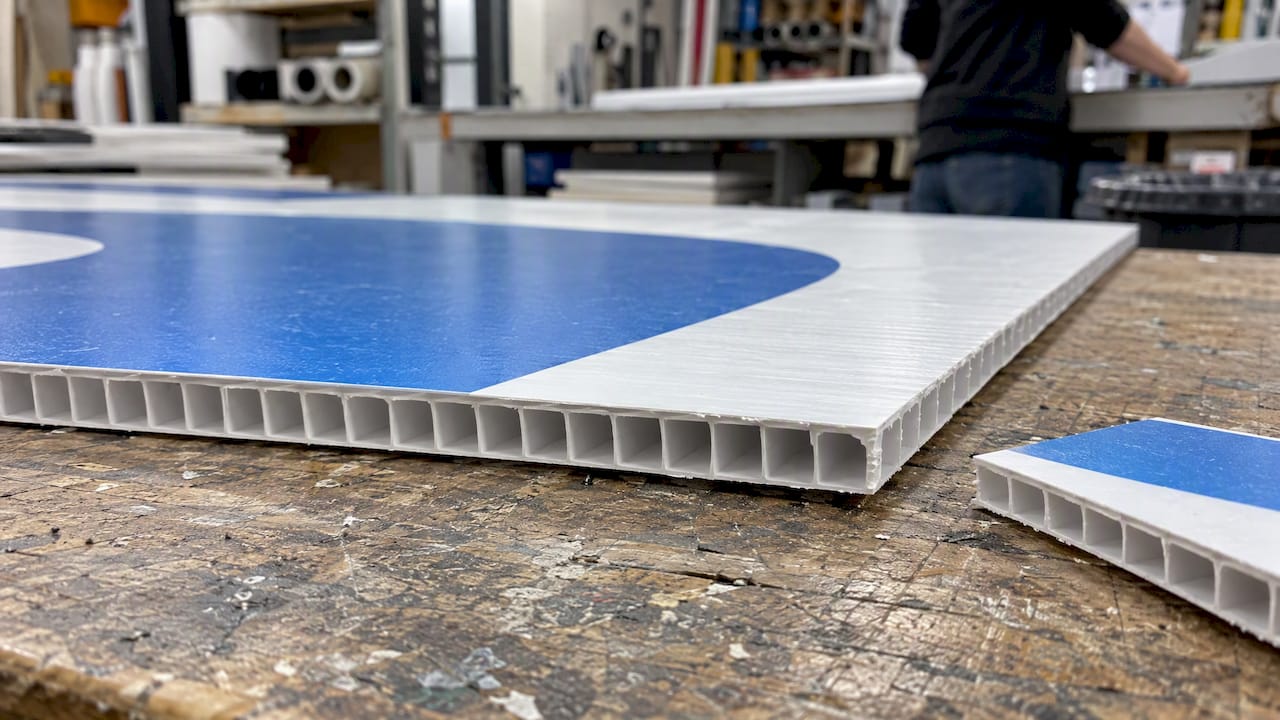
Most professionally printed yard signs use coroplast, a brand name that people use for corrugated polypropylene sheet. According to the manufacturer’s print datasheet, it is waterproof, weather resistant, tougher than corrugated fiberboard and lighter than solid extruded plastic, and sheets are available from 2 mm to 12 mm. The twin-wall flutes are what let a thin sheet stay rigid and take a stake.
Thickness
4 mm is the common choice for economical temporary signs. Thicker stock is used for harsher conditions or longer use. The datasheet also cautions against UV printing below 4 mm, so a very thin sheet is not a way to save money on a UV-printed job.
Surface treatment
The sheet is corona treated to help inks and adhesives bond. That is why you cannot judge a blank by looks: a sheet that is not properly treated, or an ink that does not suit polypropylene, can scratch or peel early. Match the ink system to the substrate rather than assuming that any plastic sign blank will hold paint or toner.
Alternatives and when they make sense
| Material | Best for | Watch out for |
|---|---|---|
| Coroplast (4 mm) | Temporary outdoor yard signs, real estate, events, campaigns | Can crease if bent hard; flute direction matters for stakes |
| Thicker corrugated plastic | Longer-term or windy sites | Higher material cost |
| Aluminum or plywood (MDO) | Permanent post-and-panel signs | Heavier, more expensive, not a quick yard sign |
| Paper or poster board | One-day indoor or covered use | Fails in rain and sun |
For deeper comparisons, see our sign materials comparison, and for permanent builds our notes on MDO plywood for outdoor signs. If coroplast is new to you, what a coroplast sign is and why realtors use it covers the basics.
Decide on single or double-sided printing
Signs are usually staked at an angle to the road rather than facing it head-on, so a single-sided sign shows its blank back to half the traffic. Printing both sides doubles the audience for a modest extra step. Use single-sided only when the sign sits against a wall or fence, or for a very short-term event where cost is the priority.
If the back carries a different message (for example, a phone number on one side and a web address on the other), proof both sides separately. Mistakes on the back are the ones people miss.
Prepare artwork that prints correctly
File prep is where most amateur jobs go wrong. One trade specification in the coroplast datasheet lists 300 dpi, CMYK color, PDF format and 1 inch total bleed. Your printer’s template may differ, so always download and use theirs, but these are sensible defaults.
Design rules for a sign read at a glance
- One message. A name, one offer or action, one contact method. If a driver cannot read it in three seconds, cut words.
- High contrast. Dark on light or light on dark. Avoid pastel on white and red on green.
- Large type, simple fonts. Thin scripts vanish at distance.
- Big logo, small clutter. Leave margin around the edges so stakes, grommets and trimming do not cut into text.
- One QR code at most, and only if the destination is mobile friendly. Make it large with a quiet border, and test it from the print proof.
File checklist
- Vector artwork (logo and text outlined) or images at 300 dpi at final size
- CMYK color mode, not RGB, to avoid color shifts
- Bleed added as the printer’s template requires
- Text kept inside the safe margin
- Orientation set to match the stake plan (see below)
- Export as PDF unless the printer asks for something else
A common DIY mistake is to build the design on a letter-size document and enlarge it. Low-resolution images then look soft at 18 by 24 inches. Start at the final size.
Plan the stakes and flutes before you print
The flutes are the hollow channels in coroplast. A standard H-stake has two arms that slide into the channels, so the flutes must run vertically. For that, a common production specification is to order the sign wider than it is tall, with the flutes running up and down.
This is easy to get wrong. If you design a portrait sign and the flutes run horizontally, the H-stake will not seat properly, and you will either force a bad fit or have to use zip ties and a different mount. Decide on the stake style, then orient the design.
Other finishing choices:
- Grommets: for fences, wire frames or hanging. Allow margin so the grommet does not cover text.
- Contour cutting: custom shapes such as houses, arrows or circles. Keep points and thin parts simple, because they snap more easily.
- Hardware: wire H-stakes for lawn, heavier stakes for wind, and frames for hard ground.
How yard signs are actually printed
There are four realistic routes. The right one depends on quantity, durability and how professional you need the result to look.
1. Print at home and mount
You print on a home printer and attach the paper to a board. It is the cheapest for one sign, and it fails fastest outdoors: paper warps with moisture and inkjet or toner colors fade. Weatherproof vinyl or adhesive stock improves it, but a home printer rarely handles the size of a real yard sign, so you end up tiling sheets. Fine for a two-day garage sale, not for a campaign or business sign.
2. Apply printed vinyl to a blank
Sign makers often print adhesive vinyl and apply it to a coroplast blank. It gives a durable, bright face, but it is labor intensive. Application must be squeegeed cleanly to avoid bubbles and edge lifting, and the cost per sign rises with hand work.
3. Direct digital UV printing
A flatbed UV printer prints directly onto the coroplast and cures the ink with UV light. That is why the manufacturer’s 4 mm minimum for UV printing matters. This route suits batches, double-sided jobs and quick turnaround, and it is what most commercial yard sign producers use.
4. Screen printing
For very large runs of one design, such as thousands of campaign signs, screen printing can be efficient, but setup makes it impractical for small orders or designs with many colors.
Check local sign rules before you print
This is the mistake that costs the most. A beautifully printed sign that must be pulled the next day is a total loss. Yard sign rules in the U.S. are set locally, so they differ from city to city, and the rules for your own lawn often differ from those for a roadside or median.
Some examples of how much they vary:
- Seattle, WA: the city’s yard sign guide limits qualifying signs in the public right-of-way to 8 square feet and 36 inches tall, with a 24-inch height limit within 30 feet of an intersection. It stresses visibility at intersections and unobstructed sidewalks.
- Hampton, VA: the city explains that right-of-way sign rules apply even when the sign belongs to a private business.
- Marysville, WA: under a 2024 ordinance, the city requires a temporary sign permit and the abutting owner’s permission for signs in the right-of-way, and caps temporary signs at 6 feet tall and 8 square feet.
- Oakwood, OH: the city says temporary yard signs in a residential district do not need a permit, while temporary signs in a business district may.
The pattern is clear: size, height, number, setback and permit requirements are all local. Before you finalize artwork, call or check the website of your city’s planning and zoning department and confirm:
- Maximum sign area and height for your zone
- Whether a permit is needed for a temporary sign
- Whether signs are allowed in the right-of-way, and under what conditions
- How long a temporary sign may stay up
- Written permission from the property owner, if the sign is not on your own land
If you are a business, HOA or property manager, also check for deed restrictions or lease terms. Rules from a homeowners association can be stricter than the city’s.
Proof everything, then inspect on delivery
Before approving a print, check:
- Spelling of names, phone numbers, URLs and dates (read digits aloud)
- QR code scans from the proof
- Final dimensions and orientation against the stake plan
- Color: ask how the printer handles brand colors, and request a physical sample for critical jobs
- Bleed and cut lines
When the signs arrive, count them, check edges and print quality on a few from each box, and test-fit a stake before heading out to install. Spotting a flute error with 5 signs is cheap. Spotting it with 150 is not.
What to have ready before asking for a quote
A printer can give an accurate quote only if you supply the details that affect material and production. The more complete the request, the fewer back-and-forth emails:
- Final dimensions and quantity
- One or two sides
- How long the sign will be outdoors
- Artwork file, or whether you need design help
- Substrate preference and flute direction
- Stakes or grommets
- Delivery location and installation date
Also ask the printer to confirm proof approval, color handling, cut dimensions and what weather performance to expect. If you want a map of the whole process from request to install, our custom sign workflow guide and guide to ordering custom signs lay it out step by step.
Our perspective: where DIY stops paying off
We see the same pattern over and over. Someone prints one sign at home to test an idea, and that is a perfectly good way to test a message. The trouble starts when the same approach gets used for a listing, a job site or a promotion that has to look credible for weeks.
A sign is a small piece of your brand standing in public. Faded color, a curled corner or a crooked stake tells passersby something about the business behind it. That is why we build around the environment and the brand, not just the file: material choice, flute direction, finishing and placement are decided together, and compliance questions come up in the quote conversation, not after delivery.
Our advice for most business owners, agents and event organizers: do your own thinking on the message and the placement, check the local rules, and then let a shop handle the print and finishing so the result is consistent across every sign. If you handle a batch, a few extra dollars on double-sided printing and proper stakes protects the whole run.
— Yossi
Get yard signs printed by Custom Signs Today
If you want the result without the trial and error, we produce custom signs in the size, material and finish your site calls for, including real estate signs, A-frames, directional signs and more. Our custom signs page shows what we make, and you can request a free quote there. For realtors, the guide to ordering real estate signs explains setup. If timing is tight, read how on-demand printing can work for your schedule. For outdoor longevity, see our tips on weatherproofing outdoor signs.
FAQ
Can a Cricut make yard signs?
A cutting machine can cut adhesive vinyl lettering and shapes, which you can then apply to a coroplast or other blank. It is slow for large signs, and the size limits of the mat or roll restrict what you can do. It suits a single custom sign, not a batch.
Does Office Depot print yard signs?
Big-box print centers generally offer some form of yard sign printing, but products, sizes, turnaround and stake options vary by store and change over time, so confirm directly with the location. A sign shop can usually offer more control over material, finishing and design support.
What size should a yard sign be?
The right size depends on how far readers are from it and on your local limits. Check your city’s maximum area and height first, since some cities cap signs at around 8 square feet. Our yard sign size guide covers readability in more detail.
Do I need a permit for a yard sign?
It depends on the city and the location. Some cities do not require permits for temporary residential yard signs, while business districts and public right-of-way placements often do. Contact your local planning and zoning department before you print.
Sources
- Coroplast print datasheet
- Seattle DOT: Yard Signs in the Public Right-of-Way
- Hampton, VA: Posting signs
- Marysville, WA: Temporary Signs
- City of Oakwood: Do I need a permit for a temporary yard sign?