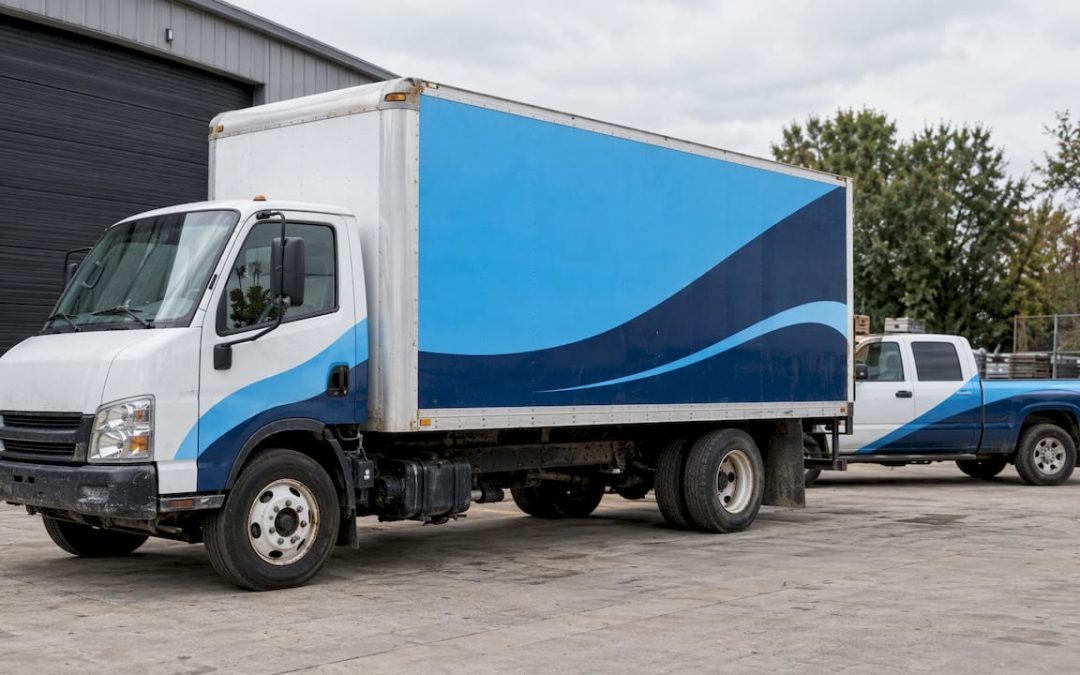
Fleet branding is the practice of putting your company’s identity (logo, colors, name, phone number and a clear message) on every vehicle you run, so the whole fleet looks like one business. It is done with decals, cut lettering, partial wraps or full wraps. For a company whose vans, trucks or cars are already on the road every day, it turns that driving time into advertising. We design, produce and install this kind of vehicle graphics, from vehicle lettering and car magnets to full vehicle wraps.
This guide explains what fleet branding is, which graphics options exist, what the available evidence says about its reach, and how to roll it out across several vehicles without ending up with a mismatched fleet.
TL;DR
- Fleet branding means applying consistent graphics to all your company vehicles: logo, colors, services and contact details.
- There are five common levels: spot graphics and decals, partial wraps, full wraps, reflective accents and full reflective wraps.
- A 2017 trucking-industry report cites American Trucking Associations research putting a typical trailer wrap at about 10 million impressions a year.
- Consistency matters more than size: one template, adapted to each vehicle type, is what makes a fleet recognizable.
- Plan the design, the vehicle condition and the installation together, and get a quote before you commit to a coverage level.
Table of Contents
- What fleet branding means
- Why businesses brand their vehicles
- The five levels of fleet graphics
- How fleet branding differs from a single wrapped vehicle
- How to brand your fleet, step by step
- Common mistakes to avoid
- Fleet branding for different businesses
- Our perspective
- Get your fleet quoted
- FAQ
- Sources
What fleet branding means
A fleet is any group of vehicles a business owns or operates: three pickup trucks, a dozen service vans, a set of box trucks, a few sales cars. Fleet branding (also called fleet vehicle branding) is the deliberate, uniform graphic treatment of those vehicles. LCM Fleet describes it as using wraps, decals and logos to promote a company’s identity on the road, and says it helps customers recognize your team and builds trust.
Three ideas sit inside that definition:
- Identity. The vehicle carries the same logo, colors and typography you use on your signs, website and uniforms.
- Consistency. Every vehicle follows the same system, so a customer who sees two trucks in one week connects them to one company.
- Message. The graphics say what you do and how to reach you, not just who you are.
Fleet branding is closely related to fleet advertising. The difference is mostly emphasis. Branding is the standing identity of the vehicles. Advertising can also include a temporary message, such as a seasonal offer, added on top of that identity.
Why businesses brand their vehicles
The case rests on a simple fact: your vehicles already travel through the neighborhoods where your customers live and work. A branded vehicle adds a message to trips you were making anyway.
Recognition and trust on the road
A clearly marked van parked outside a customer’s home tells the neighbors who is working there. A uniform look also signals a organized, established company. For service businesses, contractors, delivery companies and property management firms, that recognition shortens the distance between “I see them everywhere” and “I’ll call them.”
What the numbers say about reach
Trade reporting gives a sense of scale. A Heavy Duty Trucking report from 2017 cites an American Trucking Associations study finding that a typical trailer wrap generates 10 million impressions a year. The same report puts the figure at 14 million with reflective graphics and 16 million for local delivery vans. It also cites research of 101 impressions per mile traveled for fleet graphics.
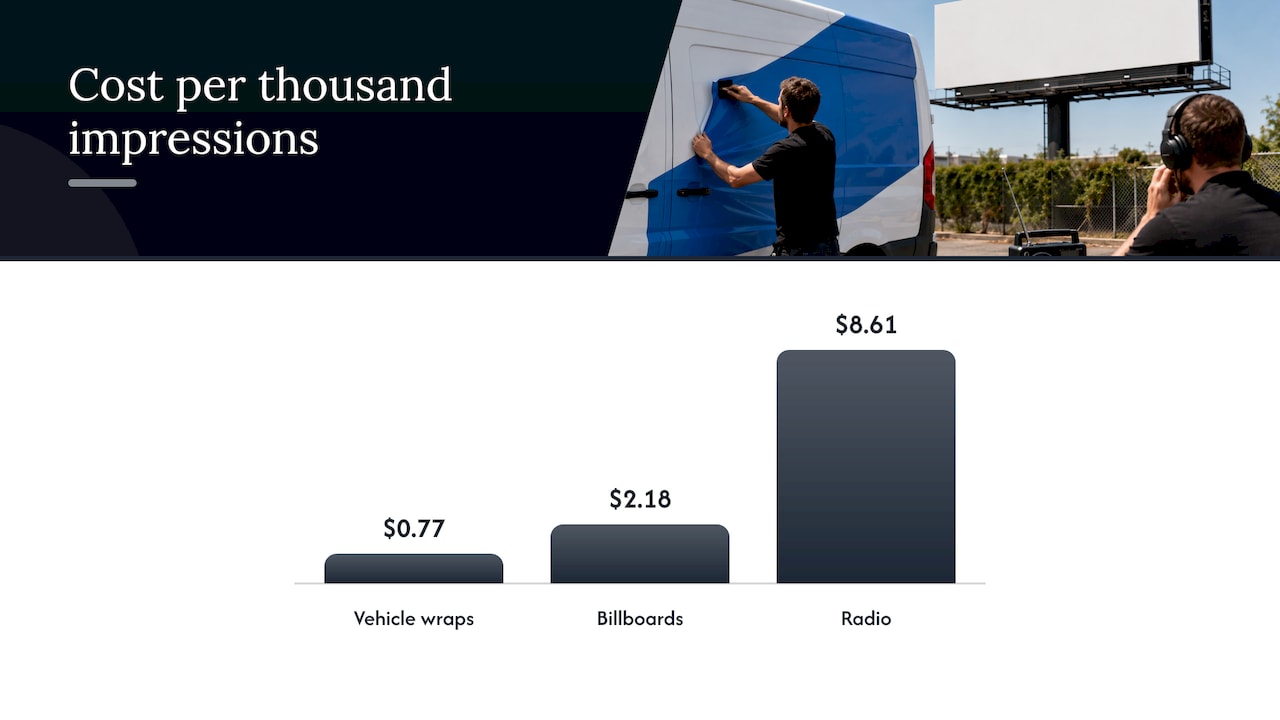
On cost, the same article quotes Outdoor Advertising Association of America figures of $0.77 per 1,000 impressions for vehicle wraps, compared with $2.18 for billboards and $8.61 for radio. These are industry estimates from 2017, and the figures vary by market, route and vehicle, so treat them as an indication of scale rather than a promise for your own fleet.
If you want to compare mobile advertising with other out-of-home formats, it helps to look at the advertising value of out-of-home media and consider how each format reaches people.
Matching the investment to how you drive
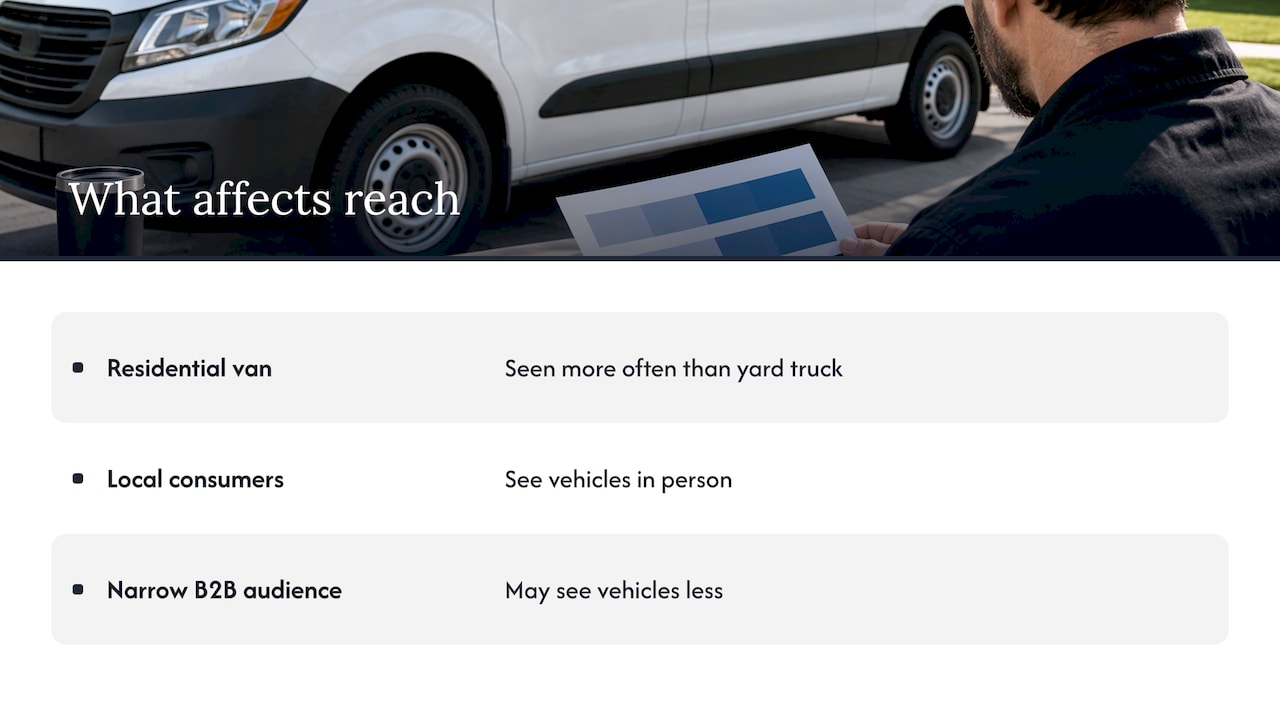
The return depends on how your vehicles are used. A van that works residential streets every day will be seen far more often than a truck that sits in a yard. Who you sell to matters too. Local consumers see your vehicles in person; a narrow commercial audience may see them less. The right graphics level follows from that, which is why the options below start small and scale up.
The five levels of fleet graphics
3M, a maker of vehicle graphics films, lays out five fleet wrap options. They give you a practical way to choose.
| Option | What it is | Best for |
|---|---|---|
| Spot graphics and decals | Simple logos and cut lettering on doors, tailgates or windows | Starting a fleet program, fast and budget-friendly rollouts |
| Partial wraps | Graphics covering at least one-third of the vehicle | Strong presence without covering the whole body |
| Full wraps | A full color change or printed wrap over the whole vehicle | Maximum visual impact |
| Reflective accents | Reflective film added to the design for visibility at night | Vehicles that work early, late or on busy roads |
| Full reflective wraps | A wrap made entirely from reflective film | 24-hour visibility on high-exposure vehicles |
Spot graphics and decals
This is the entry point: your logo, company name, phone number and website in cut vinyl lettering or printed decals. It is quick to produce and easy to repeat on every vehicle. For a business with a mixed fleet of cars, vans and pickups, a consistent lettering package is often the fastest way to make the whole group look like one company. We explain more in our guide to custom decals for branding and on our custom vinyl decals page.
Partial wraps
A partial wrap covers at least a third of the vehicle, usually the rear and lower sides or a large panel area, and often works with the vehicle’s own paint color as part of the design. It gives you room for a headline, imagery and contact details, so it suits companies that want a bolder look without a full-body treatment.
Full wraps
A full wrap covers the vehicle in a continuous design, either a color change or a printed graphic. It gives you the largest canvas and the most control over how the vehicle looks. It suits box trucks, cargo vans and trailers, where large flat panels carry a message well. Our overview of vinyl car wraps and business visibility goes into how wraps support brand recognition.
Reflective accents and reflective wraps
Reflective film makes graphics visible when headlights hit them. 3M lists reflective accents, such as its Scotchlite Series 680, for 24/7 visibility and night safety, and full reflective wraps for vehicles that need the maximum. For a fleet that runs at dawn, dusk or on dark roads, this adds both brand exposure and visibility.
How fleet branding differs from a single wrapped vehicle
One wrapped van is a good advertisement. A branded fleet is a system. The differences show up in four places:
- Template. A fleet needs a design that can adapt to different vehicle shapes (a sedan, a cargo van, a box truck, a trailer) while staying recognizably the same.
- Placement rules. Logo position, phone number size and tagline placement are decided once, then applied everywhere.
- Scheduling. Vehicles come out of service for installation in batches, so work needs to be planned around your jobs.
- Replacement. New vehicles join the fleet over time. A written spec means the next van matches the last ten.
How to brand your fleet, step by step
Step 1: Take stock of the vehicles
List every vehicle: make, model, body type, how often it is used, where it drives and how long you plan to keep it. Vehicles that stay in service for years and spend their days on public roads are the strongest candidates for larger graphics. The list also tells you how many different templates you need.
Step 2: Decide what the graphics must say
To be read from a moving car, a vehicle carries a short message. Keep to your company name, one line on what you do, a phone number or web address, and your logo. Large, high-contrast lettering reads at a distance; long lists of services do not. We help business owners boil their message down to what a passing driver can take in, as part of the design consultation.
Step 3: Choose the coverage level
Use the five levels above. A common approach is to give high-exposure vehicles partial or full wraps and mark the rest with spot graphics, all built from the same logo, colors and fonts. That way every vehicle belongs to the same family even when the budgets differ.
Step 4: Design for each vehicle, not just one
A design that looks balanced on a cargo van can look cramped on a pickup. Windows, door handles, rivets, curves and bumpers all interrupt a design, so each vehicle type needs its own layout built from the shared template. We handle full customization of size, materials and design, so each layout is built for its vehicle and your brand.
Step 5: Prepare the vehicles and plan the install
Graphics need a clean, sound surface to bond to. Plan the installation window so vehicles are out of service as little as possible, and install them in batches. Our installation is certified, and we aim for fast turnaround for both local and nationwide clients. For a few lettering jobs, we also offer same-day service on selected items, so ask us what applies to your project.
Step 6: Check compliance
Vehicle markings can interact with local rules and with regulatory requirements for certain commercial vehicles. Our compliance consulting is part of the process, so the graphics fit the rules that apply to your vehicles and your area before anything is produced.
Step 7: Write it down
Keep a one-page spec with logo files, color values, fonts, placement measurements and the film used. When you buy a new vehicle or replace a damaged panel, the spec lets your installer match what is already on the road.
Common mistakes to avoid
- Too much text. Seven lines of services cannot be read at 40 mph. Choose one message.
- Low contrast. Pale lettering on a light vehicle disappears. Contrast matters more than decoration.
- Inconsistent versions. Different logo files and colors across vehicles weaken recognition. Work from one set of master files.
- No contact point. A beautiful vehicle without a phone number or web address wastes the exposure. Include one.
- Designing for the screen only. A flat mockup does not show how a design wraps around a curve or breaks at a door seam. Ask for the design to be checked against the actual vehicle.
Fleet branding for different businesses
Service and trades companies
HVAC, plumbing, landscaping and cleaning companies are on residential streets all day. Their vans act as a neighborhood presence, and a strong phone number and service line matter most.
Real estate and property management
Agents and property managers use branded cars and vans to link a name to the yard signs, banners and lockbox signage in the same area. When your vehicle graphics use the same color and logo as your real estate signs and banners, a listing and your car reinforce each other.
Event organizers
Event companies can pair vehicle graphics with feather banners, retractable banners and directional signs, so the arrival of the delivery truck already signals the event brand.
Delivery and logistics
Box trucks and trailers offer large flat surfaces, and reflective graphics support visibility on night runs. This is where the high impression figures cited above come from.
Our perspective
We have always thought of a company vehicle as the first sign a customer sees. It arrives before you do, it sits in front of the job, and it is parked in the neighborhood long after the work is done.
What makes fleet branding work is not size. It is a clear system. One logo, one color palette, one short message, and a layout adapted to each vehicle. When those pieces agree, a fleet of five reads like a much bigger company.
That is why we handle the whole path: consultation, design, compliance, fabrication and certified installation. A business owner should not have to coordinate four vendors to get one consistent look on the road. We build each layout around your brand and the vehicle it goes on, from simple lettering to full wraps, using durable materials made to hold up outdoors.
If you run vehicles in the field every day, they are working for your brand already. Branding them makes that work visible.
Yossi
Get your fleet quoted
We produce vehicle lettering, decals, car magnets and wraps for businesses, real estate agents, event organizers and property managers, locally and nationwide. Tell us how many vehicles you run and what they do, and we will recommend a coverage level and a layout that fits. You can start with a quote request or look through our vehicle lettering and car magnets.
If you also need matching signage for your storefront or job sites, we can build it into the same plan from our main site.
FAQ
What is fleet branding in simple terms?
It is putting the same logo, colors and message on all of your company vehicles. The graphics can be simple lettering, a partial wrap or a full wrap. The goal is that customers recognize your company wherever your vehicles go.
What is the difference between fleet branding and fleet advertising?
Fleet branding is the standing identity of your vehicles: logo, colors and contact details. Fleet advertising uses the same vehicles to carry a specific message, such as a promotion. Most businesses start with the branding and add messages on top of it when they need to.
Do I need to wrap the whole vehicle?
No. According to 3M’s guide to fleet options, you can choose spot graphics, partial wraps that cover at least a third of the vehicle, or full wraps. Many fleets mix levels, with bolder treatments on the vehicles that are seen most and consistent lettering on the rest.
How many vehicles do I need for fleet branding?
There is no minimum. Two or three vehicles with the same system already look like one organized company. A written design spec makes it easy to add vehicles later.
How do I get started?
Gather a list of your vehicles, your logo files and the message you want drivers to read. Then send us a quote request and we will walk through coverage, design, compliance and installation with you.
Sources
- Fleet branding 101: 5 things to know about turning vehicles into marketing tools (LCM Fleet)
- Importance of Mobile Truck, Van Marketing (Heavy Duty Trucking, 2017)
- Vehicle Wrap Options for Your Fleet (3M US)