
Advertising signs are any printed or fabricated message placed to bring a business, listing or event to the attention of people passing by. The right one depends on four things: who needs to see it, from how far away, for how long, and what you can spend. Banners and A-frames suit short promotions. Exterior signs and vehicle graphics build a permanent brand presence. Interior signs guide people once they are inside. Below is how to choose among them, design them so they get read, and avoid permit trouble.
TL;DR
- Match the format to the job: banners and A-frames for short campaigns, exterior signs for long-term identity, vehicle graphics for mobile reach, interior signs for wayfinding and in-store sales.
- Size lettering for distance: the International Sign Association recommends at least 1 inch of letter height for every 25 feet of viewing distance.
- Pick material by location and lifespan: foam core is indoor-only, corrugated plastic suits short-term outdoor use, and aluminum composite suits long-term installations.
- Check local permit rules before you order. Fees and restrictions vary widely between cities.
- Place signs where people can see them in time to act, and keep the message short.
Table of Contents
- What advertising signs do for a business
- The main types of advertising signs
- Design rules that make a sign get read
- Choosing materials for indoor and outdoor use
- Where to place advertising signs
- Permits and local rules
- How to choose the right sign for your goal
- Our perspective
- Get your advertising signs made
- FAQ
- Sources
What advertising signs do for a business
A sign works around the clock. It tells people who you are, what you sell and where to go, without a media budget attached to each impression. For a local company, a property manager, a real estate agent or an event organizer, it is often the first thing a customer sees.
The International Sign Association groups business signage into building-mounted signs, freestanding signs, interior signs and digital signs, with costs ranging from a few hundred dollars into the thousands. The same page cites studies showing that vehicle advertising gets noticed: in one, 94% of drivers recalled seeing mobile advertising and 80% could remember the specific company.
Signs also do quieter work inside a building. The same ISA resource notes that grocery stores using dynamic digital signage saw a 33% increase in additional sales for the advertised product, and that digital displays in a lobby reduce perceived wait time. The lesson for any business: signs are not only for attracting strangers from the street. They also shape what people do after they walk in.
The main types of advertising signs
Most businesses need a small mix, not every type. Here is how the common formats compare.
| Sign type | Best for | Typical lifespan | Where it works |
|---|---|---|---|
| Banners (vinyl, mesh) | Sales, grand openings, events, fencing | Short to medium term | Indoor and outdoor |
| Feather and retractable banners | Events, trade shows, curbside promotion | Reusable, short campaigns | Indoor and outdoor |
| A-frame signs | Daily specials, sidewalk traffic | Reusable | Sidewalk, entrances |
| Storefront and exterior signs | Permanent identity | Long term | Outdoor |
| Interior and directional signs | Wayfinding, reception, retail messaging | Long term | Indoor |
| Vehicle lettering and wraps | Mobile brand exposure | Medium to long term | On the road |
| Window graphics and decals | Hours, offers, branding, privacy | Medium term | Storefronts, offices |
| Real estate and property signs | Listings, open houses, site marketing | Short to medium term | Yards, lots, buildings |
Banners and flags
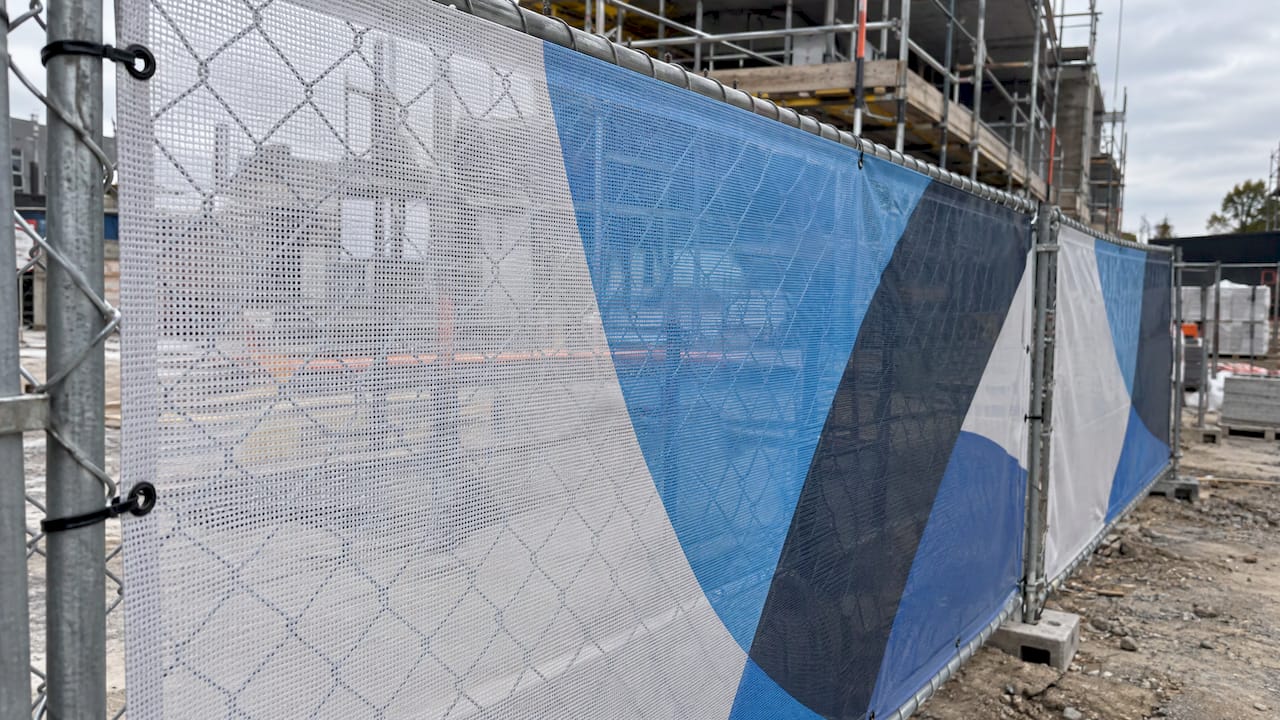
Banners are the fastest way to announce something. They are printed to any size, hung on a fence or building, and replaced when the promotion ends. Mesh banners let wind pass through, which helps on fences and scaffolding. Feather banners and retractable banners add portability for events and lobbies.
Exterior and storefront signs
These carry your name for years. The ISA lists wall or fascia signs, awnings, projecting signs, window signs, monument signs and pole signs among the main options. If you are deciding between them, our guide to which types of outdoor signs fit your business walks through the trade-offs, and our exterior signs page shows what we produce.
Interior and directional signs
Once a customer is inside, signs help them find the counter, the restroom or the next department. Reception signs, wall graphics and directional door signs keep that experience clear and on brand. See our interior signs range for office, lobby and retail options.
Vehicle graphics
A work van or company car is a moving billboard. Options run from magnets that come off for personal use, to lettering, to full wraps. Our vehicle lettering and car magnets and vehicle wraps and vinyl printing pages cover the choices.
Real estate and property signs
Listing signs, open-house A-frames and site signs do double duty: they advertise the property and the agent or manager. If this is your field, read how to design property signage and our real estate sign compliance guide, because local rules on where listing signs can stand differ by city and by homeowners association.
Design rules that make a sign get read
People read advertising signs in seconds, often while moving. Design for that.
Keep the message short
The Oregon Department of Transportation’s billboard design guidance says an effective out-of-home ad normally has three elements: an image or graphic, a copy line and the business name. It also notes that viewers may have about 7 seconds or less. If your draft needs more than that, move the detail to your website or a QR code and keep the sign for the hook.
Size letters for the distance
The ISA’s design and placement guidance recommends at least 1 inch of letter height for every 25 feet of viewing distance. Its example: a sign read from 410 feet at 30 mph needs letters about 16.4 inches tall. Ornate lettering needs to be larger still, and the ISA does not recommend it for functional signs.
A quick way to apply this:
- Measure or estimate where people will first see the sign, in feet.
- Divide by 25 to get the minimum letter height in inches.
- Round up, and go larger for decorative fonts or fast traffic.
A banner on a fence read from 100 feet away needs letters of at least 4 inches. A wall sign read from 250 feet needs at least 10 inches.
Use contrast and familiar forms
The Sign Research Foundation’s summary of sign design research reports that familiar logos, words and fonts are processed faster, and that contrast between copy and background affects readability. It also reports that a letter stroke of about one-fifth of the letter height supports prime readability. In practice: dark on light or light on dark, a clean typeface, and your logo used consistently so people recognize it at a glance.
Our signage design tips go deeper on color, layout and logo use.
Choosing materials for indoor and outdoor use
The sign’s substrate decides how long it lasts. Vanderbilt University Printing Services publishes a clear guide to sign materials that says to weigh display location, required lifespan, handling and installation, finish, budget and reuse. Its summary of common options:
| Material | Use |
|---|---|
| Foam core | Economical, indoor only |
| Acrylic | Indoor signs |
| PVC | Indoors, and outdoors short term |
| Corrugated plastic | Weather-resistant, short-term outdoor |
| Aluminum composite material (ACM) | Rigid and dimensionally stable, long-term indoor or outdoor |
For vinyl banners, window graphics and wraps, the same logic applies: tell your sign maker where the piece will hang, how long it needs to last and how it will be installed. We help clients choose the materials that fit each of those conditions, and we produce for both indoor and outdoor use.
Where to place advertising signs
A well-designed sign in the wrong spot fails. The Sign Research Foundation’s research on sign placement says placement depends primarily on the distance between sign and viewer, and that signs should sit within the driver’s sight cone and high enough to clear parked cars and other obstructions. At 55 mph a viewer travels 80 feet per second, so drivers need enough distance to read, process and react safely.
Orientation matters too. A United States Sign Council Foundation visibility study found perpendicular signs more detectable and legible than parallel ones in its tested locations. In one location, 30% of perpendicular signs were missed versus 60% of parallel signs. In a strip-development test, nearly no perpendicular signs were missed versus 30% of parallel signs, even though the parallel signs were two to three times larger.
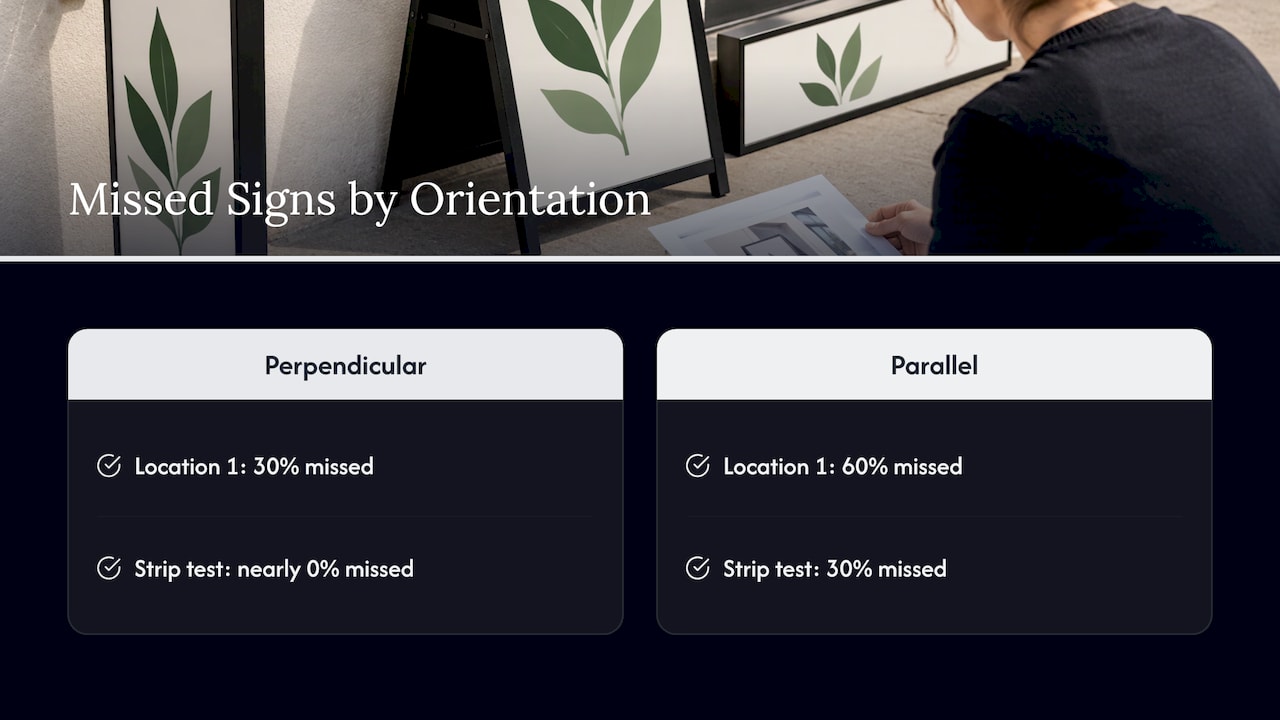
So for a storefront on a busy road, a projecting or blade-style sign can outperform a larger flat sign on the wall. For retail interiors, our retail sign placement guide and tips for effective sign placement show where to put messages along the customer’s path.
A sign brings people to your door, but many of them check you online first. Pairing signage with local search optimization keeps your name, address and listing consistent with what the sign promises.
Permits and local rules
In the US, sign rules are set mostly by cities and counties, so the answer to “do I need a permit?” is usually yes for permanent exterior signs. Examples from published city pages show how much it varies:
- Mountain View, California: a combined Planning and Building permit is required, and new sign fees run $1,000 to $1,350. Illuminated signs also need an electrical permit, and the city prohibits animated or flashing signs, off-site signs and temporary A-frame signs.
- Liberty Hill, Texas: new sign permits cost $2.00 per square foot, capped at $100, and temporary sign permits are $50 for 30 days or less. Billboards and off-site advertising are not allowed, and wall signs are limited to 30 square feet or 10% of the wall area, whichever is smaller.
- Fort Worth, Texas: detached signs need a site plan showing dimensions to property lines, engineering applies if any part is above 25 feet, and location and electrical inspections are required.
Fees come from pages published in 2024 and cities revise them, so check your own city’s current schedule. Before you order, ask your planning or building department these questions:
- Is a permit required for this sign type and size?
- Are there limits on area, height, lighting or placement?
- Are temporary banners and A-frames treated differently from permanent signs?
- Does my landlord or association need to approve it?
We offer compliance consulting as part of our process, so the sign you approve is designed with your site’s constraints in mind. If you are placing listing signs, start with our real estate sign compliance guide.
How to choose the right sign for your goal
Work backward from what you want a viewer to do.
Announce something for a few weeks. Choose a vinyl or mesh banner. It is quick to produce, large, and easy to swap.
Pull in foot traffic daily. An A-frame at the entrance with one offer and a clear arrow does this well, where the city allows it.
Build a lasting brand at your location. Choose exterior signs in durable material, sized for the distance from the road.
Reach people across town. Use vehicle lettering, magnets or a wrap. The ISA’s mobile advertising recall figures above make this one of the more efficient ways to repeat your name.
Guide visitors inside. Add directional and interior signs so the building explains itself.
Market a property. Combine yard or site signs with banners and a flyer or brochure. Our custom printing page covers business cards and brochures that match your signs.
Budget deserves a straight answer. The ISA gives a wide range, from a few hundred dollars to well into the thousands, and the spread comes from size, material, lighting and installation. The most reliable way to learn the cost of your project is a quote built on your dimensions and site. Our page on what to expect from a custom sign quote explains the information that helps.
Our perspective
Most signs we see underperform for the same three reasons: too many words, letters too small for the distance, and a location chosen after the sign was designed instead of before.
We start every project with the place. Where will people stand or drive when they first see it? How long do they have? What does the building, the road or the vehicle allow? Only then do we choose the size, the material and the message. A banner on a fence and a monument sign at a driveway are different jobs, even when the logo is the same.
We also think a sign should be treated as part of a set. The storefront sign, the window graphics, the van, the interior directions and the business cards should look like they came from one company. That consistency is what makes a brand recognizable, and it is why we handle design, fabrication, installation guidance and compliance together instead of leaving you to coordinate them.
If you tell us what you want people to do after they see your sign, we can work backward from there.
Yossi
Get your advertising signs made
We design and produce banners, storefront and exterior signs, interior and directional signs, vehicle graphics, window wraps, decals and printed pieces for businesses, real estate agents, property managers and event organizers. Sizes, materials and designs are fully customizable, and we give installation guidance and help with compliance questions along the way.
Tell us what you need and where it will go, and we will come back with options. Request a free quote on our custom signs page, or start from the Custom Signs Today home page.
FAQ
What are the most effective advertising signs for a small business?
There is no single best type, but the most common starting points are a durable exterior sign, a banner for promotions and vehicle graphics if you drive to jobs. Choose by where your customers pass and how long they can see the sign. A short message in large, high-contrast lettering outperforms a detailed one in nearly every case.
How big should the letters on my sign be?
The International Sign Association recommends at least 1 inch of letter height for every 25 feet of viewing distance. A sign read from 200 feet should therefore have letters of at least 8 inches. Use larger letters for decorative fonts or when viewers are moving quickly.
Do I need a permit for an advertising sign?
Permanent exterior signs usually need one, and many cities regulate temporary banners and A-frames as well. Rules and fees are set locally, so contact your city’s planning or building department before ordering. Illuminated signs often add an electrical permit.
Which materials are best for outdoor signs?
For short-term outdoor use, corrugated plastic is weather-resistant, and PVC works indoors and outdoors short term. For long-term installations, aluminum composite material is rigid and dimensionally stable, according to Vanderbilt University Printing Services. Foam core is for indoor use only.
Are vehicle wraps worth it as advertising?
The International Sign Association cites a study in which 94% of drivers recalled seeing mobile advertising and 80% could remember the specific company. That makes wraps, lettering and magnets a strong way to keep your name in front of local customers while you work.
Sources
- Identification of Sign Types, International Sign Association
- Design & Placement of Signs, International Sign Association
- Billboard Design Tips, Oregon Department of Transportation
- Arts & Science of Sign Design, Executive Summary, Sign Research Foundation
- Arts & Science of Sign Design, Sign Research Foundation
- Real World Sign Visibility, United States Sign Council Foundation
- Choosing the Right Sign Material, Vanderbilt University Printing Services
- Signs, City of Mountain View, CA
- Signs Guidelines, City of Liberty Hill, TX
- Sign Permits, City of Fort Worth, TX