
TL;DR:
- Class K signage is essential for clearly identifying extinguishers used for cooking oil fires in kitchens.
- Proper placement, durable materials, and regular inspections ensure signage compliance and staff awareness.
- Effective signage improves emergency response speed and reduces compliance violations in commercial kitchen environments.
Most facility managers assume that a generic red fire extinguisher sign covers every situation. It does not. Commercial kitchens operate under a completely different fire risk profile, and the signage requirements reflect that. Grease fires from cooking oils and fats behave nothing like ordinary combustibles. They reignite faster, burn hotter, and respond badly to the wrong suppression agent. Posting the wrong sign, or placing the right one incorrectly, puts your staff at risk and exposes your business to serious code violations. This guide walks you through exactly what Class K fire extinguisher signage requires, where the regulations come from, and how to stay fully compliant.
Table of Contents
- What is Class K fire extinguisher signage?
- Legal requirements and compliance for Class K signage
- Correct placement and visibility tips
- Best practices for sign selection and maintenance
- What most compliance checklists miss about Class K signage
- Get custom Class K signage for full compliance
- Frequently asked questions
Key Takeaways
| Point | Details |
|---|---|
| Class K signage is specialized | It is required for kitchens where cooking oils and fats could cause unique fire risks. |
| Compliance is legally mandated | Both OSHA and NFPA specify exact placement and durability requirements for extinguisher signage. |
| Visibility prevents violations | Signs must be installed and maintained to remain unobstructed and clear at all times. |
| Proactive maintenance matters | Regular checks and quality materials keep signage compliant and staff safe. |
What is Class K fire extinguisher signage?
Class K fire extinguisher signage is a specific category of safety signage used to identify extinguishers designed for commercial cooking environments. These signs are not interchangeable with Class A, B, C, or D signs. Each classification targets a different type of fire, and using the wrong label in an inspection can result in a failed compliance check even if the extinguisher itself is correct.
Fire extinguisher classes break down like this:
- Class A: Ordinary combustibles like wood, paper, and cloth
- Class B: Flammable liquids such as gasoline and solvents
- Class C: Electrical equipment fires
- Class D: Combustible metals used in industrial settings
- Class K: Cooking oils, fats, and greases in commercial kitchens
Class K extinguishers are specifically designed for fires involving oils and fats in commercial kitchens. That distinction matters because the chemical makeup of a grease fire requires a wet chemical agent, not dry powder or CO2. The sign must communicate this clearly to any staff member who might need to act fast under pressure.
Visually, Class K signs typically feature a black background with a white letter K inside a geometric shape. This color coding follows NFPA standards for fire safety signage and is designed to stand out in the chaotic, steam-filled environment of a working kitchen. The contrast matters. A sign that blends into a stainless steel wall or gets obscured by condensation is functionally useless.
For facility managers who want a broader foundation, understanding safety signs across all categories helps build a consistent compliance program. If your facility also serves customers or has public-facing areas, ADA-compliant signage requirements may apply alongside fire safety codes.
Key point: Class K signage is not just a label. It is a communication tool that tells trained staff exactly which agent to use, and where to find it, when seconds count.
| Fire class | Hazard type | Extinguishing agent |
|---|---|---|
| A | Wood, paper, cloth | Water, dry chemical |
| B | Flammable liquids | CO2, dry chemical |
| C | Electrical fires | CO2, dry chemical |
| D | Combustible metals | Dry powder |
| K | Cooking oils and fats | Wet chemical |
Legal requirements and compliance for Class K signage
Regulations for Class K signage come from two primary sources: OSHA and NFPA. Understanding both is essential because they work together rather than independently.
NFPA 10 outlines detailed requirements for portable fire extinguisher placement and signage. It specifies that extinguishers must be identified by approved signs when the unit is not immediately visible from normal approach angles. This is the standard most fire marshals and inspectors reference during commercial kitchen audits.
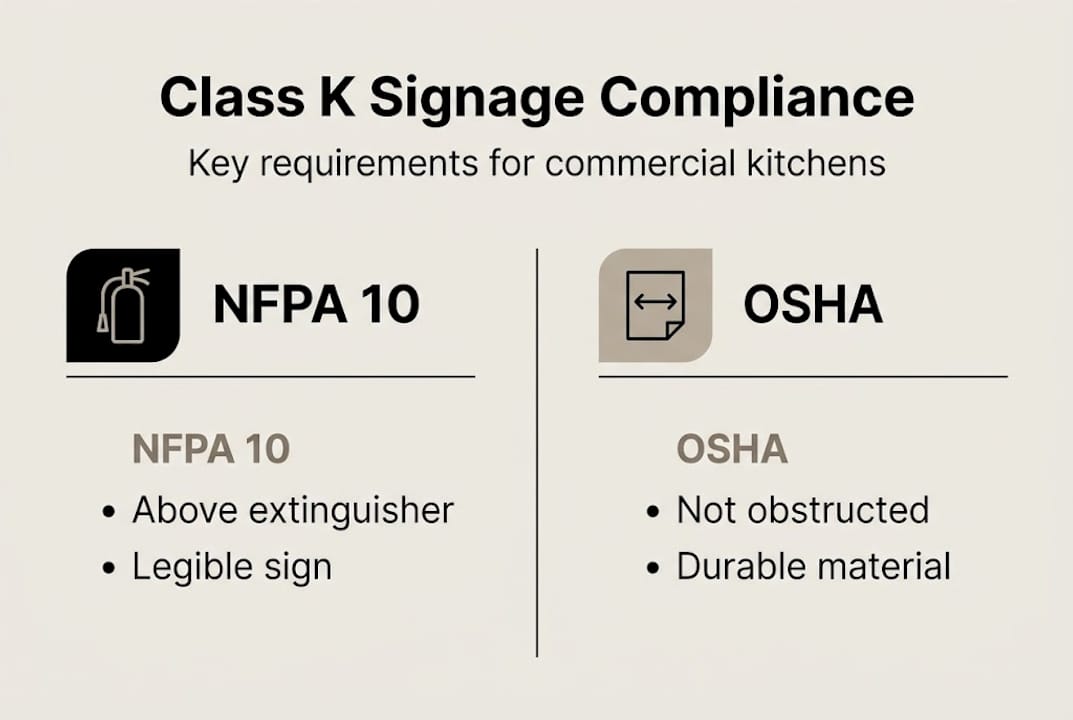
OSHA’s framework reinforces these requirements at the federal level. An OSHA interpretation from 2012 clarified that employers are responsible for ensuring extinguishers are both accessible and clearly marked. That responsibility extends directly to the signage.
State and local codes often layer additional requirements on top of federal standards. Some jurisdictions require bilingual signage. Others mandate minimum sign dimensions or specific mounting hardware. Always verify with your local fire marshal before finalizing your signage plan.
Here is what inspectors typically check during a Class K signage review:
- Sign is present and identifies the correct extinguisher class
- Sign is mounted above the extinguisher at the required height
- Sign is undamaged, legible, and free from fading
- Sign is not obstructed by shelving, equipment, or stored goods
- Sign material is appropriate for the kitchen environment
For a deeper look at what qualifies as a mandatory sign requirement under safety codes, reviewing the full scope of required signage categories helps you avoid gaps. Proper sign installation guidance also applies indoors, especially in high-traffic commercial kitchens.
Statistic: Facilities that fail fire extinguisher inspections due to signage issues face fines that can range from hundreds to thousands of dollars per violation, depending on the state.
Pro Tip: Do not wait for an annual inspection to check your signage. Build a monthly visual walk-through into your kitchen manager’s routine. Catching a faded or obstructed sign early costs nothing. Failing an inspection costs significantly more.
| Requirement | NFPA 10 | OSHA standard |
|---|---|---|
| Sign above extinguisher | Yes | Yes |
| Legible and undamaged | Yes | Yes |
| Class identification | Yes | Yes |
| Local code compliance | Varies | Varies |
Correct placement and visibility tips
Knowing the rules is one thing. Applying them in a real commercial kitchen is another. Kitchens are crowded, loud, and constantly changing. Equipment gets moved. Storage shifts. Grease builds up on walls. All of these factors affect whether your Class K sign remains visible and compliant.
The International Fire Code states that signs must be clearly visible, unobstructed, and placed above the actual extinguisher. That means directly above, not beside or nearby. The standard mounting height is typically between five and six feet from the floor to the bottom of the sign, though your local code may specify exact measurements.
Here are the most common placement mistakes facility managers make:
- Mounting the sign on a door that swings open and blocks the view
- Placing the extinguisher near a shelving unit that grows over time
- Installing the sign at eye level instead of above the unit
- Using a sign that is too small to read from ten feet away
- Failing to account for steam and condensation reducing visibility
Lighting is a factor that most checklists ignore. A sign in a poorly lit corner of a prep kitchen is technically present but practically invisible during an emergency. Consider adding a small directional light above the sign or choosing a photoluminescent material that glows when the power goes out. Kitchen fire risks often escalate precisely when visibility is worst, such as during a power failure caused by the fire itself.
Material choice also affects long-term visibility. Laminated paper signs peel and yellow in humid environments. Rigid aluminum or acrylic signs hold up far better in commercial kitchens. For more on how signage installation best practices affect long-term performance, the mounting method matters as much as the material.
Remember: A sign that cannot be read in three seconds under stress has failed its purpose, regardless of whether it technically meets code.
Pro Tip: Walk your kitchen during a busy dinner service and look for your Class K sign from every angle staff might approach. If you cannot spot it immediately from the grill station, the prep area, and the dishwashing zone, reposition it. Signage and safety impact studies consistently show that visibility from multiple approach angles is the single biggest factor in emergency response speed.
Best practices for sign selection and maintenance
Choosing the right sign upfront saves you time, money, and compliance headaches down the road. Not all Class K signs are created equal, and the environment of a commercial kitchen is genuinely harsh on materials.
Here is a step-by-step approach to selecting and maintaining your signage:
- Choose the right material. Aluminum and rigid PVC are the top choices for high-humidity, high-heat environments. Avoid paper-based or thin vinyl signs in kitchen settings.
- Verify the dimensions. Confirm that your sign meets the minimum size requirements specified by your local fire code before ordering.
- Check the mounting method. Use corrosion-resistant hardware. Standard screws rust quickly near commercial cooking equipment.
- Schedule monthly inspections. Add sign checks to your existing monthly fire extinguisher inspection routine.
- Replace proactively. Do not wait until a sign is unreadable. Replace it at the first sign of fading, peeling, or physical damage.
Damaged or faded signage is considered non-compliant by inspectors, even if the extinguisher itself is in perfect condition. The sign and the unit are evaluated together.
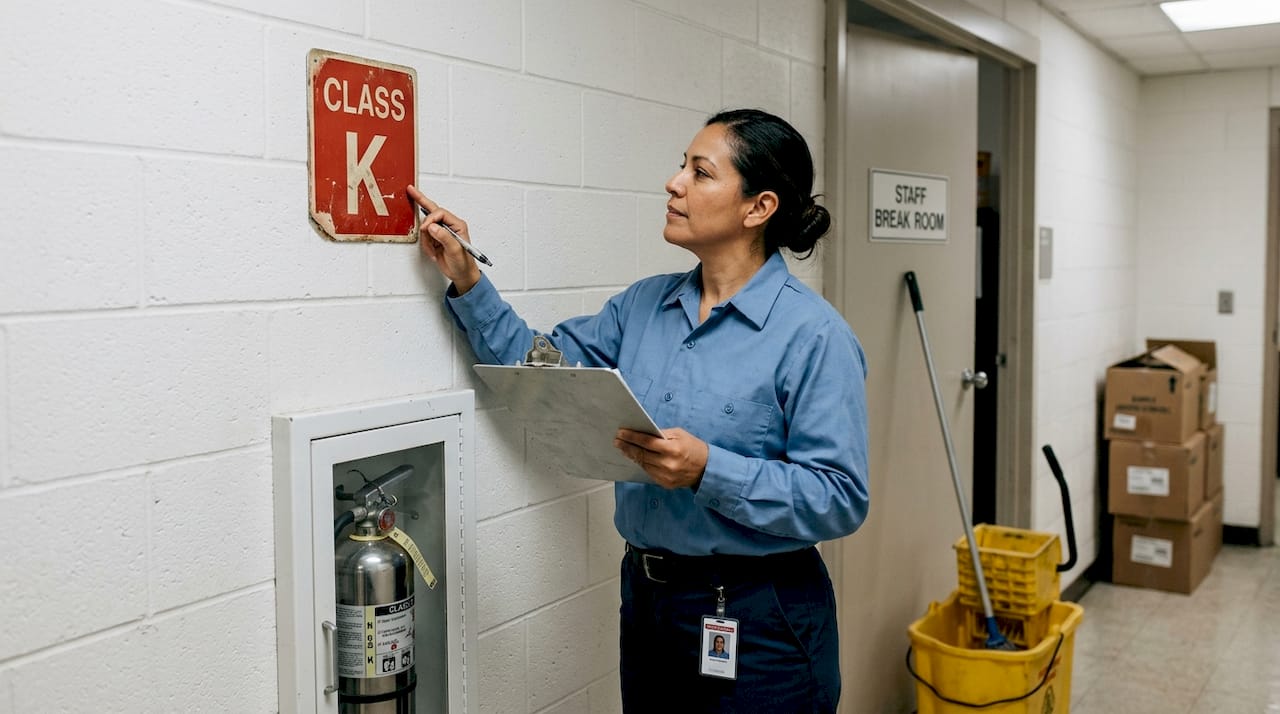
Custom signage has a real advantage over stock options in commercial settings. A custom sign can be sized to fit your exact wall space, printed with your facility’s floor plan reference, and produced in materials rated for your specific environment. Stock signs are cheaper upfront but often require more frequent replacement. For facilities with unique layouts, improving sign visibility through custom sizing and placement is worth the investment.
Pro Tip: Photograph your signage during each monthly inspection and keep a dated log. This creates a paper trail that demonstrates good-faith compliance efforts, which matters significantly if a violation is ever disputed.
| Sign material | Best environment | Lifespan estimate |
|---|---|---|
| Aluminum | High heat and humidity | 5 to 10 years |
| Rigid PVC | Moderate humidity | 3 to 7 years |
| Acrylic | Low humidity, indoor | 3 to 5 years |
| Laminated paper | Dry, low-traffic areas | Under 1 year |
What most compliance checklists miss about Class K signage
Compliance checklists are useful tools, but they measure presence, not effectiveness. A sign can be present, mounted at the correct height, and made from the right material and still fail in a real emergency because nobody on staff knows what it means.
We have seen this pattern repeatedly. Facilities pass inspections and then watch staff freeze during a grease fire because they could not connect the sign to the action required. The sign pointed to the extinguisher. The extinguisher was there. But the mental link between the black K symbol and the correct response had never been reinforced through training.
Visual consistency across your facility also matters more than most managers realize. When every safety sign follows the same design language, staff develop faster recognition. Mixing sign styles, sizes, and colors creates cognitive friction at exactly the wrong moment. Creative signage solutions that balance compliance with visual clarity are not just aesthetic choices. They are safety decisions.
The most effective compliance programs treat signage as one layer of a broader communication system, not a standalone checkbox.
Get custom Class K signage for full compliance
Getting your Class K signage right does not have to be complicated. The key is working with a provider who understands both the regulatory requirements and the physical demands of commercial kitchen environments.

At Custom Signs Today, we produce durable, code-ready Class K fire extinguisher signs built for real kitchen conditions. Whether you need a single replacement sign or a full facility kit, we offer custom face change signs and a wide range of site signage options that meet NFPA and OSHA specifications. Fast turnaround, custom sizing, and materials rated for high-humidity environments mean you get compliant signage without the guesswork. Ready to get started? Request a sign quote today and let us help you close every compliance gap.
Frequently asked questions
What makes Class K fire extinguisher signage different from other types?
Class K signage is specifically designed for fires caused by cooking oils and fats, making it essential for commercial kitchens where standard extinguisher classes would be ineffective and dangerous.
Where should Class K fire extinguisher signs be placed?
They must be mounted directly above the Class K extinguisher and remain visible and unobstructed from every approach angle in the kitchen.
How often should Class K fire extinguisher signage be inspected?
Signage should be checked monthly alongside the extinguisher itself, since damaged or faded signs violate inspection standards even when the unit is fully functional.
What materials should be used for Class K extinguisher signs?
Aluminum or rigid PVC are the best choices for commercial kitchens because material choice affects compliance in high-heat, high-humidity environments where softer materials degrade quickly.