TL;DR:
- Custom sign fabrication involves designing, engineering, and installing signs tailored to specific requirements, ensuring durability and compliance. It distinguishes itself from pre-made options through engineering, material choice, and adherence to local codes, providing long-term brand impact. Selecting appropriate methods, materials, and partnering with experienced providers are key to creating effective, lasting signage for any environment.
Custom sign fabrication is one of the most misunderstood investments a business owner or event organizer can make. Most people assume “custom” just means slapping your logo onto a standard template and calling it done. The reality is far more involved, and far more powerful. True custom fabrication blends design, engineering, compliance, and material science into a single deliverable that works as hard as your team does. This guide walks you through every critical layer, so you can make smarter decisions and stop leaving brand impact on the table.
Table of Contents
- What is custom sign fabrication?
- Key methods: From CNC to new technologies
- Materials and durability: Choosing the right sign for your needs
- Design pitfalls and compliance: What to watch out for
- Our perspective: Why “custom” is more than a buzzword
- Elevate your brand with expert custom signage
- Frequently asked questions
Key Takeaways
| Point | Details |
|---|---|
| True customization matters | Custom sign fabrication means tailored design, engineering, and compliance far beyond generic templates. |
| Method selection is critical | CNC and laser cutting offer proven durability, while 3D printing has limitations for outdoor signage. |
| Materials impact performance | Choosing the right material can determine your sign’s lifespan, especially in harsh outdoor settings. |
| Avoid common mistakes | Proper specs, code checks, and experienced partners help prevent costly rework and compliance failures. |
| Expert help elevates results | Working with true signage experts ensures your investment drives visibility and builds your brand. |
What is custom sign fabrication?
Custom sign fabrication is the process of designing, engineering, producing, and installing a sign that is built entirely to your specific requirements. It is not ordering a pre-sized banner online and uploading a logo. The process starts with a consultation to understand your location, audience, and goals. From there, a design phase translates your brand identity into visual specs. Then comes engineering review, where load calculations, mounting requirements, and local building codes are evaluated. Only after all that does actual production begin.
A typical workflow looks like this:
- Consultation: Understand the environment, visibility range, and branding requirements
- Design: Create layouts using your brand assets, optimizing for readability and impact
- Compliance check: Verify local codes, permits, and engineering requirements
- Material selection: Choose substrates, illumination, and finishes based on conditions
- Production: Fabricate using CNC, laser, or other methods
- Installation: Mount securely with weatherproofing and structural considerations
What separates custom-fabricated signs from off-the-shelf options is accountability at every step. A pre-made sign is a commodity. A fabricated sign is an engineered product designed for your specific context. According to the expert sign design process, custom fabrication includes design, engineering, and code compliance for multi-location branding, which means it scales with your business without sacrificing consistency.
“A sign that complies with engineering codes and suits your environment is not just a display tool, it’s a long-term investment in brand credibility.”
Full-service providers handle the parts most business owners don’t even know exist, like wind load calculations, electrical permitting for illuminated signs, and ADA compliance for directional signage. If you’re managing multiple locations or hosting large-scale events, those details aren’t optional. They’re the difference between a sign that works and one that creates liability.
Pro Tip: Ask your sign provider whether they handle permits and engineering review in-house. If they outsource it, factor in extra lead time and potential coordination gaps.
Key methods: From CNC to new technologies
With the process outlined, it’s important to understand the “how.” Different fabrication techniques produce very different results, and choosing the wrong method for your environment or budget can mean costly do-overs.
CNC cutting (Computer Numerical Control) is the workhorse of the signage industry. A CNC router carves shapes from materials like aluminum, acrylic, HDU foam, and wood with extreme precision. It’s fast, repeatable, and cost-effective for high-volume work. Most exterior business signs you’ve seen on retail storefronts are CNC-fabricated.
Laser cutting takes precision even further. It’s ideal for fine detail work, thinner materials, and projects where clean edges are non-negotiable. Acrylic letters, branded displays, and interior wayfinding signs are perfect candidates. The cut quality is nearly flawless, which matters when a sign is viewed at close range.
Traditional hand fabrication still has its place. Metal bending, welding, and hand-painting produce results that can’t be replicated by machines, especially for custom architectural or artistic signage. These are slower and more expensive, but for flagship locations or premium branding, the craftsmanship shows.
3D printing is generating a lot of excitement, and it does have genuine applications in signage, particularly for prototyping and short-run channel letters. However, as emerging 3D printing methods show, traditional methods like CNC and laser are still preferred over 3D printing for outdoor durability. UV exposure, temperature swings, and moisture can degrade printed polymers faster than machined aluminum or acrylic. Use 3D printing for indoor displays, trade show props, or prototyping. Avoid it for exterior signage that needs to last years.
Here’s a quick comparison of the four major fabrication methods:
| Method | Best for | Durability | Cost | Speed |
|---|---|---|---|---|
| CNC cutting | Exterior signs, large format | Very high | Moderate | Fast |
| Laser cutting | Fine detail, interior signs | High | Moderate to high | Fast |
| Hand fabrication | Architectural, artistic, premium | Very high | High | Slow |
| 3D printing | Prototypes, indoor displays | Moderate | Low to moderate | Very fast |
One area where many businesses underestimate the decision is illumination. LED illuminated signs are brighter, more energy-efficient, and longer-lasting than older neon options, but neon still has a warmth and aesthetic that LED can’t fully replicate. If you’re running a venue, boutique hotel, or upscale event space, neon might be the brand-correct choice even if it costs more to maintain.
For businesses focused on outdoor visibility and exterior signage basics, CNC and laser remain the gold standard because they produce signs that hold up under real-world conditions.
Pro Tip: If you’re prototyping a new sign concept before committing to full production, a 3D printed mockup is a smart low-cost step. Just don’t confuse the prototype with the final product.
Materials and durability: Choosing the right sign for your needs
Knowing the method is just half the story. The right material can make or break your sign’s performance, and this is where many buyers make expensive assumptions.
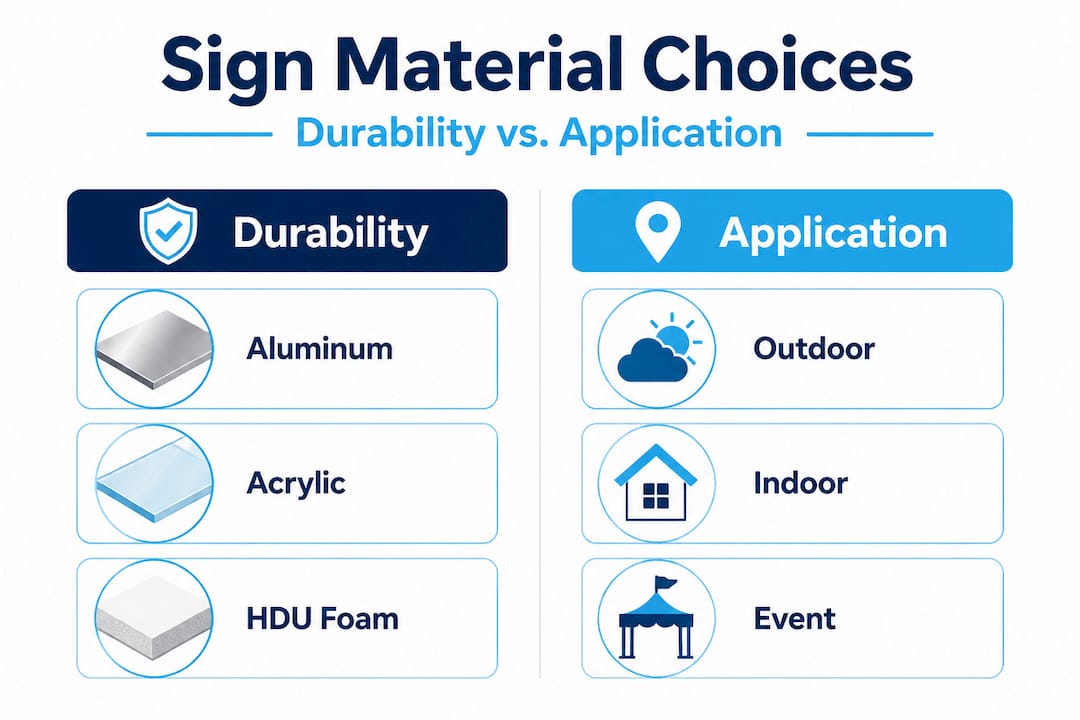
Aluminum is the most common material for exterior signs. It resists rust, handles temperature extremes well, and accepts most surface finishes. Painted aluminum signs can last 10 or more years outdoors with minimal maintenance. It’s the default choice for most business signage for good reason.
Acrylic is a go-to for illuminated channel letters and interior signs. It transmits light beautifully and comes in a huge range of colors. The tradeoff is that it can crack in very cold climates if not properly supported, and it scratches more easily than metal.
Vinyl is the most versatile and affordable material in the signage world. Banners, vehicle wraps, window graphics, and temporary event signage all rely on vinyl. High-grade cast vinyl can last 7 or more years outdoors. Budget calendared vinyl is better for short-term use under two years.
Mesh is specifically designed for large format banners in outdoor or windy environments. It has a perforated structure that lets air pass through, dramatically reducing wind load. As noted in the custom signage design guide, mesh and wind-resistant materials are crucial for event signage exposed to the elements.
HDU foam (High Density Urethane) is a popular choice for dimensional letters and carved signs. It’s lightweight, easy to paint, and looks premium when finished well. It’s not ideal for signs that will take physical impact.
Here’s a material reference table to guide your decision:
| Material | Durability | Cost | Best application |
|---|---|---|---|
| Aluminum | 10+ years | Moderate | Exterior business signs |
| Acrylic | 5-8 years | Moderate | Illuminated letters, interior |
| Cast vinyl | 5-7 years | Low to moderate | Vehicle wraps, outdoor graphics |
| Mesh banner | 3-5 years | Low | Outdoor events, fencing |
| HDU foam | 5-10 years | Moderate | Dimensional letters, décor |
| Corrugated plastic | 1-3 years | Very low | Temporary event signs |
For outdoor event signage specifically, the material decisions become critical fast. A vinyl banner without reinforced grommets can tear away in the first serious gust. A mesh banner under the same conditions might barely move. Learning how to weatherproof outdoor signs starts with choosing the right substrate before you ever think about graphics.
Lawn signs and ground-mounted event directionals have their own material logic, and it’s worth reviewing what lawn sign materials are best suited for short-term outdoor use before placing your order.
Pro Tip: For events lasting more than a weekend, invest in reinforced grommets and heavy-duty mesh rather than standard vinyl banners. The cost difference is minimal. The performance difference is significant.
Design pitfalls and compliance: What to watch out for
Once you’ve selected your method and material, staying on top of the details is critical. This is the stage where many sign projects quietly fail, not in production, but in the design and compliance steps that happen before a single piece of material is cut.
Common design mistakes that cause rework:
- Tight kerning: Letters placed too closely together become unreadable at a distance. Signage is not a brochure. Text needs room to breathe.
- Low contrast: A light gray font on a white background might look modern in a PDF. On a sign viewed from 30 feet in direct sunlight, it disappears.
- Missing bleed and spec lines: Submitting artwork without proper bleed zones leads to cropped edges or misaligned production files.
- Scaled-down thinking: Designs that look sharp on a monitor often fall apart when printed at 10 feet wide. Always review your design at final scale.
- Ignoring wind load specs: For large-format outdoor signs, wind resistance isn’t just a material issue. It’s a mounting and design issue too.
Per sign design red flags, design mistakes like tight kerning and missing specs are a leading cause of rework and project delays. The cost isn’t just the reprint. It’s the missed event deadline or the grand opening you can’t postpone.
Compliance is the other major risk area. Cities and counties regulate signage more than most business owners realize. Permit requirements, setback rules, maximum sign area relative to building facade, and illumination limits are all real constraints. For multi-location brands, the same sign design often needs to be re-engineered for each municipality because codes vary significantly.
“Compliance isn’t just a box to check. It’s what separates a sign that works for years from one that gets ordered down in weeks.”
Full-service fabrication providers take on this complexity for you. They know the local permit landscape, can stamp engineering drawings for structural review, and flag issues before they become violations. That’s an enormous value, especially for franchises, national retail chains, or event organizers managing signage across multiple venues.
Pro Tip: Before finalizing any exterior sign design, call your city’s planning or permitting office and ask specifically about sign permits for your address. A five-minute call can save weeks of rework.
Our perspective: Why “custom” is more than a buzzword
Beyond processes and pitfalls, there’s a truth our team has learned from years of real-world projects: most businesses that think they’re getting custom signage are actually getting customized templates. There’s a meaningful difference.
A customized template is when a provider takes a standard layout, drops in your logo and colors, and hands it back to you. It looks personalized. It may even look good. But it hasn’t been engineered for your environment, it hasn’t been checked against your local codes, and it hasn’t been designed with your specific viewer distance and lighting conditions in mind.
Real custom fabrication treats your sign as a functional object, not just a visual one. That distinction pays off in ways that are hard to quantify upfront but very visible over time. A well-fabricated sign maintains color fidelity for years. It doesn’t warp, fade, or rattle in the wind. It stays level and secure regardless of what weather throws at it. And when your brand evolves, it can often be refaced or updated rather than replaced entirely.
For event organizers especially, there’s a false economy in choosing the cheapest signage vendor available. A sign that tears at your outdoor festival, or that gets flagged by venue management for non-compliance, doesn’t just cost money to replace. It costs you credibility with attendees and sponsors. The ROI of getting it right the first time is significant.
Our honest recommendation: partner with providers who ask hard questions about your environment before they start designing. Questions like: What direction does the sign face? What’s the wind exposure? Is there a local permitting requirement? Is this sign going to be reused? That’s how you know you’re working with fabricators, not just printers. Understanding why durability is essential is the first step in making signage decisions that hold up long after the event or grand opening is over.
Elevate your brand with expert custom signage
If this guide has made one thing clear, it’s that a great sign starts long before the material is cut. It starts with the right questions, the right process, and a partner who understands both the craft and the compliance side of fabrication.
At Custom Signs Today, we work with business owners and event organizers who want signage that actually performs, not just looks good in a proof. From custom sign services tailored to your brand environment to specialized solutions like face change signs for businesses that evolve, we handle every step in-house. Planning an upcoming event? Our outdoor event sign guide will help you plan smarter. Reach out for a free quote and let’s build something worth looking at.
Frequently asked questions
How long does custom sign fabrication take from start to finish?
Most custom sign projects take 2 to 4 weeks from design approval, depending on complexity, material selection, and whether compliance reviews or permits are required.
What’s the difference between a custom fabricated sign and a pre-made sign?
Custom fabricated signs are built-to-spec for your brand, environment, and legal requirements, while pre-made signs are generic products that offer no engineering or compliance considerations.
What fabrication method is best for outdoor business signs?
CNC and laser-cut signs are preferred for outdoor use because of their superior durability and clean finish. As noted in the 3D printing sign research, traditional methods outperform 3D printing for outdoor longevity.
How do I avoid common design mistakes in custom signage?
Work with a provider who reviews spacing, specs, and compliance at every stage, and always proof at actual output scale before approving production. Design errors like tight kerning remain among the top causes of costly reprints.
Does my event sign need wind-resistant materials?
Yes. For any outdoor event, wind-resistant materials like mesh are essential to prevent banner damage and maintain readability throughout the event.