
{
“@type”: “Article”,
“image”: {
“url”: “https://csuxjmfbwmkxiegfpljm.supabase.co/storage/v1/object/public/blog-images/organization-6408/1775781388632_Manager-updating-digital-display-office-agenda.jpeg”,
“@type”: “ImageObject”,
“caption”: “Manager updating digital display office agenda”
},
“author”: {
“url”: “https://customsignstoday.us”,
“name”: “Customsignstoday”,
“@type”: “Organization”
},
“@context”: “https://schema.org”,
“headline”: “Digital displays for business promotion: what works in 2026”,
“publisher”: {
“url”: “https://customsignstoday.us”,
“name”: “Customsignstoday”,
“@type”: “Organization”
},
“inLanguage”: “en-US”,
“articleBody”: “Learn what digital displays are, how they work, and how to use them to grow your business, real estate listings, or events with proven ROI strategies in 2026.”,
“description”: “Learn what digital displays are, how they work, and how to use them to grow your business, real estate listings, or events with proven ROI strategies in 2026.”,
“datePublished”: “2026-04-10T00:36:45.783Z”
}
TL;DR:
- Digital displays are affordable and flexible tools that can significantly increase foot traffic and sales.
- They allow instant content updates, remote management, and impactful motion or video visuals.
- Combine digital and traditional signage for an effective, strategic marketing approach.
Digital displays are no longer reserved for Times Square billboards or Fortune 500 lobbies. If you run a local shop, list properties, or organize events, these screens are now within reach and delivering real results. Many business owners assume the technology is too complex or too expensive to bother with. That assumption is costing them customers. This article breaks down exactly what digital displays are, how they work, and how you can use them to drive more attention, more foot traffic, and more sales, without needing a tech background or a massive budget.
Table of Contents
- What is a digital display?
- How do digital displays work?
- Digital displays vs. traditional signage: What’s the difference?
- Smart ways to use digital displays in your business or event
- Our perspective: Why most businesses underuse digital displays
- Get started with impactful custom digital signage
- Frequently asked questions
Key Takeaways
| Point | Details |
|---|---|
| Digital displays defined | Digital displays use electronic screens to present dynamic content or information for business and event visibility. |
| Superior flexibility | Easily update messaging or visuals in real time to match changing marketing or event needs. |
| Proven ROI | Businesses using digital displays see up to 52% ROI, especially in retail and events. |
| Creative applications | Event organizers and realtors can use digital displays for real-time promotions, directions, and branded engagement. |
| Maximize impact | Ongoing fresh content and smart strategies amplify return on your digital display investment. |
What is a digital display?
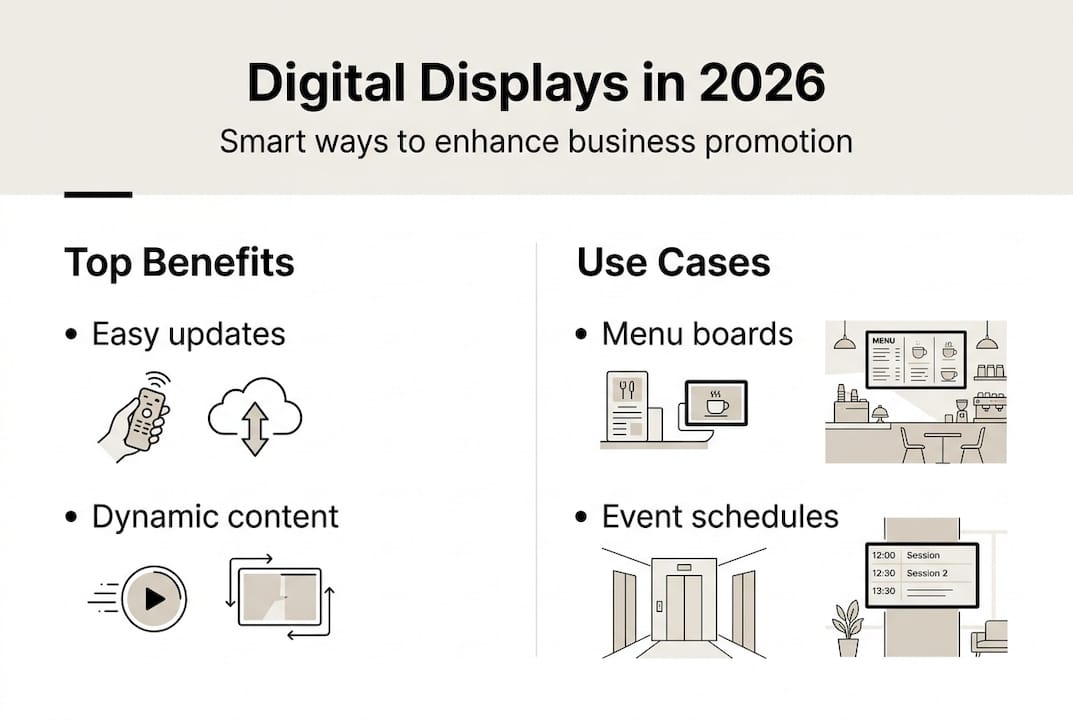
A digital display is an electronic screen that shows visual content, including images, videos, text, or live data. Think of it as a sign that never has to be reprinted. You update the content from a computer or phone, and the screen reflects the change almost instantly. That flexibility is what makes digital displays so powerful for modern businesses.
They come in many shapes and sizes. A small kiosk in a hotel lobby is a digital display. So is a massive LED billboard on a highway. In between, you have wall-mounted screens in retail stores, menu boards at restaurants, and touchscreens at trade show booths. The digital signage basics cover a wide range of formats, and the right choice depends on your setting and goals.
Here are the most common types of digital displays:
- LED displays: Bright, energy-efficient, and ideal for outdoor or high-ambient-light environments
- LCD screens: Cost-effective and sharp for indoor use, common in retail and offices
- Touchscreen kiosks: Interactive, great for wayfinding, ordering, or self-service scenarios
- Video walls: Multiple screens tiled together for dramatic visual impact in large spaces
- Digital posters: Slim, standalone units perfect for lobbies, waiting rooms, or storefronts
The sign display options available today span all these categories, making it easier than ever to find a format that fits your space and budget.
The market reflects this growing adoption. The digital signage market is valued at roughly $28 to $35 billion in 2025 and is projected to reach $45 to $64 billion by 2030 to 2036, growing at 7 to 10% annually. That kind of growth signals one thing clearly: businesses across every industry are investing in digital displays because they work.
Pro Tip: For indoor retail or office settings, LCD screens offer the best value. If your display will face direct sunlight or compete with bright ambient light, LED is worth the extra investment for visibility.
How do digital displays work?
At their core, digital displays work by connecting a screen to a content source, either a local media player or an internet-connected system. You create or upload your content, schedule when it plays, and the display does the rest. No printing, no installation crew, no waiting.
Here is a simple step-by-step view of how the process works:
- Create your content: Design images, videos, or slideshows using tools like Canva or Adobe Express
- Upload to a content management system (CMS): A CMS is the software that controls what plays on your screen and when
- Connect your display: The screen links to the CMS via Wi-Fi, a local network, or a USB media player
- Schedule your playlist: Set specific content to run at specific times, for example, a lunch special from 11 a.m. to 2 p.m.
- Monitor and update remotely: Change content from anywhere, in real-time or in advance, without touching the screen
This remote management capability is a game-changer for businesses with multiple locations or for event organizers managing several venues at once. You can push a last-minute schedule change to every screen in seconds.
The digital display trends in 2026 show a strong move toward AI-assisted content scheduling, where software automatically adjusts what displays based on time of day, weather, or audience demographics.
The impact on purchasing behavior is hard to ignore. According to industry research, retail digital signage drives an average 52% ROI, with 29% of purchases in retail being unplanned after customers see dynamic screen content. Quick-service restaurants see 48% ROI with 38% of orders influenced by digital menu boards. The overall average ROI across industries sits at 42% in 2026.
“Dynamic content on digital displays does not just inform, it influences. The right message at the right moment turns a browser into a buyer.”
Digital displays vs. traditional signage: What’s the difference?
Traditional signs are not going anywhere. Vinyl banners, printed posters, and painted boards still serve a purpose. But when you compare them side by side with digital displays, the differences in flexibility and long-term value become clear.

| Feature | Digital display | Traditional signage |
|---|---|---|
| Content updates | Instant, remote | Requires reprint or replacement |
| Upfront cost | Higher | Lower |
| Ongoing cost | Low (no reprinting) | Medium to high (reprinting) |
| Visual impact | High (motion, video) | Moderate (static) |
| Durability | Requires power source | No power needed |
| Best use case | High-traffic, changing info | Permanent or low-change info |
The innovations in signage materials are also improving traditional options, but digital still wins on adaptability. A restaurant that changes its specials daily would spend thousands reprinting boards every week. A digital menu board pays for itself in months.
That said, traditional signage has clear advantages in specific scenarios:
- Outdoor permanent signage: A building name or directional sign does not need to change
- Budget-limited launches: A vinyl banner for a grand opening costs a fraction of a screen
- No-power environments: Construction sites, outdoor markets, or rural locations where electricity is limited
- Brand consistency: Dimensional letters or monument signs carry a permanence that screens cannot replicate
The digital signage market growing at 7 to 10% annually does not mean traditional signs are obsolete. It means smart businesses are using both strategically. The best signage strategy blends digital flexibility with the durability and presence of physical signs.
Smart ways to use digital displays in your business or event
Knowing what digital displays are is one thing. Knowing how to use them effectively is where the real advantage comes from. Here are the most impactful applications for business owners, real estate agents, and event organizers.
For retail and restaurants:
Use digital menu boards and promotional screens to highlight daily specials, upsell items, and reduce perceived wait times. Studies show unplanned retail purchases increase by 29% when customers are exposed to dynamic digital content in-store.
For real estate agents:
Mount a digital display in your office window or open house entrance showing rotating property listings, virtual tours, and neighborhood stats. It creates a professional impression and keeps prospects engaged while they wait.
For event organizers:
Use screens for real-time agendas, sponsor recognition, wayfinding, and live social media feeds. Explore event signage strategies to see how dynamic displays outperform printed programs at live events.
| Industry | Use case | Avg. ROI (2026) |
|---|---|---|
| Retail | Promotional displays | 52% |
| Quick-service restaurants | Digital menu boards | 48% |
| Events | Agenda and sponsor screens | 35-40% |
| Real estate | Property listing displays | 30-38% |
Here are five practical steps to get started:
- Identify one high-traffic location in your business or event space
- Choose a screen type that fits the lighting and viewing distance
- Start with simple, rotating image content before adding video
- Use a free or low-cost CMS to schedule and update your playlist
- Review your indoor signage guide to understand placement and sizing best practices
Pro Tip: Refresh your digital display content at least once a week. Stale content trains your audience to ignore the screen. Rotating promotions, seasonal messages, and timely announcements keep eyes on the display.
Our perspective: Why most businesses underuse digital displays
Here is something we see constantly: a business invests in a quality digital display, sets it up with a nice slideshow, and then never touches it again. Six months later, it is still showing the same three images from the launch day. That is not a digital display strategy. That is an expensive static sign.
The businesses that see dramatic ROI from digital displays treat them like a social media channel. They test different messages, swap out content based on the season or time of day, and pay attention to what drives customer action. The screen is a living part of their marketing, not a one-time installation.
We have seen indoor sign ideas transform waiting areas and retail floors when the content stays fresh and relevant. The technology is not the hard part. The commitment to ongoing content is where most businesses fall short. If you are willing to update your display regularly, you will consistently outperform competitors who treat theirs as wallpaper.
Get started with impactful custom digital signage
If you are ready to put digital displays to work for your business or event, the right signage partner makes all the difference. At Custom Signs Today, we help business owners, real estate agents, and event organizers find the right display solutions for their specific goals and spaces.
Explore our full range of custom digital displays to find the right fit for your location. For businesses that need versatile, updateable options, our face change signs offer a smart bridge between traditional and digital formats. We also offer site signage solutions for outdoor and event environments. Request a free quote today and let us help you build a display strategy that actually delivers results.
Frequently asked questions
What types of content can I show on a digital display?
You can show images, videos, real-time data, event schedules, advertising messages, or interactive content. Most content management systems support common file formats like JPEG, MP4, and HTML.
Are digital displays expensive for small businesses?
Costs have dropped significantly, and the returns are strong. Businesses across industries report an average 42% ROI from digital signage in 2026, making even a modest screen investment worthwhile for most small operations.
Can digital displays be used outdoors?
Yes, weather-resistant LED and LCD models are built specifically for outdoor use, handling rain, temperature swings, and direct sunlight without losing image quality or functionality.
How quickly can I update the content on my digital display?
Most systems allow real-time remote updates from any device connected to the internet, so you can change a promotion, fix a typo, or add an event in under a minute.
What industries get the most ROI from digital displays?
Retail leads with a 52% average ROI in 2026, followed by quick-service restaurants at 48%. Event venues and real estate offices also report strong returns when content is kept current and targeted.