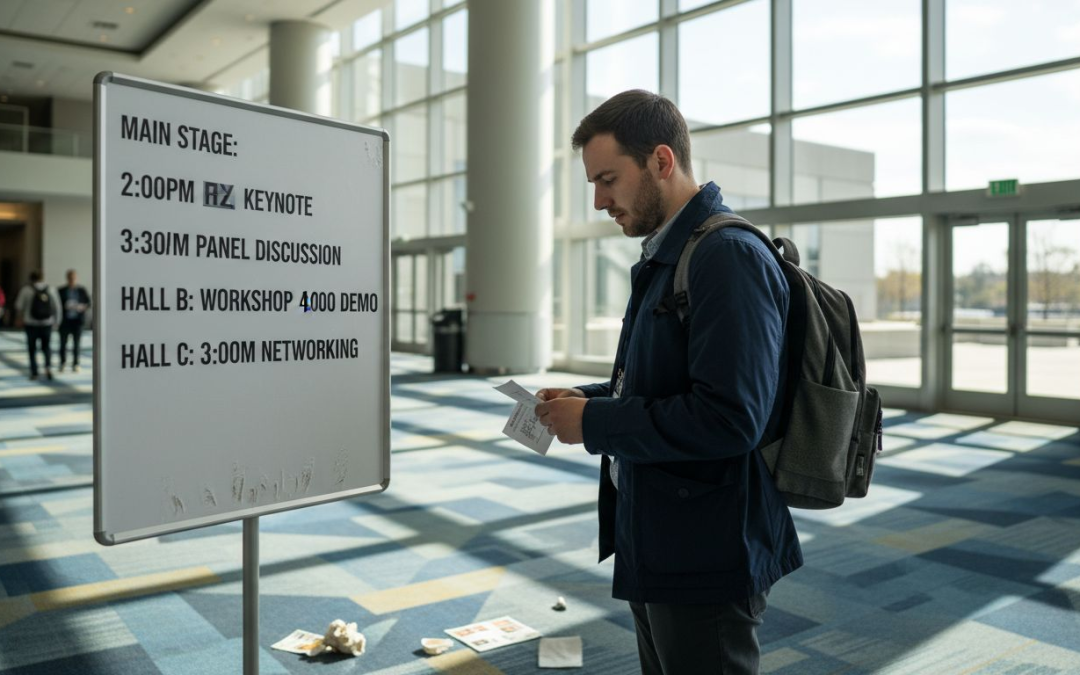
Poor event signage damages first impressions and undermines your marketing investment before attendees even enter. While you dedicate countless hours to programming and logistics, inadequate directional signs, inconsistent branding, and unclear messaging create confusion that erodes attendee satisfaction and sponsor value. This comprehensive guide transforms your approach to event signage by covering strategic preparation, tactical execution, and measurable evaluation techniques that deliver lasting impact. You’ll discover how combining traditional and digital signage creates memorable experiences that strengthen your brand and maximize return on investment.
Table of Contents
- Understanding The Impact Of Event Signage
- Preparing Your Event Signage Strategy
- Executing Effective Event Signage Deployment
- Measuring Signage Success And Optimizing Future Events
- Enhance Your Event With Custom Signage Solutions
- Frequently Asked Questions
Key takeaways
| Point | Details |
|---|---|
| First impressions matter | Signage drives 75% of attendees’ initial event perceptions and sets the tone for their entire experience. |
| Revenue impact | Consistent brand presentation through signage increases revenue by up to 23% compared to inconsistent messaging. |
| Digital advantages | Digital signage improves attendee satisfaction by 35% and boosts sponsor engagement by 40% over static options. |
| Strategic placement | Positioning signs in high-traffic areas and natural sightlines reduces congestion by 25% and improves flow. |
| Hybrid approach | Combining digital and traditional signage maximizes visibility while maintaining cost effectiveness and flexibility. |
Understanding the impact of event signage
Your signage creates the foundation for every attendee interaction. Research shows 75% of attendees form their first impression based solely on the visual communication they encounter, making it the single most influential touchpoint in your marketing arsenal. This initial perception cascades through the entire event experience, affecting satisfaction scores, social media sharing, and likelihood to return.
The financial implications extend beyond attendee experience. Studies demonstrate that consistent brand presentation increases revenue by up to 23%, directly linking your signage investment to bottom-line results. When directional signs, sponsor displays, and informational graphics maintain unified visual language, you reinforce brand recognition and create professional credibility that translates to higher conversion rates.
Digital signage delivers particularly impressive performance metrics. Event venues implementing digital displays report 35% higher attendee satisfaction, 40% improved sponsor engagement, and a 25% reduction in crowd congestion compared to traditional-only approaches. These improvements stem from digital signage’s ability to provide real-time updates, dynamic content rotation, and interactive wayfinding that adapts to changing event conditions.
The operational benefits compound over time:
- Reduced staff interruptions for directions and schedule inquiries
- Faster attendee movement through registration and transition areas
- Enhanced sponsor visibility through motion graphics and timed rotations
- Improved accessibility with multilingual content and larger text options
- Lower printing costs for schedule changes and last-minute updates
Understanding these measurable impacts helps you justify signage budgets and prioritize investments. When you recognize that effective signage simultaneously improves attendee experience, sponsor value, and operational efficiency, it becomes a strategic asset rather than a tactical expense. This foundation sets the stage for building a comprehensive signage strategy that delivers results across every event metric you track. For deeper insights on attendance impact, explore why signage boosts attendance and review our event branding guide for revenue optimization techniques.
Preparing your event signage strategy
Effective signage begins long before installation day. Successful outdoor event signage starts with crystal clear understanding of who you’re communicating with and what you want to achieve. Start by defining your target audience segments: first-time attendees need different wayfinding support than returning guests, while VIP sponsors require premium placement that justifies their investment level.
Your messaging goals should align with specific attendee actions. Do you need to drive traffic to sponsor booths, reduce registration wait times, or promote keynote sessions? Each objective requires distinct signage types, placement strategies, and content approaches. Map these goals to your venue layout, identifying natural congregation points, potential bottlenecks, and high-visibility zones where strategic signage delivers maximum impact.
Choosing between traditional, digital, and hybrid signage depends on budget, venue infrastructure, and content update frequency. Traditional banners and directional signs offer simplicity and cost effectiveness for static information that remains constant throughout your event. Digital displays excel when you need dynamic content updates, real-time schedule changes, or interactive elements. The data supports digital adoption: 83% of modern event organizers have embraced digital signage to automate updates and enhance branding consistency.
Content development requires ruthless editing. Ensure your content remains concise and highly legible across different display mediums by following these principles:
- Limit text to 7 words per line and 3 lines per sign for optimal readability
- Use high-contrast color combinations that remain visible in varying lighting conditions
- Select sans-serif fonts at minimum 72-point size for distance viewing
- Incorporate white space generously to prevent visual clutter
- Test mockups at actual viewing distances before production
Pro Tip: Create a signage content matrix that maps each sign type to its specific purpose, location, and update frequency. This planning document becomes your master reference during production and installation, preventing last-minute confusion and ensuring nothing gets overlooked.
Your signage hierarchy should follow a logical information architecture. Primary wayfinding signs guide attendees to major destinations like registration, session rooms, and restrooms. Secondary signs provide detailed directions at decision points where attendees choose between multiple paths. Tertiary signs offer supplementary information like WiFi passwords, social media hashtags, and safety protocols.
| Signage Type | Best Use Case | Update Frequency | Typical Cost Range |
|---|---|---|---|
| Vinyl Banners | Sponsor branding, event identity | Once per event | $50 to $300 |
| Retractable Stands | Session room identification, registration | Once per event | $100 to $400 |
| Digital Displays | Schedules, announcements, wayfinding | Real-time updates | $500 to $3000 |
| Directional Signs | Navigation, crowd flow management | Once per event | $25 to $150 |
Placement planning requires venue walkthroughs from an attendee perspective. Trace the path from parking or public transit to registration, then to primary event spaces, noting every decision point where attendees might hesitate or choose wrong directions. These moments of uncertainty mark your critical signage locations. For comprehensive design guidance, reference our design event signage guide and outdoor event signage guide for weather-resistant solutions.
Executing effective event signage deployment
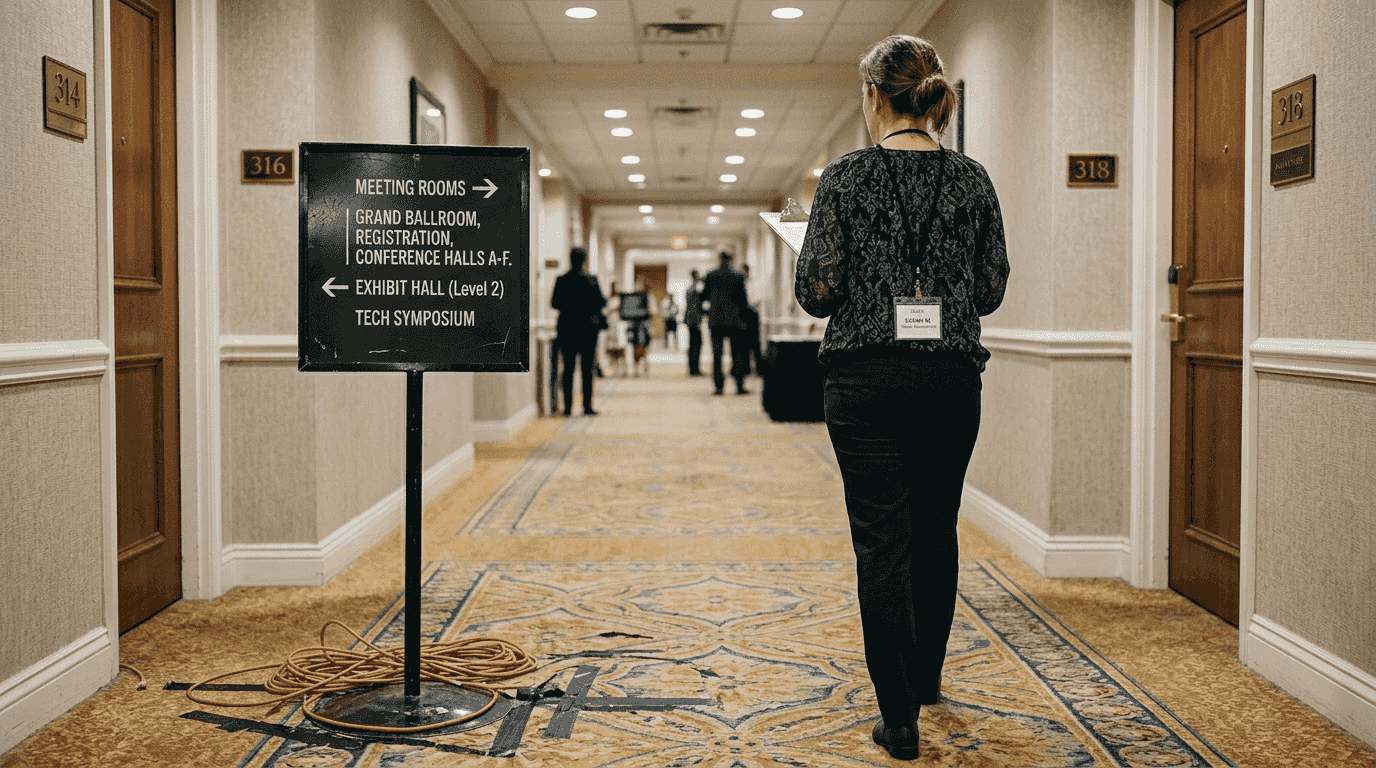
Installation timing and technique determine whether your carefully planned signage delivers its intended impact. Begin deployment 24 to 48 hours before attendee arrival, allowing time for adjustments without last-minute panic. Secure traditional signage in high-traffic areas using appropriate mounting hardware: adhesive strips for temporary indoor applications, weighted bases for freestanding displays, and reinforced grommets with zip ties for outdoor banners facing wind exposure.
Digital signage requires additional technical preparation. Test all displays for proper resolution, brightness levels, and content playback at least 12 hours before doors open. Position screens at eye level, typically 60 to 65 inches from floor to screen center, angled slightly downward for optimal viewing. Ensure power sources and network connections remain accessible for troubleshooting without disrupting attendee flow.
Follow this deployment sequence for systematic coverage:
- Install primary wayfinding signs at venue entrances and main corridors first
- Position registration area signage including queue management and directional markers
- Deploy session room identifiers and schedule displays outside each space
- Add sponsor recognition signage in high-visibility locations per contractual agreements
- Place supplementary signs for amenities like restrooms, food service, and emergency exits
- Conduct final walkthrough from multiple entry points to verify complete coverage
Real-time content management separates adequate signage from exceptional attendee experience. Digital displays enable immediate schedule updates when speakers run late or room changes become necessary. This agility prevents confusion and demonstrates professional event management. Research confirms digital signage improved communication effectiveness with a 42% increase in message engagement compared to static alternatives.
Integration with event management systems amplifies these benefits. Connect your digital signage network to registration databases for live attendance counts, session capacity alerts, and personalized welcome messages. Link to social media feeds for real-time attendee posts that build community engagement. Sync with mobile event apps so directional prompts on screens match navigation guidance on smartphones.
Crowd management becomes proactive rather than reactive when you leverage dynamic signage. Monitor high-traffic areas and adjust directional prompts to redistribute attendees toward underutilized spaces or alternative routes. Display wait time estimates at popular sessions or food vendors, helping attendees make informed decisions about their schedule. Event venues report digital display deployment increased response speed by 50%, enabling faster adaptation to changing conditions.
Pro Tip: Designate a signage coordinator with radio contact to your operations team who can authorize content updates throughout the event. This single point of accountability prevents conflicting messages and ensures updates happen quickly when circumstances change.
Maintain a deployment checklist that your team reviews at regular intervals. Check that all signs remain properly positioned, lighting conditions haven’t created glare issues, and no obstructions have blocked sightlines. For outdoor events, inspect weatherproofing after any precipitation and reinforce mounting as needed. These ongoing checks prevent small issues from escalating into attendee frustration. Explore customization techniques that enhance your deployment effectiveness and create memorable branded experiences.
Measuring signage success and optimizing future events
Quantifying signage performance transforms intuition into actionable intelligence for continuous improvement. Start with qualitative feedback through brief post-event surveys asking attendees to rate wayfinding ease, information clarity, and overall signage helpfulness on a five-point scale. Include open-ended questions about confusing moments or missing information that reveal specific improvement opportunities your metrics might miss.
Engagement metrics provide objective performance data. For digital signage, track content view duration, interaction rates with touchscreen elements, and QR code scans that connect physical signs to digital resources. Compare these metrics across different locations and content types to identify your highest-performing placements and messaging approaches. Analytics platforms integrated with digital displays reveal exactly which content captures attention and drives desired actions.
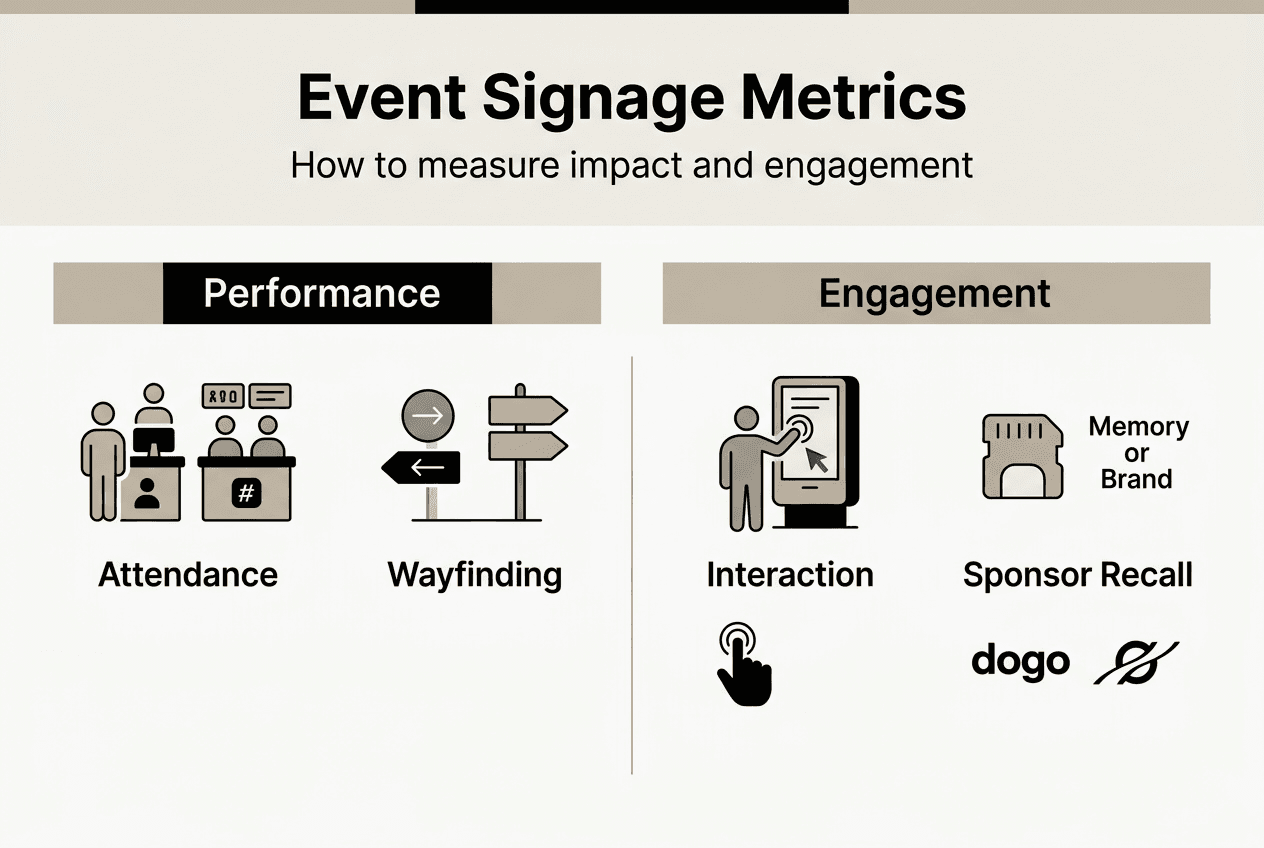
Sponsor recall measurements demonstrate signage value to your funding partners. Survey a random sample of attendees 48 hours post-event, asking them to name sponsors without prompting. Research shows digital sponsor placements yield a 43% higher recall rate than traditional banners, providing compelling evidence for premium digital sponsorship packages. This data helps justify sponsor investment and supports renewal conversations.
| Metric Category | Traditional Signage | Digital Signage | Measurement Method |
|---|---|---|---|
| Sponsor Recall | Baseline (100%) | 43% higher | Post-event surveys |
| Attendee Satisfaction | Baseline (100%) | 35% higher | Satisfaction ratings |
| Crowd Congestion | Baseline (100%) | 25% reduction | Traffic flow analysis |
| Message Engagement | Baseline (100%) | 42% increase | Interaction tracking |
Operational impact assessment reveals efficiency gains that justify signage investment. Document staff time spent answering directional questions, comparing events with strong signage to those with minimal wayfinding support. Calculate cost savings from reduced printing when digital displays eliminate schedule reprints. Venues using digital signage report 25% reduction in crowd congestion, translating to faster attendee movement and improved experience ratings.
Photographic documentation creates valuable reference material. Capture images of every sign type, placement location, and installation technique during your event. These photos inform future planning discussions, help train new team members, and provide visual proof of sponsor deliverables. Annotate images with performance notes: which signs generated questions, where attendees congregated unexpectedly, and what placement adjustments improved flow.
Comparative analysis across multiple events identifies patterns and best practices. Track how signage variables like quantity, placement density, and digital versus traditional ratios correlate with attendee satisfaction scores. Test hypotheses systematically: does adding digital displays at registration reduce wait time complaints? Do sponsor logos on directional signs improve recall without cluttering wayfinding?
Implement these assessment practices:
- Conduct real-time observation during peak traffic periods, noting attendee hesitation points
- Review social media posts for unsolicited feedback about signage effectiveness
- Compare actual attendee flow patterns to your planned routes using heatmap analysis
- Calculate cost per impression for different signage types to optimize budget allocation
- Interview sponsors about their visibility satisfaction and perceived value delivery
Apply learnings immediately to your signage library. Update templates with proven color schemes, font sizes, and messaging frameworks. Refine your placement guidelines based on which locations consistently outperform others. Build a decision matrix that helps you choose between signage options based on venue characteristics, audience size, and budget constraints. For inspiration and proven approaches, review our event signage examples showcasing successful implementations across diverse event types.
Enhance your event with custom signage solutions
Transforming signage strategy into reality requires a partner who understands event marketing dynamics and delivers professional quality on demanding timelines. Custom Signs Today specializes in tailored signage solutions that elevate your event’s visual impact and attendee experience. Our expertise spans face change signs for dynamic messaging, site signs for outdoor visibility, and comprehensive event signage systems that integrate seamlessly with your branding.
We recognize that every event presents unique challenges, from venue constraints to last-minute program changes. Our team works with you to design signs that maximize impact while maintaining flexibility for updates. Whether you need weather-resistant outdoor banners, elegant retractable displays, or digital signage content optimization, we provide solutions that enhance brand visibility and guide attendees effortlessly. Explore our design event signage guide for expert insights, then connect with our team to bring your vision to life with professional signage that delivers measurable results.
Frequently asked questions
What types of event signage are most effective?
Traditional signs like vinyl banners and directional markers excel for static information, offering cost effectiveness and simplicity for wayfinding and sponsor branding. Digital signage provides dynamic content capabilities with instant updates for schedules, announcements, and interactive elements that adapt to real-time conditions. Hybrid approaches combining both formats maximize visibility while maintaining budget flexibility, with traditional signs handling permanent information and digital displays managing variable content.
How can I measure the ROI of my event signage?
Use post-event surveys to gather qualitative feedback on wayfinding ease and information clarity, providing attendee perspective on signage effectiveness. Track quantitative metrics like sponsor recall rates, digital display engagement duration, and crowd congestion reduction to demonstrate operational impact. Monitor cost savings from reduced staff time answering directional questions and eliminated printing expenses for schedule updates. Compare these benefits against signage investment to calculate return and justify future budget allocation.
What are best practices for digital signage content?
Keep messages concise with maximum seven words per line and three lines total, ensuring readability from typical viewing distances. Use consistent brand fonts, colors, and visual hierarchy that reinforce your event identity across all digital touchpoints. Research demonstrates emotional or inspirational messaging significantly outperformed purely informational content, generating an 11 to 12% conversion lift. Rotate content every 10 to 15 seconds to maintain attention without causing information overload.
What common mistakes should event planners avoid with signage?
Avoid overcrowding signs with excessive information that overwhelms attendees and reduces readability from distance. Plan signage early in your event timeline to ensure quality production and avoid rushed decisions that compromise effectiveness. Don’t neglect digital signage benefits like real-time updates and improved engagement that justify initial investment through long-term value. Place signs where attendees naturally gather and make decisions rather than spacing them uniformly without considering actual traffic patterns. Review our event signage design guide for detailed mistake prevention strategies.