Listing marketing is the work of presenting an available property, business or event so that the right people notice it and take a next step: an inquiry, a showing, a visit or a quote. The strongest listings are launched as one coordinated system, not a single post. Prepare the property and the media, publish where buyers search, add physical wayfinding, create a viewing moment, then measure what came in. This guide walks through that sequence, with the numbers and rules that matter in the U.S.
TL;DR
- Treat a listing as a launch: NAR’s consumer guide lists staging, professional photography, social media, signage, open houses, pricing and MLS exposure as parts of one plan, not interchangeable tactics.
- Photos carry the most weight: listing agents rated them important or more important to sellers in 88% of cases, per NAR’s staging research.
- Online and physical work together. Promote open houses at least two days ahead and put signs on every approach route.
- Keep every ad truthful and fair-housing safe, in both copy and targeting.
- Measure showings and inquiries weekly, and report them to the seller.
Table of Contents
- What a listing means in marketing
- The listing marketing plan, step by step
- Online and offline: what each channel does
- Listing marketing for local businesses
- Our perspective: signs are the part of a listing people forget
- Stay truthful and fair-housing compliant
- Where our signs fit
- FAQ
- Sources
What a listing means in marketing
In real estate, a listing is the public presentation of a property that is for sale or rent. In local business marketing, the word also covers the profile that lets customers find a company online and in person. The goal is the same in both cases: attract qualified attention and convert it into an action.
For homes, NAR defines the marketing mix as staging, professional photography, social media, signage, open houses, competitive pricing and MLS distribution. The MLS (multiple listing service) is the online platform that compiles brokerage listings and usually gives the widest exposure.
The agent matters too. NAR’s 2025 profile found that 88% of buyers purchased through an agent or broker, and 91% of sellers used an agent. Buyers judge the property and the professional behind it, so your logo, photo, website and yard sign all work as part of the pitch.
The listing marketing plan, step by step
1. Define the audience and the action
Decide who the ideal viewer is (a first-time buyer, a downsizer, a tenant, an investor) and what you want them to do. For a house, that is usually booking a showing or attending the open house. For a commercial space, it may be a call to a leasing contact. Every piece of copy, every sign and every QR code should point to that one action.
2. Prepare the property and the offer
Staging and presentation pay off in measurable ways. In NAR’s staging report, 29% of agents saw a 1% to 10% increase in the dollar value offered on staged homes, and 30% said staging reduced time on market. Photos mattered most to sellers (88%), then video (47%) and traditional physical staging (43%).
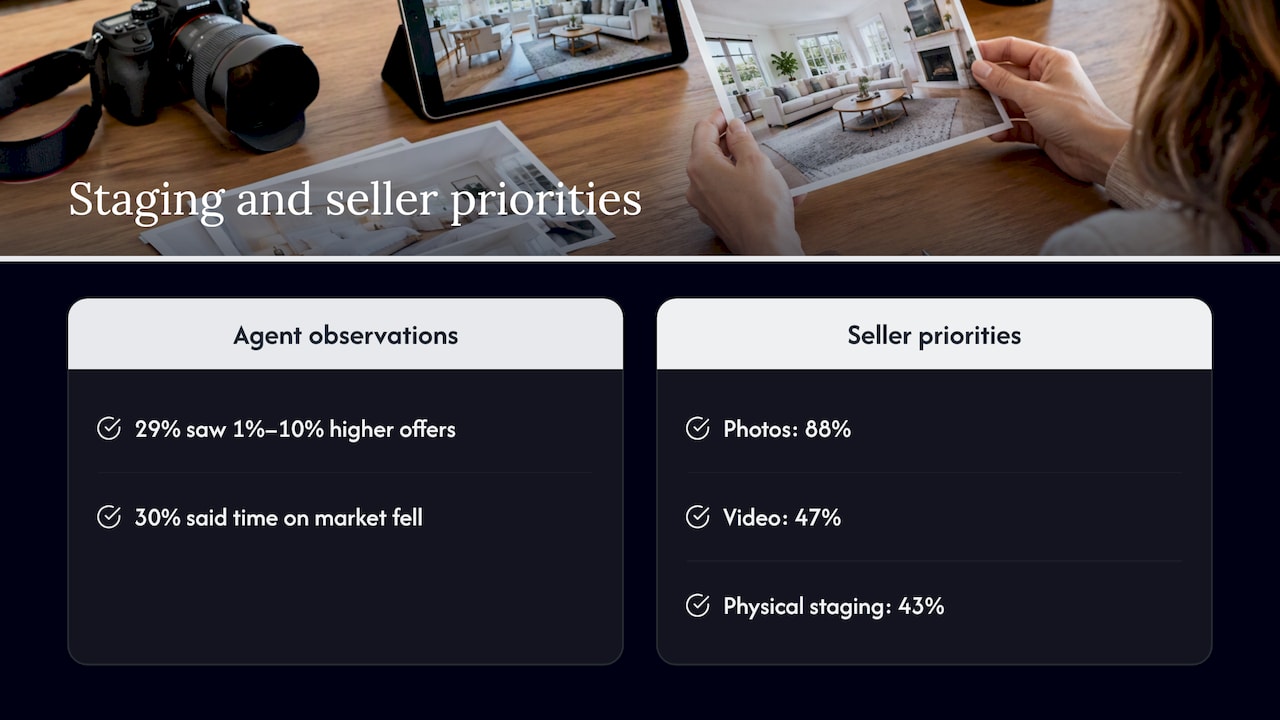
That ranking is a good guide to a tight budget: pay for photography before anything else, then decide on video and staging by property type.
3. Produce accurate media and copy
Gather what you need before the listing goes live:
- Professional photos of every main room and the exterior, taken in good light.
- A short video or walkthrough if the property suits it.
- A floor plan or map, and a QR destination that opens the listing page.
- Copy that describes the property and the neighborhood factually. Leave out anything that expresses a preference about who should live there.
4. Publish where buyers search
Put the listing on the MLS first, then syndicate and share it through email and social channels. Your local MLS rules decide timing, so read them before you plan the launch date.
There is a strategic choice here. NAR describes office-exclusive and delayed-marketing listings as ways to control exposure. Office-exclusive listings stay off the MLS and public channels. Delayed-marketing listings appear on the MLS but are temporarily withheld from syndication. NAR notes that many MLSs require a listing to be added within one business day after public marketing, such as a yard sign or social post, though requirements vary. If a seller wants a quiet launch, check your MLS rules before the sign goes in the ground.
5. Add physical wayfinding
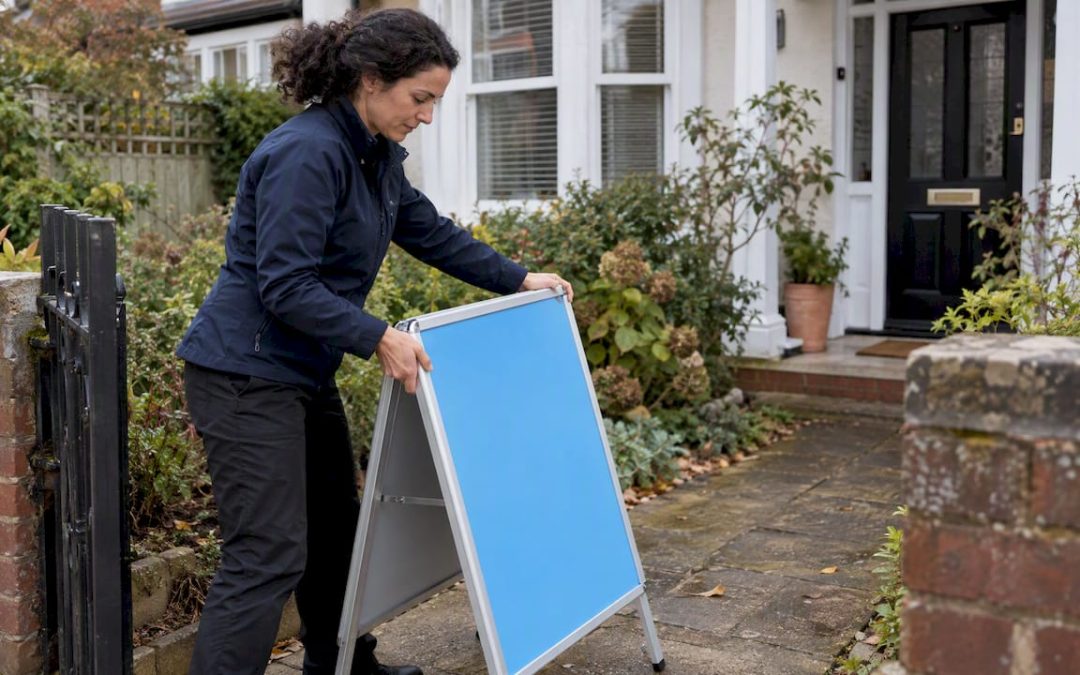
Online reach brings people to the listing page. Signs bring in the neighbors, the drive-by buyers and the people who never set the right filters. Our guides on real estate sign types and real estate sign placement cover the details. The short version:
- A property sign at the front identifies the listing and the agent.
- Directional signs on the approach routes lead strangers to the door. See our piece on the role of directional signs in real estate.
- Indoor signs keep visitors moving through the house. Our indoor signage placement guide shows how.
- Banners suit new developments, large lots and commercial space. Read about banners in property marketing.
6. Schedule the viewing moment
NAR frames open houses as a complement to online discovery. In-person viewing builds connection and can surface properties buyers missed through narrow online search criteria. NAR contributors suggest advertising an open house at least two days beforehand across social media, the MLS, showing-scheduling sites, major real estate websites, email and strategic signs, with a live video on the day.
The same NAR article describes an agent who uses 10 or more open-house signs instead of one or two. The lesson for your own routes: a buyer who loses the trail at one turn is a buyer who never walks in. Our open house sign ideas include route mapping and copy templates.
7. Follow up and review
Send the seller a weekly list of activity: showings, inquiries, online views and feedback. Compare your days on market with your area’s average and adjust price, photos or signage if traffic stalls. A listing that gets views but no showings usually has a price or photo problem. A listing with few views has a distribution or visibility problem.
Online and offline: what each channel does
| Channel | What it does best | Weak spot | Check before you launch |
|---|---|---|---|
| MLS and syndication | Broadest reach to agents and buyers | Anonymous, easy to scroll past | Local MLS timing rules |
| Social and email | Targeted reach and sharing | Short shelf life | Fair-housing-safe targeting |
| Yard sign | Neighborhood recognition, lead capture | Only reaches passers-by | HOA and municipal rules |
| Directional signs | Moves strangers to the door | Easy to place badly | Local sign ordinances |
| Open house | Builds connection, gets feedback | Time-limited | Two days of advance promotion |
| Banners | Visibility for large sites and developments | Needs a visible location | Permit and size limits |
No single row wins. The table is why NAR’s guidance treats the elements as parts of one plan.
Listing marketing for local businesses
The word “listing” also describes a business profile. Google’s guidelines say the business should be represented consistently across real-world signage, stationery and branding, with one profile per location, accurate address or service-area data, and complete hours and categories. Your storefront sign therefore does double duty: it helps customers recognize you and matches what your online profile says.
Google also explains what influences local ranking: relevance, distance and prominence. If you want a primer on the wider discipline, this local SEO academy is a useful starting point. Then make sure the name on your door, your van and your profile are identical. Our exterior signs and vehicle lettering are built around that consistency.
Our perspective: signs are the part of a listing people forget
Most listing plans we see are heavy on photos and posts, and light on what happens at the curb. We think that is backwards for one practical reason: a listing only converts when someone can find the door.
We make signs for agents, property managers and event organizers, so we see the same mistakes repeatedly. A directional sign with too much text that nobody can read at 30 mph. A property sign in a brand color that disappears against the landscaping. An open house with one arrow at the main road and none at the last turn. A banner hung where the traffic never looks.
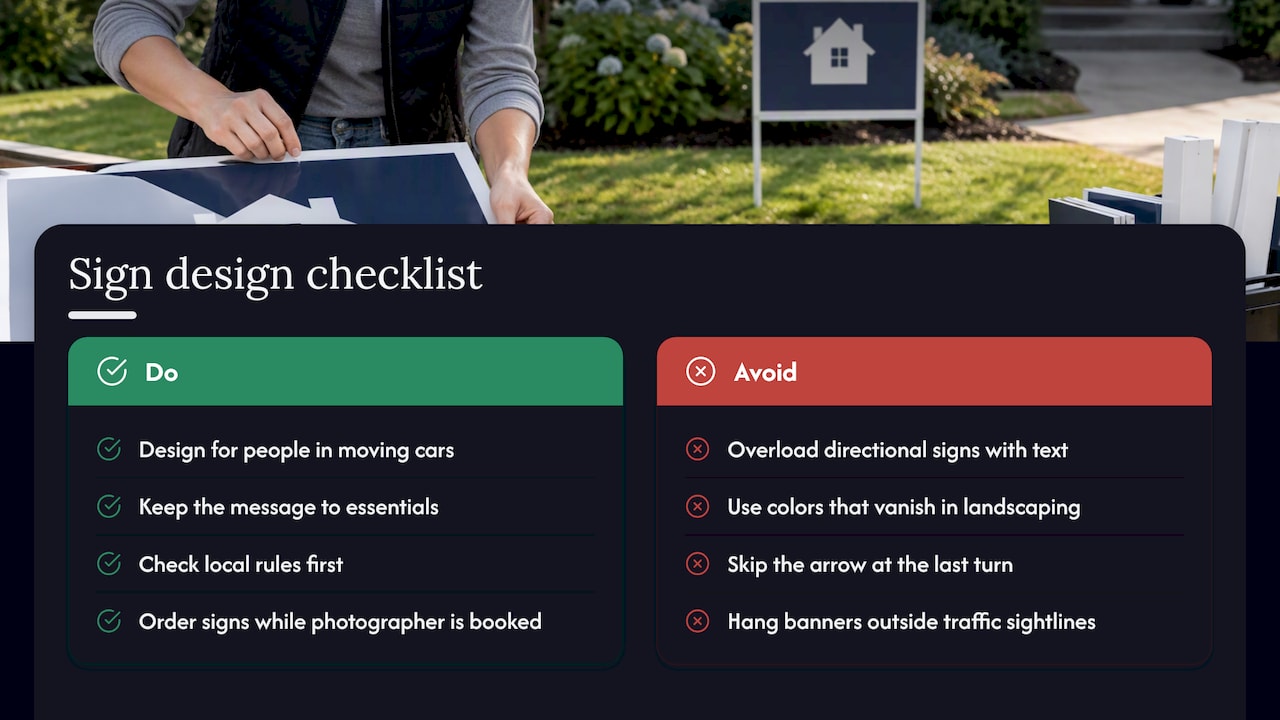
Our advice is simple. Design the sign for the person in a moving car. Keep the message to the essentials: the word that says what it is, the agent name, a phone number or QR code. Match the colors to your brand so the sign works as a repeat impression across listings. Check local rules first, because many municipalities and HOAs limit size, count and placement. Our real estate sign compliance guide is a good place to begin.
Finally, treat signs as part of the launch date, not an afterthought. Order them while the photographer is still booked, so the sign in the yard and the listing online go live on the same day.
— Yossi
Stay truthful and fair-housing compliant
Marketing can be optimized right into a legal problem. Two areas deserve a deliberate check.
Fair housing. HUD’s guidance on advertising through digital platforms warns that targeting or ad delivery can unlawfully deny information, steer people, discourage protected groups or offer different terms. HUD’s housing provider FAQ adds that housing advertising must not express preferences or limitations based on protected characteristics such as race, color, religion, sex, disability, familial status or national origin. That applies to the words on a sign, too. If you are unsure whether copy or an audience setting is acceptable, ask your broker or a fair-housing attorney before it runs.
Honest testimonials. The FTC’s revised 2023 endorsement guidance targets fake reviews, undisclosed material connections and review suppression. Use real client reviews and disclose any relationship.
Signs and MLS rules. As noted above, a yard sign can count as public marketing under some MLS rules. Get the owner’s authorization and confirm the listing status before the sign goes up.
Where our signs fit
If you are launching a listing and want the physical side handled, we design and produce real estate signs, A-frames and directional signs, plus banners in retractable, feather and mesh formats. We can also help with interior signs for open houses and show units, and with installation guidance and compliance questions. Tell us the property, the timeline and the routes, and we will work out what you need. You can request a custom sign quote to start.
FAQ
What is a listing in marketing?
A listing is a public presentation of something available, such as a property, business, service or event. It is designed to attract qualified attention and prompt an action like an inquiry, showing, booking or quote. In real estate it usually means the MLS entry plus the photos, copy and signs that support it.
How do I market my listings?
Start by defining the audience and the action you want. Then prepare professional photos and accurate copy, publish to the MLS and social channels, add signs and a promoted open house, and review results weekly. NAR’s guidance treats these as one connected plan.
How far ahead should I promote an open house?
NAR contributors recommend at least two days ahead. Use social media, the MLS, showing-scheduling websites, email and signs on the approach routes, and consider a live video on the day.
Do yard signs affect when a listing must go on the MLS?
In many markets, yes. NAR notes that many MLSs require a listing to be added within one business day after public marketing such as a yard sign. Requirements vary, so confirm your local MLS rules before the sign goes up.
Sources
- NAR: Consumer Guide, Marketing Your Home
- NAR: Consumer Guide, Alternative Listing Options
- NAR: Help Agents Make Their Open Houses Stand Out
- NAR: 2025 Profile of Home Buyers and Sellers
- NAR: Home Staging Report
- Google Business Profile Help: Guidelines for representing your business
- Google Business Profile Help: Tips to improve your local ranking
- HUD: Guidance on Advertising through Digital Platforms