
The right sign starts with one question: where will people see it, and what should they do next? Answer that, and the type (banner, vinyl graphic, wall sign, vehicle wrap), the material and the print file mostly follow. This guide walks through each decision in the order you will face it, so your quote request is specific and your sign works the day it goes up.
TL;DR
- Pick the sign type by its job (find you, guide visitors, promote an offer, warn of a hazard), then by where it will be seen and for how long.
- Match the material to the setting: foam core and styrene indoors, corrugated plastic for short-term outdoor use, aluminum or ACM for long-term outdoor use.
- Send print-ready artwork sized for the viewing distance, and ask for a physical proof when brand colors matter.
- Permanent room signs and workplace safety signs come with federal rules. Check them before you order, not after installation.
- Request a quote with your location, size, mounting surface and timeline, and you will get a faster, more accurate answer.
Table of Contents
- The main sign types and what each one does
- How to choose a sign type for your purpose, audience and location
- Banners: the fastest way to put a message up
- Vinyl, window and vehicle graphics
- Sign materials for indoor and outdoor use
- Design and file prep that keeps a sign readable
- Compliance checks before you order
- Perspective: why we start with the site, not the catalog
- Get a quote for your sign project
- FAQ
- Sources
The main sign types and what each one does
Businesses use far more than a single storefront sign. Industry guidance separates building-mounted signs, such as awnings, projecting signs and wall signs, from freestanding monument and pylon signs. The first group brands a building and helps customers find it. The second can sit at a highway exit or the entrance to a business complex.
A retail-focused breakdown groups signage a little differently: exterior and storefront signs, interior and wayfinding signs, promotional point-of-purchase signs, and digital signs. For most small and mid-sized companies, the printed side of that list looks like this:
| Sign type | Best job | Typical setting | Where to start |
|---|---|---|---|
| Exterior signs | Be found, build recognition | Building front, site entrance | Exterior signs |
| Interior signs | Guide people, brand the space | Lobbies, offices, retail floors | Interior signs |
| Banners (vinyl, mesh, feather, retractable) | Announce, promote, mark an event | Fences, building walls, event entrances, trade shows | Banners |
| A-frame, real estate and directional signs | Point people to a place or listing | Sidewalks, roadsides, property lots | Custom signs |
| Vehicle lettering, magnets and wraps | Advertise while you drive | Vans, trucks, company cars | Vehicles |
| Window graphics, wall graphics, decals | Brand surfaces you already have | Storefront glass, feature walls | Vinyl signs |
| Safety and compliance signs | Communicate hazards and requirements | Workshops, warehouses, facilities | Safety sign guide |
Trade show graphics, vehicle wraps and safety and regulatory signs are also standard categories in print signage, covering brand presence at exhibitions, mobile advertising, and communication of hazards, compliance and accessibility.
How to choose a sign type for your purpose, audience and location
Start with the job, not the product. A sign that tries to attract, inform and sell at once usually does none of them well. Use these four filters in order.
1. What is the single job of this sign?
Pick one: be found, direct, promote, identify or warn. A coming-soon banner on a vacant storefront and a permanent lobby sign have different jobs, so they get different materials, sizes and budgets.
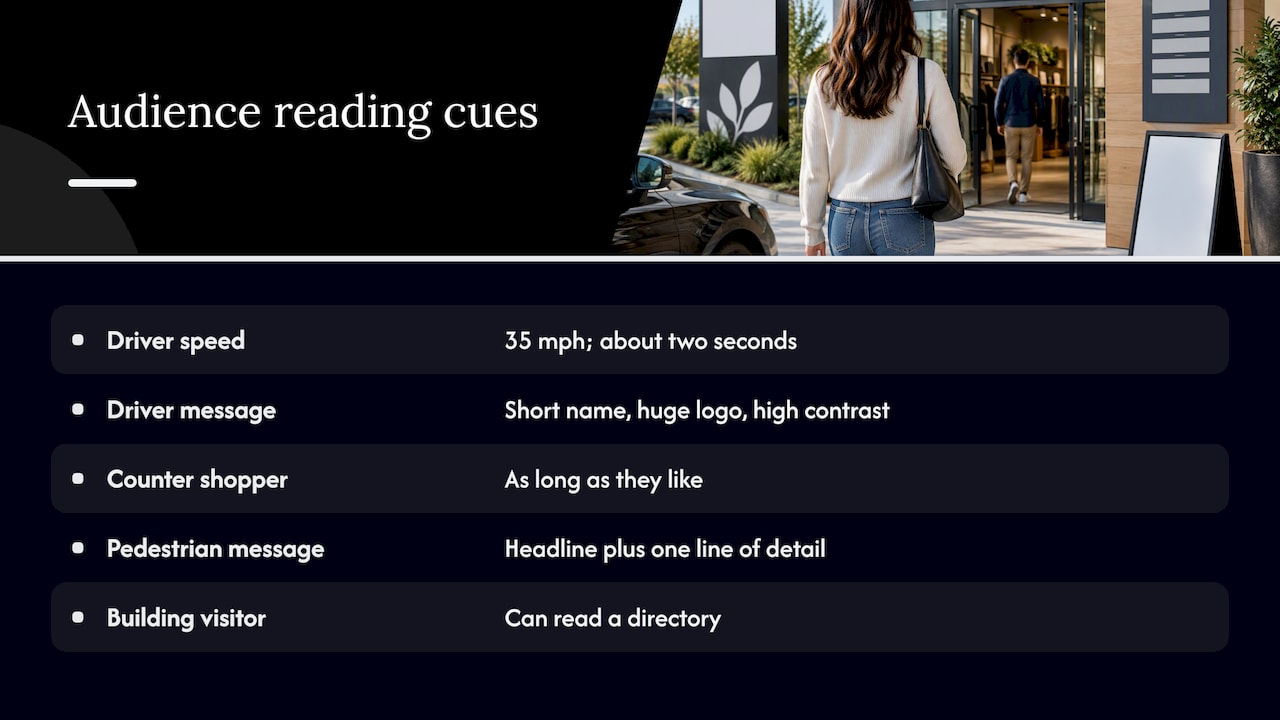
2. Who sees it, and how fast?
A driver at 35 mph gets about two seconds with your message. A shopper standing at a counter gets as long as they like. Drivers need a short name, a huge logo and high contrast. Pedestrians can handle a headline plus one line of detail. Visitors inside a building can read a directory.
3. Where will it hang, and for how long?
A three-day grand opening calls for a banner or feather flag. A three-year presence calls for rigid or building-mounted signage. A fleet that visits ten job sites a week calls for vehicle graphics, because the sign travels to your audience.
4. What does the property allow?
Landlords, homeowners associations and local sign codes often limit size, height, lighting and placement. Ask early. For real estate listings, our real estate sign compliance guide covers what to confirm before a sign goes in the ground.
Quick matches by business type
- Retail and restaurants: a storefront sign, window graphics and an A-frame for the sidewalk.
- Real estate agents: yard and directional signs for open houses, plus banners for larger properties. Our guide to real estate signs explains the common formats.
- Contractors and service companies: vehicle lettering or wraps, job-site signs and branded decals.
- Event organizers: feather banners, vinyl banners, directional signs and retractable banners that pack into a carry case.
- Property managers and facilities teams: interior wayfinding, room signs and safety signage.
Banners: the fastest way to put a message up
Banners suit short campaigns because they are large, light and quick to install. Vinyl banners work on fences and building fronts. Mesh banners let wind pass through, which matters on open fences and scaffolding. Feather banners catch attention at curbs and entrances, and retractable banners earn their place at trade shows, lobbies and sales events because they set up in minutes.
If you are weighing a banner against a permanent sign, ask how long the message stays true. Offers, openings and listings change. Your company name does not. Our articles on why banners pay off for local businesses and their role in brand visibility go deeper on use cases.
Vinyl, window and vehicle graphics
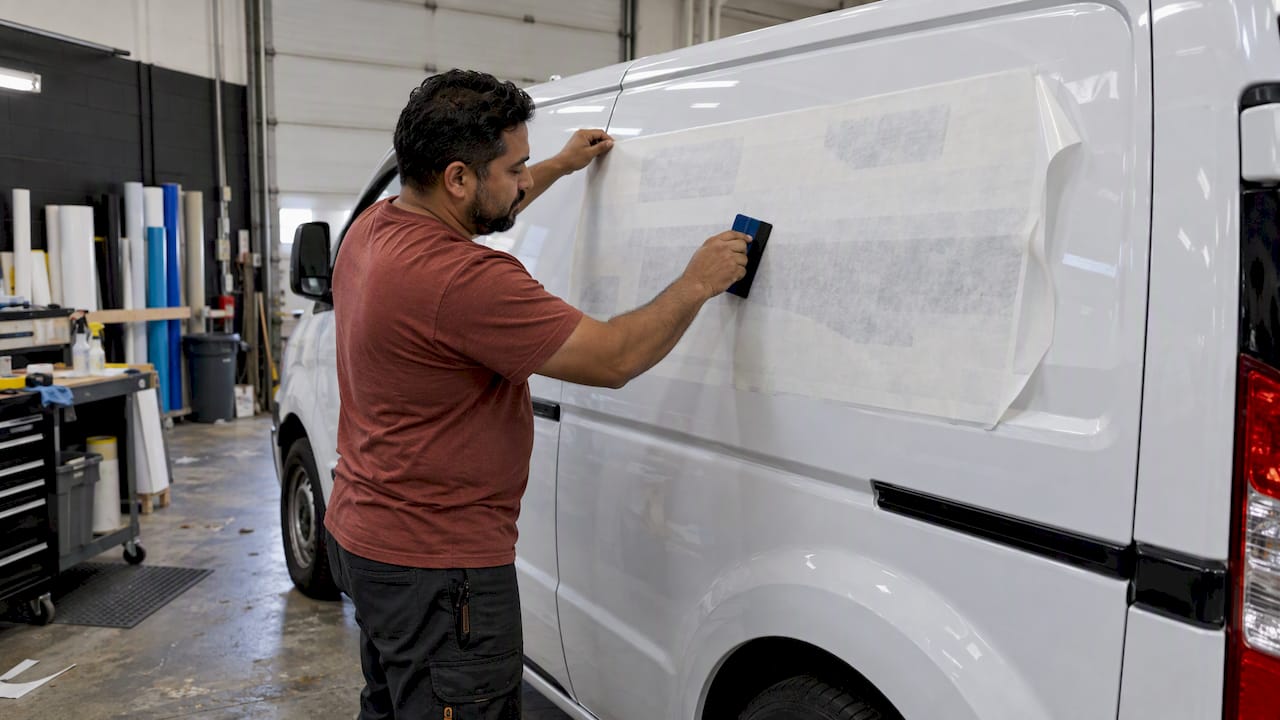
Vinyl graphics turn surfaces you already own into advertising. Window graphics brand a storefront and can add privacy. Wall graphics give an empty lobby wall a purpose. Decals carry a logo or instruction onto equipment, doors and floors. On vehicles, lettering is the budget-friendly way to show a name and phone number, magnets let you swap a message or use a personal vehicle for business, and a full or partial wrap makes the whole vehicle a moving billboard.
We cover these under vinyl printing and wraps and vehicle lettering and magnets. When you ask for a quote, give the make, model and year of each vehicle, or the glass dimensions for windows, so the template is accurate.
Sign materials for indoor and outdoor use
Material decides how long a sign survives. A university printing service that publishes plain guidance on rigid substrates says foam core and styrene are best used indoors. It lists PVC board for indoor and short-term outdoor use, corrugated plastic as weather-resistant and common for short-term outdoor signs, and aluminum and ACM as suited to long-term outdoor use, with ACM showing excellent weather resistance.
| Material | Indoor | Short-term outdoor | Long-term outdoor | Typical use |
|---|---|---|---|---|
| Foam core | Yes | No | No | Displays, presentations, counter signs |
| Styrene | Yes | No | No | Lightweight interior signs |
| PVC board | Yes | Yes | No | Interior signs, short outdoor runs |
| Corrugated plastic | Yes | Yes | No | Yard signs, event and election-style signs |
| Aluminum / ACM | Yes | Yes | Yes | Permanent exterior and directional signs |
The table follows that university guidance. Flexible media such as banner vinyl and mesh, and adhesive vinyl for glass, walls and vehicles, are chosen on different criteria: wind exposure, surface texture and how long the graphic must stay put.
For a deeper look, read our breakdown of common sign materials and how to choose.
Design and file prep that keeps a sign readable
Most print problems begin in the artwork, not on the press. These habits prevent the common ones.
- Design for distance. The farther away the viewer, the less detail they can use. Large exterior signs can be built from lower-resolution files than a counter display, but only if the artwork is vector or scaled up from a large original. Ask your sign maker for the exact file size and resolution they want.
- Keep the message short. Name, one benefit, one action. Phone numbers and web addresses should be large enough to read from where the viewer stands.
- Use contrast. Dark on light or light on dark. Avoid thin script fonts and busy photo backgrounds behind text.
- Allow for bleed and margins. Wide-format jobs need extra bleed beyond the trim line, and the amount depends on the substrate and finishing. Keep text well inside the safe area so nothing is lost at the edge.
- Convert text to outlines and send vector logos. Missing fonts and low-resolution logos are the usual reasons proofs come back wrong.
- Ask for a proof for brand colors. Large-format printers reproduce brand colors through a process color mix, and vivid colors can shift. A printed proof on the real material is the only dependable check, since the same file can look different on different materials.
If you do not have a designer, our team can build or adjust artwork as part of the order. Tell us the intended viewing distance and we will size the type to match.
Compliance checks before you order
Some signs are regulated, and a wrong sign can mean rework or a citation. Three checks cover most business situations.
Accessibility for permanent room signs
Under federal ADA design standards, permanent room and space signs must meet specific requirements, including raised characters and Braille, while temporary signs such as directories and menus are exempt from those specific requirements. The page linked is the original 1991 standard, and the current standards are the later revision, so confirm details such as character height, finish and mounting location against the current ADA standards or with your local building official before you order. Our ADA sign page is a good starting point for room identification signs.
Workplace safety signs
OSHA sets format rules for accident prevention signs. For example, Caution signs use a yellow background with a black panel and yellow letters, and tag signal words must be readable at a minimum of 5 feet. Facility managers will find the practical checklist in our guides to mandatory workplace safety signs and the four types of safety signs. For your own site, confirm the requirements with your safety officer or an OSHA-qualified consultant.
Local sign codes and permits
Cities and counties often regulate sign size, height, illumination and placement, and many require a permit for permanent exterior signs. Contact your local planning or building department before fabrication, and check lease terms and HOA rules too. We offer compliance consulting as part of the process, so bring those details to the first conversation.
Perspective: why we start with the site, not the catalog
Most sign orders that go wrong were decided in the first five minutes: someone picked a product off a list before anyone asked where it would hang and who would read it.
We do it the other way around. We ask about the building, the street, the vehicle, the event, the budget and the timeline, then recommend a sign type and material to fit. A banner might be exactly right for a two-week promotion, and the wrong tool for a permanent storefront. We would rather tell you that during the consultation than at installation.
What we can offer is one team handling design, fabrication, compliance questions and installation guidance, with certified installation and fast turnaround for local and nationwide clients. That means fewer handoffs, and a sign that matches your brand and surroundings. Bring us the problem and your measurements, and we will take it from there.
Yossi
Get a quote for your sign project
Whether you need a single storefront sign, a set of banners for an event, or branded graphics for a whole fleet, we design and fabricate custom signs and print in the size, material and finish your project needs. Tell us where the sign goes and what it should do, and we will recommend options.
Browse our custom signs or custom printing pages, or request a free quote on customsignstoday.us. For help preparing a good request, see what to expect from a custom sign quote.
What to include in your quote request
- Sign type and quantity.
- Final size, or the wall, window or vehicle measurements.
- Indoor or outdoor, and how long it needs to last.
- Mounting surface and method.
- Your logo files (vector if you have them) and brand colors.
- Your deadline and install location.
FAQ
How do I choose between a banner and a rigid sign?
Choose a banner when the message is temporary or the surface is large, such as a fence or building front. Choose a rigid sign in aluminum or ACM when the sign should last for years outdoors. If you are unsure, tell us the timeline and location, and we will recommend one.
Which sign material lasts longest outdoors?
Aluminum and ACM are suited to long-term outdoor use, and ACM is noted for excellent weather resistance, according to university printing guidance. Corrugated plastic suits short-term outdoor signs. Foam core and styrene belong indoors.
Do I need a permit for a business sign?
Often yes for permanent exterior signs, but rules vary by city and county. Check with your local planning or building department before fabrication, and review your lease or HOA rules. Temporary banners can also be regulated, so ask about those as well.
Can I use a printed sign for workplace safety?
Yes, as long as it follows the applicable OSHA format rules for colors, wording and readability. Our safety sign compliance guides outline what facilities commonly need. Your safety officer should confirm what applies at your site.
What should I send to get an accurate quote?
Send the sign type, size, indoor or outdoor use, mounting surface, artwork and deadline. Photos of the wall, storefront or vehicle help a great deal. With those details, the quote and the proof can be much more precise.
Sources
- Identification of Sign Types, International Sign Association
- Retail Signage: Types, Design Tips, and Examples
- Print Signage: Design, Types, and Business Benefits
- Choosing the Right Sign Material, Vanderbilt Printing Services
- ADA Standards for Accessible Design, Title III Regulation
- OSHA 1910.145, Specifications for accident prevention signs and tags