{
“@type”: “Article”,
“image”: {
“url”: “https://csuxjmfbwmkxiegfpljm.supabase.co/storage/v1/object/public/blog-images/organization-6408/1779416338061_Contractor-mounting-site-sign-at-construction-fence.jpeg”,
“@type”: “ImageObject”,
“caption”: “Contractor mounting site sign at construction fence”
},
“author”: {
“url”: “https://customsignstoday.us”,
“name”: “Customsignstoday”,
“@type”: “Organization”
},
“@context”: “https://schema.org”,
“headline”: “What Is a Site Sign? Types, Uses, and Best Practices”,
“publisher”: {
“url”: “https://customsignstoday.us”,
“name”: “Customsignstoday”,
“@type”: “Organization”
},
“inLanguage”: “en-US”,
“description”: “Discover what a site sign is and learn its crucial roles in safety, branding, and compliance. Maximize your location’s impact today!”,
“datePublished”: “2026-05-22T02:57:24.213Z”
}
TL;DR:
- A site sign encompasses safety, legal, branding, and directional functions at a specific location, not just a company board. Proper planning, compliance with local permits, and material choices are crucial for effective and durable signage that communicates the right information at the right time. Separating safety from branding signs in design and understanding regulatory requirements prevent costly mistakes and enhance site effectiveness.
Most people assume a site sign is just a big board outside a building with a company name on it. That assumption is only partially right. A site sign is actually a broad category of visual communication that serves safety, legal compliance, branding, and directional purposes all at once. Understanding what a site sign is and how it functions can save you money, keep you out of regulatory trouble, and make your location significantly more effective. Whether you’re managing a construction project, opening a business, or organizing an event, site signs are doing more work than you probably realize.
Table of Contents
- Key takeaways
- What is a site sign, exactly?
- The main types of site signs
- Regulations and permits you need to know
- Materials, design, and placement best practices
- Real-world applications and benefits
- My take on what businesses keep getting wrong
- Get the right site signs from Customsignstoday
- FAQ
Key takeaways
| Point | Details |
|---|---|
| Site signs serve multiple roles | A single location may need safety, directional, branding, and regulatory signs all at once. |
| Permits are often required | Local municipal codes regulate sign type, size, and placement, even for informational signs. |
| Material choice matters | PVC, polyethylene, and metal each offer different durability and weather resistance for outdoor use. |
| Design and compliance are separate | Safety signage follows strict color and format standards; branding signs follow different rules. |
| Plan before you install | Checking local codes before ordering a sign prevents costly removals, fines, or redesigns. |
What is a site sign, exactly?
Before anything else, let’s break down the two words separately, because that clarity changes how you approach everything from design to permits.
Oxford Learner’s Dictionaries defines “site” as a place where a building, town, or activity was, is, or will be located. That covers construction zones, business premises, event venues, real estate lots, and public spaces. Any physical location tied to an activity qualifies.
“Sign,” on the other hand, is a message in a public place that gives information or instructions. It’s a visible communication tool. It might warn, direct, identify, or advertise.
Put those two together and you get a site sign: any sign placed on or about a specific location to communicate something to the people there. The site sign definition is intentionally broad, and that breadth is the point. Here’s what falls under that umbrella:
- Construction site signs: Warnings, hazard notices, contractor branding, and project identification boards at active build sites
- Business premises signs: Exterior identification signs, hours of operation boards, and entry/exit markers at commercial locations
- Real estate site signs: Property listings, open house notices, and developer branding at land or building sales sites
- Event site signs: Venue identification, directional arrows, sponsor branding, and safety notices at temporary event locations
- Public space signs: Park rules, facility information, and regulatory notices at government or community-managed sites
The term “site sign” varies widely by context, making it critical to clarify your purpose before you start the design or installation process. A safety sign for a construction crew and a branding board for a real estate developer are both site signs, but they require completely different approaches.
The main types of site signs
Understanding site sign types is where things get genuinely practical. Most sites need more than one category, and confusing them leads to compliance problems or missed opportunities.
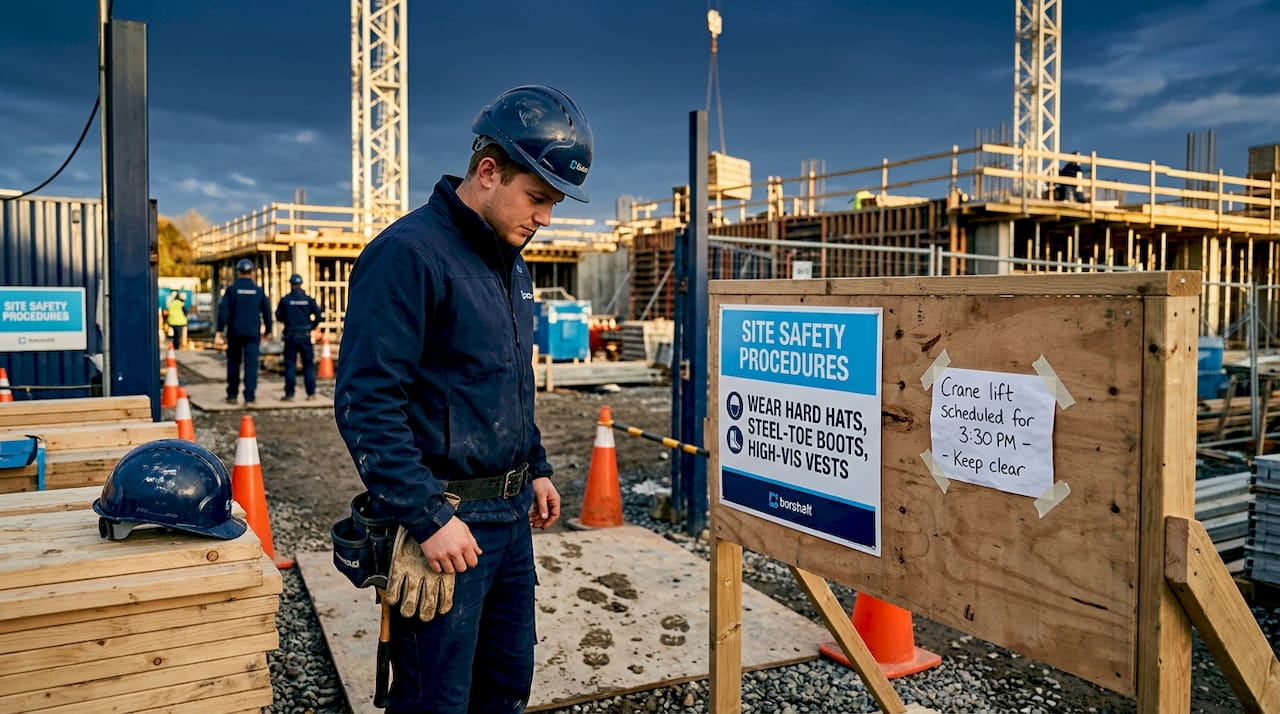
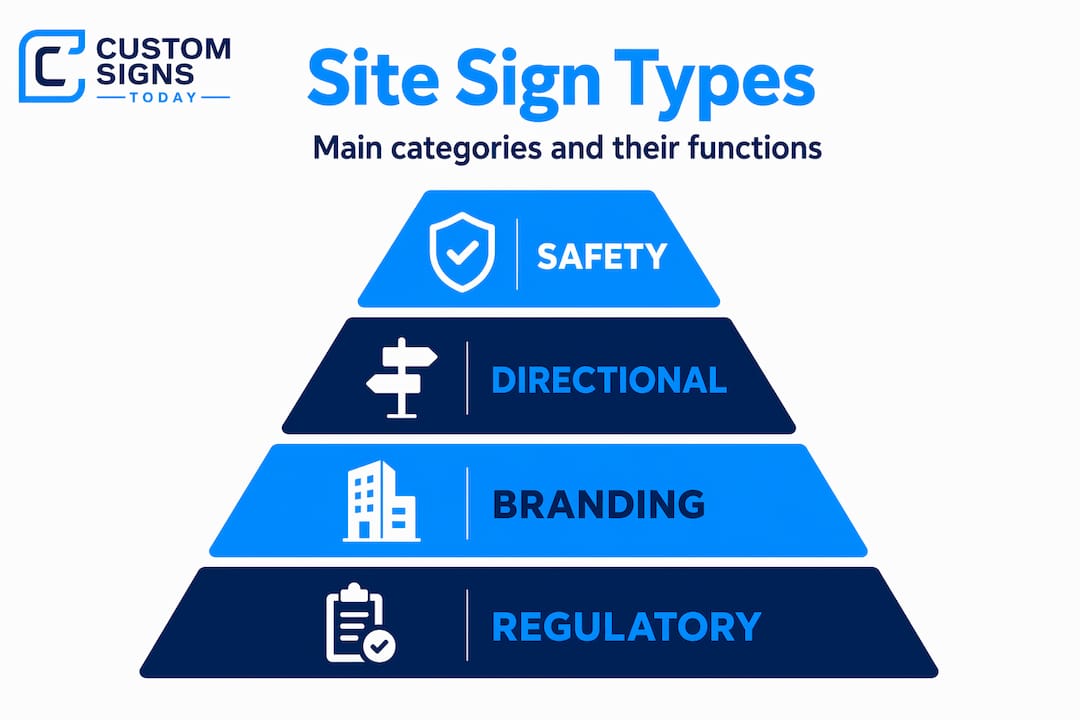
Safety and warning signs exist to protect people. Construction site signs warn personnel about dangers and regulate safe behavior. These include hard hat required notices, no unauthorized entry signs, electrical hazard warnings, and fall risk alerts. They follow strict visual conventions because recognition speed matters. A worker needs to read a warning sign in a fraction of a second under stressful conditions.
Directional signs guide people through unfamiliar spaces. On a large construction site, a visitor who can’t find the site office wastes time and creates safety risks. At a commercial location, poor directional signage for customers leads to frustration and lost business. These signs are often underestimated, but they directly affect how efficiently a site operates.
Branding and promotional signs establish identity. A contractor’s logo on a job site board builds credibility with neighbors and passersby. A real estate developer’s site sign reinforces the project brand before a single unit sells. These signs serve a marketing function even when the primary reason for being there is identification.
Regulatory and informational signs exist because the law requires them. Building permits displayed in windows, noise ordinance hours posted at construction entrances, and environmental compliance notices all fall into this category. They’re not optional, and their absence can trigger fines or stop-work orders.
Pro Tip: Most sites need at least three of these four types simultaneously. Plan your site signage as a system, not as individual pieces. A construction project, for example, typically needs safety warnings at entry points, directional signs for workers and deliveries, a contractor branding board for visibility, and a permit display for compliance.
Site signs help share crucial information including where to park, how to proceed, warnings, and branding data. The most effective site signage programs treat all four functions as equally important.
Regulations and permits you need to know
This is the section most people skip and then regret. Site sign regulations are not uniform across the country, but the general framework follows a predictable pattern.
Local municipal codes govern almost everything about a sign’s legality. Permits are required to install, replace, or expand signs unless they are specifically exempted by local planning codes. The exemptions typically cover very small signs, certain temporary signs, and safety-required notices, but the thresholds vary by city and county.
Here’s a practical breakdown of what regulators typically consider:
- Sign function: Is it advertising a business, providing safety information, or giving directions? Regulatory categories influence whether a permit is required and what size and placement restrictions apply.
- Sign size: Larger signs almost always require permits. Many municipalities cap the square footage for ground-mounted signs in commercial versus residential zones differently.
- Sign location: Setback requirements from the road, neighboring property lines, and overhead utilities affect where you can legally place a sign.
- Sign lighting: Illuminated signs face additional scrutiny, including light pollution rules and electrical safety codes.
- Sign duration: Temporary signs, like those for a construction project or real estate listing, often have time limits and different permit tracks than permanent signs.
| Sign category | Typically requires permit | Key restriction |
|---|---|---|
| Permanent business ID sign | Yes | Size, height, setback |
| Construction site branding board | Sometimes | Duration, size |
| Safety and warning signs | Usually exempt | Must follow OSHA/ANSI standards |
| Temporary real estate signs | Sometimes | Duration, size |
| Event directional signs | Sometimes | Duration, removal deadline |
Pro Tip: Translate your signage intent into recognized regulatory categories before you contact the permit office. Describing your sign as “a business identification sign” rather than “just a board with our name on it” gets you faster, more accurate guidance from planners.
Local municipal planning guides heavily influence how site signs are used and regulated, often overriding your marketing preferences. What looks great in a design presentation may not survive the permit review.
Materials, design, and placement best practices
Getting the materials and design right separates a sign that lasts three years from one that fades or warps in six months. It also separates a sign people actually read from one they ignore.
Choosing the right material
Common durable materials for outdoor site signs include:
- PVC board: Lightweight, weather-resistant, and easy to print on. Great for temporary construction boards and real estate signs. Materials like PVC optimize durability for outdoor use while keeping costs reasonable.
- Polyethylene: More flexible than PVC, handles impact well, and resists UV degradation. Used frequently for construction site barriers and safety boards.
- Aluminum composite: Rigid, lightweight, and corrosion-resistant. The standard choice for long-term business identification signs and building-mounted displays.
- Corrugated plastic (Coroplast): Inexpensive and recyclable. Ideal for short-term real estate signs and event directional markers.
Design elements that actually work
Color choices are not just aesthetic. Since 1964, orange with black text has been the standard for construction zone warning signs. That convention exists because contrast and recognition speed save lives. You do not redesign that for brand consistency.
For branding signs, the rules shift entirely. Strong contrast between background and text, readable fonts at the intended viewing distance, and logo placement that reads at speed from a moving vehicle all drive effectiveness. A branding sign for a business should prioritize recognition first and beauty second.
| Design element | Safety signs | Branding signs |
|---|---|---|
| Color standard | Orange/black, red/white | Brand palette |
| Font style | Bold, sans-serif only | Brand typeface |
| Primary goal | Instant recognition | Identity and recall |
| Regulatory standard | OSHA/ANSI required | Local code compliance |
Placement should follow a simple rule: put the sign where the intended reader is looking at the moment they need the information. A warning sign belongs at the entry point of a hazard zone, not 20 feet past it.
Real-world applications and benefits
The importance of site signs goes beyond theory. Here’s how they play out in real projects and real businesses.
A general contractor installing site signs with company branding on every job site gets free impressions from every neighbor, driver, and potential client who passes by. That passive marketing is particularly powerful in local markets where building signs impact business visibility without any ongoing cost.
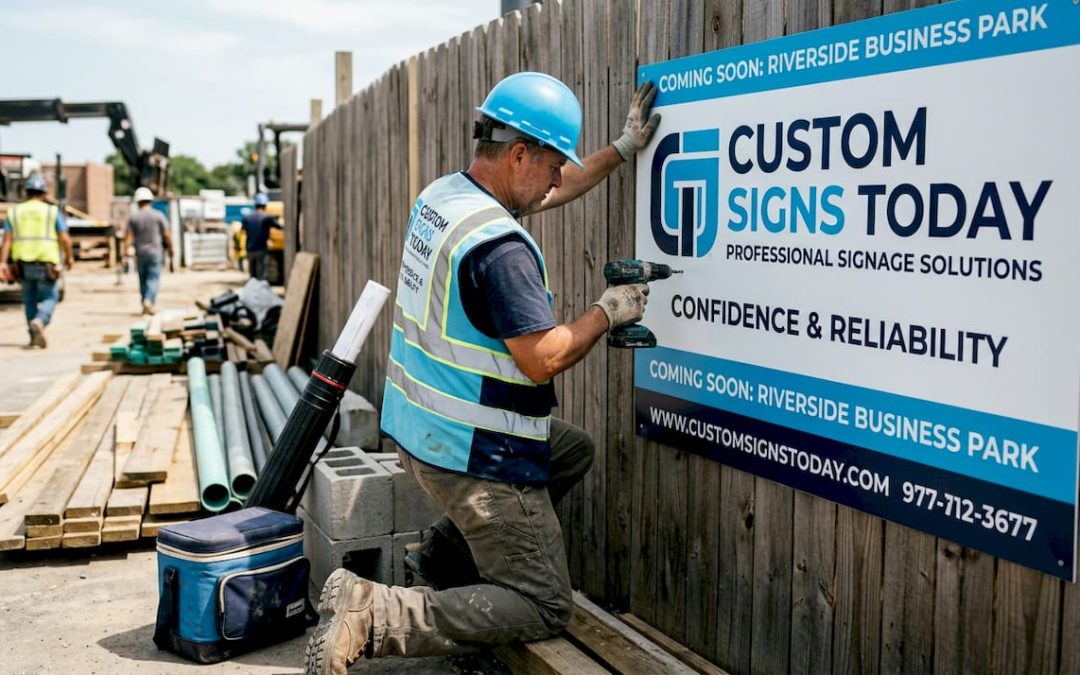
For a retail business opening in a new location, site signs during construction build anticipation. A “Coming Soon” board with the brand identity, opening date, and a website URL turns an empty storefront into a lead generation tool months before opening day.
Real estate professionals rely on site signs to drive traffic to listings. The sign in the yard is still the single most effective tool for capturing drive-by interest in a neighborhood, even in an era of online listings.
From a liability perspective, safety site signs reduce risk. A clearly marked hazard with proper warning signage shifts legal responsibility in the event of an incident. That’s not just good practice; it’s protection.
The core benefit across all these applications is the same: a well-executed site sign communicates the right information to the right person at the right moment. That’s a deceptively high bar to clear, which is why planning matters so much.
My take on what businesses keep getting wrong
I’ve spent years working with businesses and contractors on signage projects, and the same mistake comes up over and over. People treat site signs as an afterthought. They order a sign two days before a site opens, skip the permit check, and then wonder why the city is calling them or why nobody can find the entrance.
What I’ve learned is that the regulatory and safety functions of site signs get the least attention from people with marketing instincts. A business owner focused on branding naturally gravitates toward color palettes and logo placement. The permit requirements and safety sign standards feel like bureaucratic noise. But ignoring them is exactly how you end up with a $1,200 sign that gets a removal order on day three.
The other thing I’ve noticed is how rarely people think about separating safety signage from branding signage in both design and compliance. They’re governed by different rules and serve different audiences. Separating safety from branding in your planning process means you can satisfy the inspector and still present a professional, on-brand appearance. Those goals are not in conflict. They just require two different tracks of thinking.
My advice: before you finalize any site sign design, call your local planning department and describe what the sign will say, where it will go, and how big it will be. That five-minute conversation can save you weeks of rework.
— Yossi
Get the right site signs from Customsignstoday
If you’ve worked through this article and realized your site signage needs a serious upgrade, you’re in good company.

Customsignstoday specializes in exactly this kind of work. Whether you need construction site safety boards, contractor branding panels, real estate signs, or directional markers for a commercial location, the team produces custom signs built for durability and visibility. Materials range from corrugated plastic for short-term applications to aluminum composite for permanent installations. Every order is designed with your specific placement, audience, and compliance needs in mind. If you’re not sure where to start, Customsignstoday offers free quotes and practical guidance to help you get the right sign for your location without the guesswork. Visit customsignstoday.us/site-signs to explore options and request your quote today.
FAQ
What is a site sign used for?
A site sign is used to communicate safety warnings, directional information, branding identity, or regulatory compliance at a specific location. Most active sites need multiple types simultaneously.
Do site signs require permits?
Many site signs require permits depending on size, location, and function. Permits are required to install or replace signs unless specifically exempted by local planning codes, so check with your municipality before installation.
What materials work best for outdoor site signs?
PVC, polyethylene, aluminum composite, and corrugated plastic are the most common outdoor materials. Your choice depends on how long the sign needs to last, the weather conditions it will face, and your budget.
What colors should construction site warning signs use?
Construction site warning signs use orange backgrounds with black text or symbols. Since 1964, orange with black has been the recognized standard for construction zone warning signs in the United States.
Can a site sign serve both safety and branding purposes?
Yes, but they should be designed separately. Safety signs follow strict OSHA and ANSI standards, while branding signs follow your visual identity guidelines. Mixing the two formats on a single sign typically weakens both functions and can create compliance issues.