

TL;DR:
- Regulatory signs legally command drivers and pedestrians to act and must meet specific standards.
- Proper signage reduces accidents by up to 30 percent and protects against liability.
- Regular review and maintenance of signs are essential for legal enforceability and safety.
Many businesses and property managers install traffic signs with good intentions but make one costly mistake: they confuse warning signs with order-giving signs. That mix-up can expose you to serious liability, void your insurance coverage, and create genuine safety hazards for anyone on your property. Regulatory signs are the only category that legally commands drivers and pedestrians to act. Understanding which signs carry that authority, and how to use them correctly, is not optional for any business or facility manager who cares about compliance.
Table of Contents
- Understanding order-giving traffic signs: Regulatory vs. warning and guide signs
- What shapes and colors mean: Recognizing regulatory signs at a glance
- Common examples of order-giving traffic signs and their meanings
- Why regulatory signs matter: Safety improvements and compliance
- Why most businesses underappreciate regulatory signage (and what to do instead)
- Upgrade your signage solution with expert support
- Frequently asked questions
Key Takeaways
| Point | Details |
|---|---|
| Regulatory signs give orders | Traffic signs classified as regulatory tell you what must or must not be done by law. |
| Shapes and colors signal meaning | Octagons, red circles, and blue circles are quick cues for order-giving signs across regions. |
| Legal compliance is crucial | Using the correct regulatory signs protects against fines and liability for accidents. |
| Standard signs lower accidents | Compliant regulatory signage can reduce accidents by up to 30 percent. |
Understanding order-giving traffic signs: Regulatory vs. warning and guide signs
Not every sign on a road or parking lot carries the same legal weight. Traffic signs fall into three broad categories, and only one of them actually gives orders.
Regulatory signs tell people what they must or must not do. They are backed by law, and ignoring them can result in fines, accidents, or legal action against the property owner. As the Pennsylvania Driver’s Manual states, traffic signs that give orders are regulatory signs, which tell drivers what they must do or must not do according to traffic laws.
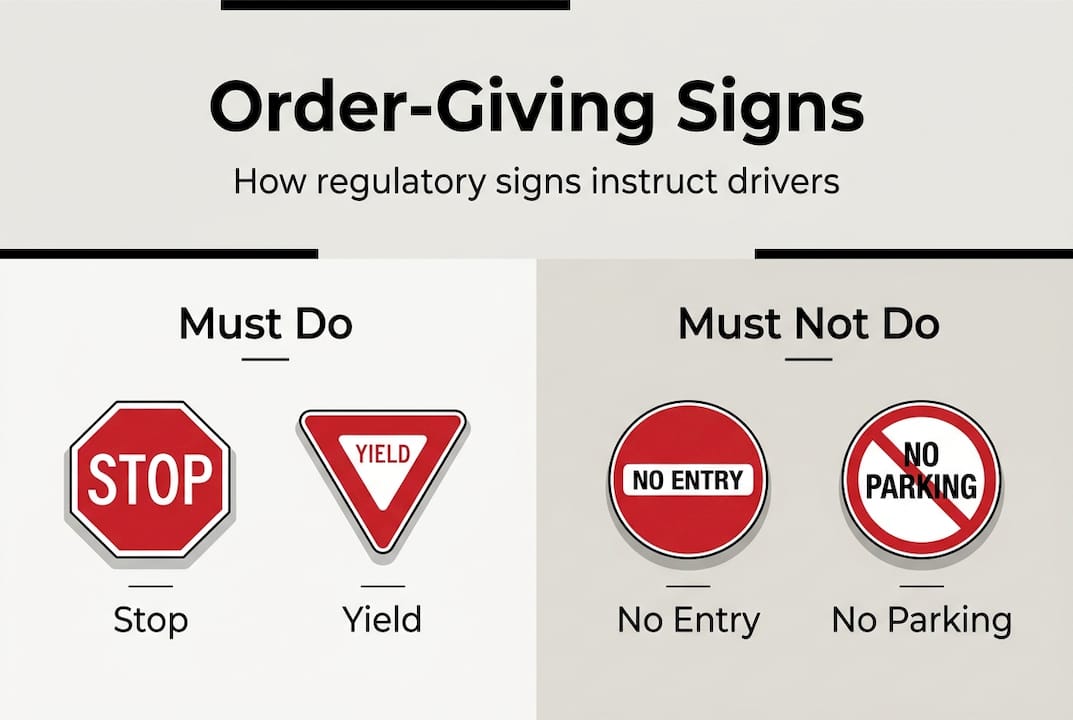
Warning signs alert drivers to potential hazards ahead, such as sharp curves, pedestrian crossings, or slippery surfaces. They advise caution but do not issue commands. Ignoring them is risky, but the legal obligation is different.
Guide and informational signs simply direct people toward destinations, services, or points of interest. Think highway exit signs or hospital direction markers. No legal order is attached.
Here is why the distinction matters so much for your property:
- Using a warning sign where a regulatory sign is required can leave you legally unprotected if an accident occurs
- Installing the wrong sign type can invalidate an insurance claim
- Regulatory signs must meet specific design standards to be enforceable
- Misidentified signs create confusion that increases accident risk
“The type of sign you install is not just a design choice. It is a legal statement about what you expect people to do on your property.”
Understanding safety sign meanings is the first step toward building a compliant, effective signage system. When you treat every sign as interchangeable, you are gambling with both safety and liability.
What shapes and colors mean: Recognizing regulatory signs at a glance
With regulatory signs defined, it is time to recognize them instantly, for both legal and practical reasons.
One of the smartest features of modern traffic signage is that shape and color do a lot of the communicating before you even read the text. Regulatory signs follow strict visual rules that allow people to react quickly, even at speed.
In the United States, regulatory signs are typically rectangular with white backgrounds, black text, and red accents for prohibitions. The octagon is universally reserved for STOP signs. No other sign shape carries that same instant meaning globally. Circles appear on railroad advance warning signs and, in international systems, on prohibition or mandatory signs.

Under the Vienna Convention, which governs traffic signage in most of Europe and many other countries, regulatory signs split into two clear groups: prohibitory signs use a red circle with a diagonal slash, and mandatory signs use a blue circle. Red means “you must not,” blue means “you must.”
The United States takes a different approach. As noted by Wikipedia’s regulatory sign entry, the US lacks a separate mandatory category and folds all order-giving signs into a single regulatory classification. That means American drivers rely more heavily on text and color contrast than on shape alone.
| Feature | US regulatory signs | Vienna Convention signs |
|---|---|---|
| Shape | Rectangle (most), octagon (STOP) | Circle (prohibition/mandatory) |
| Prohibition color | Red text or border | Red circle with slash |
| Mandatory color | Black on white | Blue circle |
| Text use | Heavy | Minimal, relies on symbols |
| Legal framework | MUTCD | Vienna Convention |
Pro Tip: If you manage a property with international visitors or workers, consider adding symbol-based signs alongside text-based ones. It reduces confusion and strengthens your compliance posture.
Browsing available traffic sign styles can help you match the right design standard to your specific location and audience.
Common examples of order-giving traffic signs and their meanings
Now that you can spot regulatory signs, see what the most important order-giving signs look like in actual use.
The most recognized order-giving signs share one trait: they remove ambiguity. There is no room for interpretation. Here are the most common ones and what they legally require:
- STOP requires a complete stop before a marked line or intersection. No rolling stops are legally acceptable.
- YIELD requires drivers to slow down and give the right of way to oncoming traffic or pedestrians.
- DO NOT ENTER prohibits entry into a roadway or area entirely.
- Speed limit signs set the maximum legal speed for a given zone.
- ONE WAY restricts traffic to a single direction of travel.
- NO PARKING and NO STANDING regulate where and when vehicles may stop.
- KEEP RIGHT and KEEP LEFT direct lane positioning.
Countries differ in how they classify and display these signs. Alberta’s traffic sign catalogue notes that Canadian and Australian provinces classify regulatory signs as those indicating obligations like speed, right of way, and prohibitions, which closely mirrors the US system but with distinct visual standards.
| Sign | US standard | Canada/Australia | Europe (Vienna) |
|---|---|---|---|
| STOP | Red octagon, white text | Same | Red octagon |
| Speed limit | White rectangle, black text | Similar | White circle, red border |
| No entry | Red rectangle, white bar | Similar | Red circle, white bar |
| Yield | Red and white triangle | Similar | Red triangle (inverted) |
For businesses managing parking lots, private roads, or campus environments, understanding regulatory sign requirements is critical. Signs on private property still need to meet recognized standards to be enforceable and to protect you legally.
Why regulatory signs matter: Safety improvements and compliance
You have seen which regulatory signs give orders, but why are they so crucial beyond simply obeying the law?
The answer is measurable. Standardized, properly installed regulatory signs reduce accidents by 20 to 30 percent according to Federal Highway Administration studies. That is not a minor improvement. For a busy parking lot or a private campus road, that reduction can mean the difference between a safe environment and a serious incident.
For businesses, the stakes go beyond safety statistics:
- Insurance liability: If an accident occurs on your property and your signs do not meet recognized standards, your insurer may deny the claim. Non-compliant signage signals negligence.
- Legal enforceability: A parking restriction sign that does not follow MUTCD guidelines may not hold up if challenged in court.
- Visitor confidence: Clear, professional regulatory signs signal that your property is well managed and safe.
- ADA and code compliance: Some regulatory signage overlaps with accessibility requirements, meaning gaps can trigger additional regulatory scrutiny.
Parking lots deserve special attention. They are among the most accident-prone areas on any commercial property, yet many businesses treat their lot signage as an afterthought. STOP signs at lot exits, speed limit signs in drive lanes, and pedestrian crossing markers are all regulatory signs that actively reduce risk.
The signage safety impact on events and public gatherings follows the same logic. When people are moving quickly through unfamiliar spaces, clear order-giving signs keep traffic flowing safely and reduce the chance of collisions or pedestrian injuries.
Regulatory signage is not a one-time installation. Signs fade, get damaged, or become obscured by vegetation. A sign that was compliant when installed but is now barely visible offers no legal protection and no safety benefit.
Why most businesses underappreciate regulatory signage (and what to do instead)
Here is an uncomfortable truth: most organizations treat regulatory signage as a box to check during a property build-out, then forget about it entirely. That approach is backwards.
Smart facility managers treat signage as an active, living safety system. They schedule annual reviews, replace faded signs before they become invisible, and audit their sign placement whenever traffic patterns change. A STOP sign that made sense five years ago may now be blocked by a newly installed planter or a vehicle that parks in the wrong spot daily.
The deeper issue is that many businesses do not realize their signs are unenforceable until something goes wrong. By then, the liability has already landed. Investing in safer signage installation practices from the start, and revisiting them regularly, costs far less than defending a premises liability claim.
Treat every regulatory sign on your property as a standing legal instruction. If you would not post a policy without reviewing it periodically, do not leave your signage to chance either.
Upgrade your signage solution with expert support
If you are ready to prioritize smart regulatory signage, here is how to make it seamless.
Getting compliant, durable regulatory signs does not have to be complicated. Custom Signs Today specializes in producing order-giving signs that meet recognized standards for both public and private spaces.

Whether you need face change signs to update existing installations without full replacement, fully custom signs built to your property’s exact specifications, or guidance on what your space legally requires, the team at Custom Signs Today can help. Start by requesting custom sign quotes to see how straightforward compliant signage can be. Your property, your visitors, and your insurance policy will all benefit.
Frequently asked questions
Which color traffic signs give orders?
In Europe and the UK, red circles prohibit and blue circles mandate specific actions, while US regulatory signs typically use white backgrounds with black or red text and symbols.
Are STOP and YIELD signs considered order-giving signs?
Yes. Both are classic regulatory signs that issue legal commands. The Pennsylvania Driver’s Manual lists STOP, YIELD, and speed limit signs as core examples of regulatory signage.
Why do shape and color matter for regulatory signs?
Standardized shapes and colors allow instant recognition, even at speed or in low visibility. Consistent visual standards reduce confusion and support legal consistency across jurisdictions.
Do private property signs need to follow regulatory sign rules?
Yes. Signs on private property should match MUTCD or equivalent standards to remain enforceable and protect you from liability. Compliant sign design is a key factor in premises liability cases.