
TL;DR:
- Indoor signage is essential for navigation, safety, branding, and operational efficiency.
- Effective signage enhances customer trust, experience, and brand recognition, encouraging repeat visits.
- Regular review and thoughtful planning are crucial to maximize signage impact and avoid common pitfalls.
Eight out of ten visitors depend on clear indoor signage just to find their way around your space. That’s not a minor detail — it’s a fundamental part of how people experience your business or event. Poor signage costs you more than a few confused customers; it erodes trust, slows operations, and weakens the brand impression you’ve worked hard to build. This guide walks you through what interior signage actually does, how it shapes branding and customer satisfaction, why it’s critical for safety and navigation, and what to consider when planning your own signage strategy. By the end, you’ll have a clear picture of why this investment pays off.
Table of Contents
- What interior signage does for your business or event
- The direct benefits of interior signage for branding and customer satisfaction
- How interior signage streamlines navigation and safety
- What to consider when planning your interior signage
- A fresh perspective: Why great signage is the secret advantage most businesses miss
- How to get started with custom interior signage solutions
- Frequently asked questions
Key Takeaways
| Point | Details |
|---|---|
| Critical for navigation | Clear interior signage prevents confusion and keeps visitors moving smoothly. |
| Boosts brand perception | Consistent signage reinforces branding and builds trust with your audience. |
| Enhances safety and compliance | Effective signs help meet legal requirements and improve emergency readiness. |
| Direct impact on satisfaction | Well-designed signage improves the customer experience and encourages repeat business. |
What interior signage does for your business or event
Most people think of signage as decoration. A logo on the wall, maybe a welcome banner near the entrance. But interior signage is far more than that. It’s a functional communication system that tells people where to go, what to expect, and who you are — all without requiring a single staff member to speak a word.
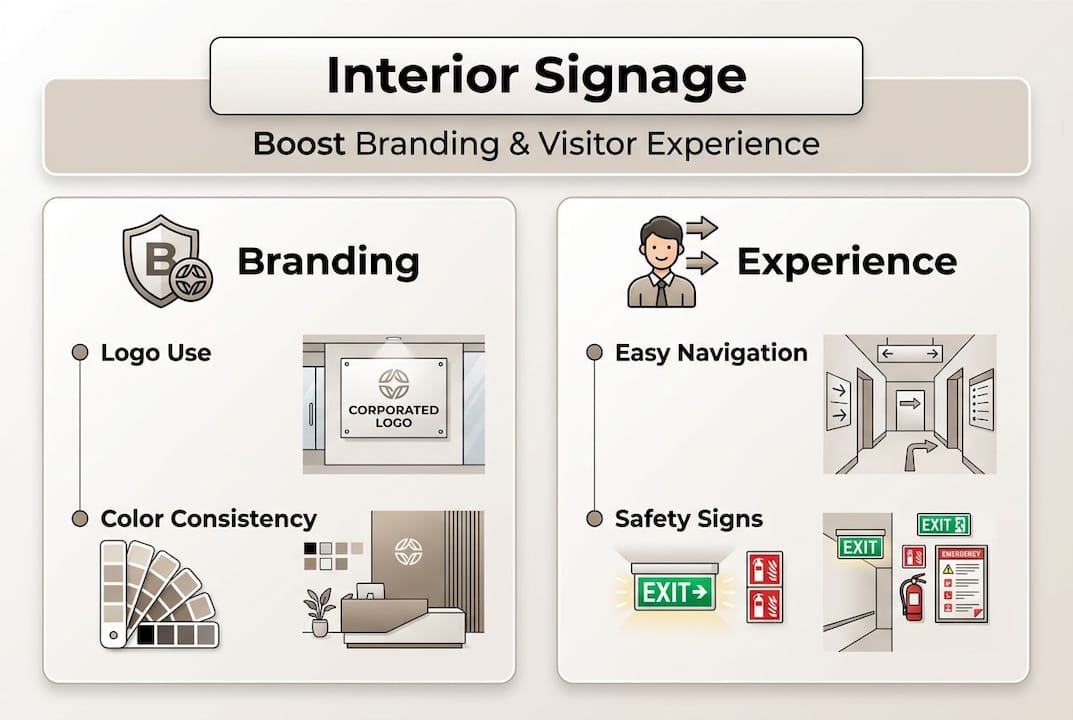
Interior signage serves five core functions that are easy to overlook until they break down:
- Navigation: Guides visitors through your space logically and without friction
- Information: Communicates hours, rules, promotions, and instructions clearly
- Legal compliance: Covers ADA requirements, emergency exit routes, and occupancy limits
- Ambiance: Shapes the mood and feel of your environment through design and placement
- Branding: Reinforces your identity, colors, and values at every touchpoint
When these functions work together, visitors feel confident and comfortable. When they fail, frustration sets in fast. As interior signage explained, every element in your space sends a message, whether you intend it to or not.
80% of visitors rely on clear indoor signage to navigate without confusion, directly impacting customer experience and operational efficiency.
That statistic puts the stakes in plain view. Failing to meet that expectation doesn’t just inconvenience visitors — it undermines their overall impression of your brand.
Here’s how signage quality affects real outcomes:
| Factor | Poor signage | Effective signage |
|---|---|---|
| Navigation | Confusion, bottlenecks, frustrated visitors | Smooth flow, confident movement |
| Brand perception | Forgettable, unprofessional | Memorable, trustworthy |
| Operational flow | Staff constantly redirecting guests | Self-sufficient visitor experience |
| Safety compliance | Potential liability and fines | Clear emergency and ADA adherence |
Good designing property signage practice accounts for all of these dimensions, not just aesthetics. Interior signage is, at its core, a system designed to let your space work for you.
The direct benefits of interior signage for branding and customer satisfaction
Branding isn’t just your logo. It’s the feeling someone gets every time they interact with your business. Interior signage is one of the most consistent and visible carriers of that feeling — and when it’s done right, the results are measurable.

Consistent use of your brand’s colors, fonts, and tone across all interior signs builds recognition. Customers who see the same visual identity repeated throughout a space begin to trust it. They feel like they’re in a place that has its act together. Contrast that with a space where signage is mismatched, uses clashing fonts, or carries outdated messaging — it signals disorganization even if everything else is running smoothly.
Clear indoor signage directly impacts customer experience and operational efficiency, and that efficiency translates into emotional outcomes that keep customers coming back. Consider the difference:
| Signage quality | Customer emotional response | Business outcome |
|---|---|---|
| Strong, on-brand signage | Confident, calm, positive | Higher satisfaction, repeat visits |
| Weak or inconsistent signage | Uncertain, frustrated, skeptical | Complaints, fewer return visits |
The benefits of getting it right go well beyond aesthetics:
- Increased trust: Visitors feel they’re in a professionally managed space
- Easier navigation: Less time searching means a more pleasant overall visit
- Stronger brand recall: Consistent visual identity sticks in memory
- More impulse decisions: Clear promotional signs at the right moments drive unplanned purchases or sign-ups
- Repeat visits: Positive first impressions encourage people to return
Exploring indoor signage solutions gives you a wide range of options to match your specific environment and goals. From lobby displays to department markers, every touchpoint is an opportunity to reinforce who you are.
Pro Tip: When designing interior signs, pull your brand’s exact hex color codes and font files. Signs printed with approximate colors or substituted fonts create subtle inconsistency that visitors notice subconsciously, even if they can’t name it. Use the same assets your marketing team uses for digital campaigns. Check out custom signs for branding to understand how this consistency pays off.
How interior signage streamlines navigation and safety
Navigation might sound like a small concern. It isn’t. When a visitor can’t find the restroom, the checkout counter, or the emergency exit, their entire experience suffers. Multiply that by hundreds of visitors a day, and you’re looking at a significant operational and reputational cost.
The 80% of visitors who rely on clear indoor signage to navigate aren’t asking for luxury — they’re expecting a basic standard. When your space meets that standard, staff spend less time answering directional questions and more time on the work that actually drives your business forward.
Here’s how to build an effective wayfinding system from scratch:
- Map visitor paths first: Walk through your space as if you’ve never been there before. Note every decision point where someone might hesitate or go the wrong direction.
- Use universally understood icons: Arrows, restroom symbols, and exit icons work across languages and literacy levels. Don’t get creative with navigation — clarity beats cleverness every time.
- Place signs before the decision point: A sign telling someone to turn right is useless if it appears after the turn. Positioning matters as much as design.
- Ensure visibility at eye level: Signs tucked high on walls or hidden behind displays might as well not exist. Match sign height to natural sightlines.
- Test with real people: Ask someone unfamiliar with your space to complete a task — find the exit, locate a specific department — without help. Where they hesitate, add signage.
Safety signage is a legal matter, not just a best practice. ADA-compliant signs, clearly marked emergency exits, and posted capacity limits are requirements in most commercial spaces. Falling short means real liability exposure. Designing wayfinding signs with compliance in mind protects you and your visitors at the same time.
Directional door signs are one of the simplest and most overlooked tools in this category. They work quietly in the background, keeping traffic flowing and confusion low without demanding attention.
Pro Tip: Walk your space with fresh eyes at least once a quarter. Bring someone who has never visited. Their instinctive confusion points are your highest-priority signage gaps. Review the role of indoor signage regularly to benchmark your setup against current best practices.
What to consider when planning your interior signage
Having great signage isn’t just about choosing nice-looking signs. It’s about planning with purpose. Before you order a single sign, take time to assess your space and your goals with intention.
Start by asking three grounding questions: Where do visitors naturally go first? Where do they get confused or slow down? What does my signage say about my brand right now?
The answers reveal your priorities. From there, avoid these common mistakes that trip up even experienced business owners:
- Inconsistent fonts and colors: Mixing three font styles across six signs looks unprofessional and dilutes brand recognition
- Information overload: Packing too much text onto a single sign causes people to stop reading. Keep messages focused and scannable
- Poor lighting or placement: A beautifully designed sign that’s backlit by a window or mounted in shadow is invisible. Placement and lighting are part of the design
- Ignoring compliance needs: ADA, fire code, and occupancy signage aren’t optional. Skip them and you’re exposed to real fines and liability
Use this checklist when planning your signage project:
- Define clear goals: navigation, branding, compliance, or all three
- Audit existing signs for condition, consistency, and relevance
- Identify high-traffic zones and decision points in the visitor journey
- Confirm material durability requirements — high-touch areas need tougher materials
- Check compliance requirements specific to your space type and local codes
- Plan for flexibility — spaces change, and signage should too
Clear signage directly impacts operational efficiency and visitor satisfaction, and that impact compounds over time when your signage system grows with your business rather than lagging behind it.
Pro Tip: Don’t treat signage as a one-time project. Build a review cycle into your calendar — at minimum annually, and always after a renovation, rebrand, or layout change. A signage planning guide can help structure this process so nothing slips through. You can also browse interior signs to see what options are available before your planning session.
A fresh perspective: Why great signage is the secret advantage most businesses miss
Here’s something worth sitting with: businesses routinely spend thousands on digital advertising campaigns that visitors forget within hours, while leaving their physical spaces with signage that hasn’t been updated in years. The irony is that the sign hanging in your lobby or the directional marker in your hallway gets seen by every single person who walks through your door, every single day, for free.
Signage upgrades consistently deliver faster, more measurable results than many digital campaigns — because they operate at the exact moment a visitor is physically present and ready to engage. We’ve seen spaces where a single set of well-placed, on-brand interior signs produced immediate improvements in customer flow and staff workload within the first week.
Most business owners view signage as a cost. The ones who grow fastest treat it as infrastructure. It’s the silent partner that works while you sleep, communicates while your team is busy, and sells while you’re focused elsewhere. Understanding designing effective business signs shifts the conversation from expense to investment — and that mindset shift changes everything.
How to get started with custom interior signage solutions
You’ve got the knowledge. Now it’s time to put it to work. At Custom Signs Today, we specialize in building interior signage systems that do more than fill wall space. They direct, communicate, reassure, and sell.
Our team works with business owners and event organizers to assess their specific needs and deliver solutions that match both brand goals and budget. Whether you need a full wayfinding system, branded lobby displays, or compliance signs, we handle the design and production from start to finish. Explore our full range of interior sign services or check out face change signs for flexible, updatable options. When you’re ready to move forward, learn more about custom sign quotes and get a price that fits your project.
Frequently asked questions
What is the main purpose of interior signage?
Interior signage directs visitors, reinforces branding, and ensures a smooth, safe experience throughout your space. 80% of visitors rely on clear indoor signage to navigate without confusion, making it a foundational business tool.
How does interior signage improve customer experience?
Indoor signage directly impacts customer experience and operational efficiency by reducing confusion, improving traffic flow, and creating a more welcoming environment from the moment someone enters.
What are common mistakes in interior signage design?
The most frequent errors are inconsistent branding across signs, placing signs in low-visibility locations, and cramming too much information onto a single sign — all of which reduce effectiveness and confuse visitors.
When should interior signage be updated?
Review your signage at least once a year, and immediately after any renovation, rebrand, or persistent visitor confusion — because outdated or unclear signage quietly damages the experience you’ve worked to create.