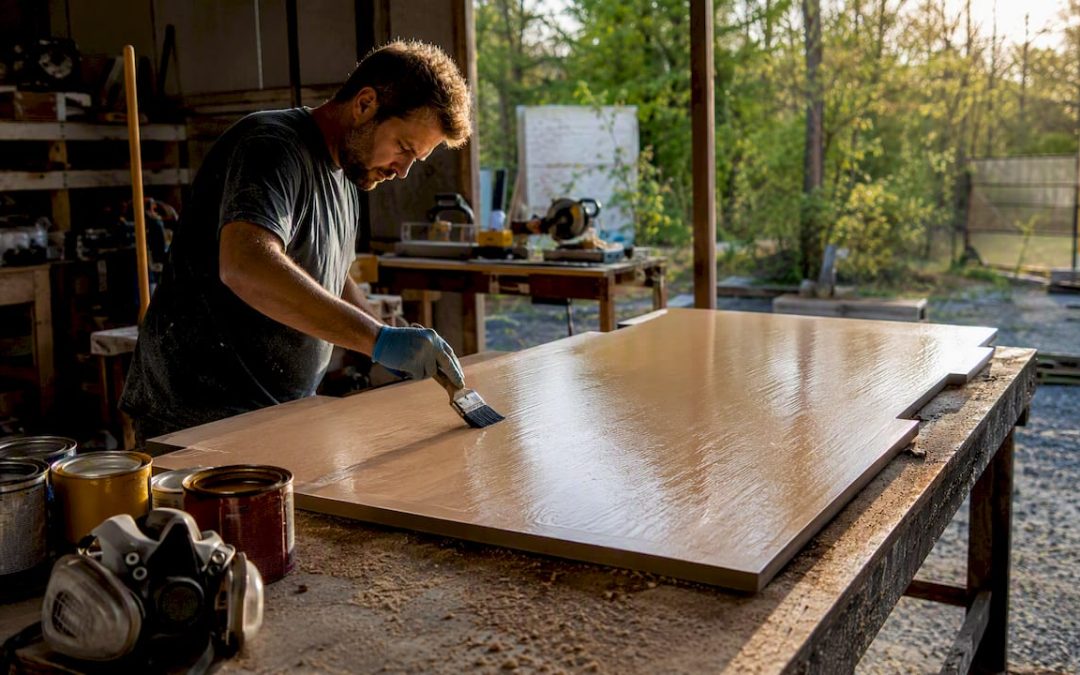
For a painted outdoor sign, MDO plywood (Medium Density Overlay) is the best choice. Its resin-impregnated kraft overlay delivers a smooth, non-porous face that holds primer and paint far better than raw exterior plywood, and its exterior-grade adhesive keeps the panel dimensionally stable through freeze-thaw cycles and coastal humidity. Professional signmakers have relied on APA-graded MDO for decades precisely because it reduces grain telegraphing and cuts finishing labor.
Two quick alternatives worth knowing: marine plywood (such as Okoume) is worth the premium when the sign faces direct water exposure or needs a void-free core for structural reasons, but it demands disciplined edge sealing. ACX or CDX plywood works for short-term or budget signs, though expect more prep work and a shorter service life without a full epoxy edge treatment.
Before you buy, check these three things:
- Look for the APA stamp and the “MDO” designation on the panel edge; without it, you cannot confirm the overlay grade.
- Choose one-sided MDO (overlay on one face) for wall-mounted signs, or two-sided MDO for freestanding double-face signs.
- For most signs, 3/4" thickness handles spans over 3 feet without flex; 1/2" is fine for smaller signs up to roughly 2×3 feet.
Key Takeaways
MDO plywood with a full edge-seal and primer-paint-UV-topcoat system is the most reliable substrate for a painted outdoor sign, delivering 5–10 years of service with annual maintenance.
| Point | Details |
|---|---|
| MDO is the top choice | APA-graded MDO’s resin overlay gives the best paint adhesion and dimensional stability for painted outdoor signs. |
| Edge sealing is critical | Seal all edges with penetrating epoxy before priming; edges fail first and drive delamination. |
| Finish system matters | Apply exterior primer, 2–3 thin paint coats, and 2 UV-resistant topcoat coats for a 5–10 year service life. |
| Thickness and mounting | Use 3/4" for spans over 3 feet; mount with stainless fasteners and a 1/4"–1/2" air gap behind the panel. |
| Customsignstoday option | For permanent or low-maintenance exterior signs, Customsignstoday fabricates with ACP, HDU, and sealed MDO systems. |
Table of Contents
- Which plywood works best for outdoor signs?
- Why MDO is the signmaker’s go-to (and when marine plywood wins)
- How to finish a plywood sign for maximum outdoor life
- Thickness, mounting, and fastener rules that prevent warping
- When plywood isn’t the right substrate
- How long will a painted plywood sign last?
- The mistakes that kill plywood signs early
- When a professional sign is the smarter call
- Sources
Which plywood works best for outdoor signs?
| Material | Best For | Durability / Lifespan | Paint Adhesion | Relative Cost | Recommended Thickness | Edge Sealing |
|---|---|---|---|---|---|---|
| MDO | Painted exterior signs | 5–10 years with maintenance | Excellent | Moderate | 1/2" or 3/4" | Moderate; epoxy seal recommended |
| HDO | Concrete formwork | 10+ years (formwork) | Poor for standard paints | Moderate-high | 3/4" | Low effort, but paint won’t bond well |
| Marine (Okoume) | Premium/wet-exposure signs | 10 years with epoxy system | Very good after epoxy | High | 1/2" or 3/4" | High; multi-coat epoxy required |
| ACX | Budget/short-term signs | 3–7 years | Fair; needs more prep | Low | 1/2" or 3/4" | Moderate; voids need filling |
| CDX | Temporary/structural backing | 2–5 years | Poor; rough face | Very low | 3/4" | Difficult; rough grain |
| Pressure-treated | Ground-contact posts/frames | 10 years (structural) | Fair; must dry fully before paint | Low-moderate | 3/4"+ | Moderate; chemicals can bleed |
A few notes that don’t fit neatly into a table:
- MDO: Specialty sign-supply yards stock APA-trademarked MDO specifically for painted exterior applications. The kraft overlay is the difference between a sign that looks sharp at year three and one that shows grain cracks by year one.
- HDO: The hard phenolic film face that makes HDO so durable for concrete forms is exactly what makes it reject standard sign paints. Skip it for painted signs unless you are using specialty adhesion primers designed for phenolic surfaces.
- Marine plywood: Void-minimized cores and WBP (water-boil-proof) adhesives give marine-grade panels structural integrity, but the APA’s guidance is clear: marine-grade still needs surface and edge sealing for long-term exterior use. It is not a set-and-forget material.
- ACX/CDX: Usable on a budget, but the face veneers are rougher and core voids are common. Fill voids with exterior wood filler, sand well, and plan on more primer coats.
- Pressure-treated: Good for sign posts and ground-contact frames, not sign faces. The preservative chemicals can bleed through paint and the wood needs weeks to dry before finishing.
Why MDO is the signmaker’s go-to (and when marine plywood wins)
MDO’s defining feature is its resin-impregnated fiber overlay, bonded to an exterior-grade plywood core under heat and pressure. That overlay does two things raw plywood cannot: it fills the surface grain so it doesn’t telegraph through paint, and it creates a slightly absorbent but uniform surface that grips primer without excessive sanding or filling. Sign shops that paint hundreds of panels a year choose MDO because it cuts prep time and produces a cleaner finished face.
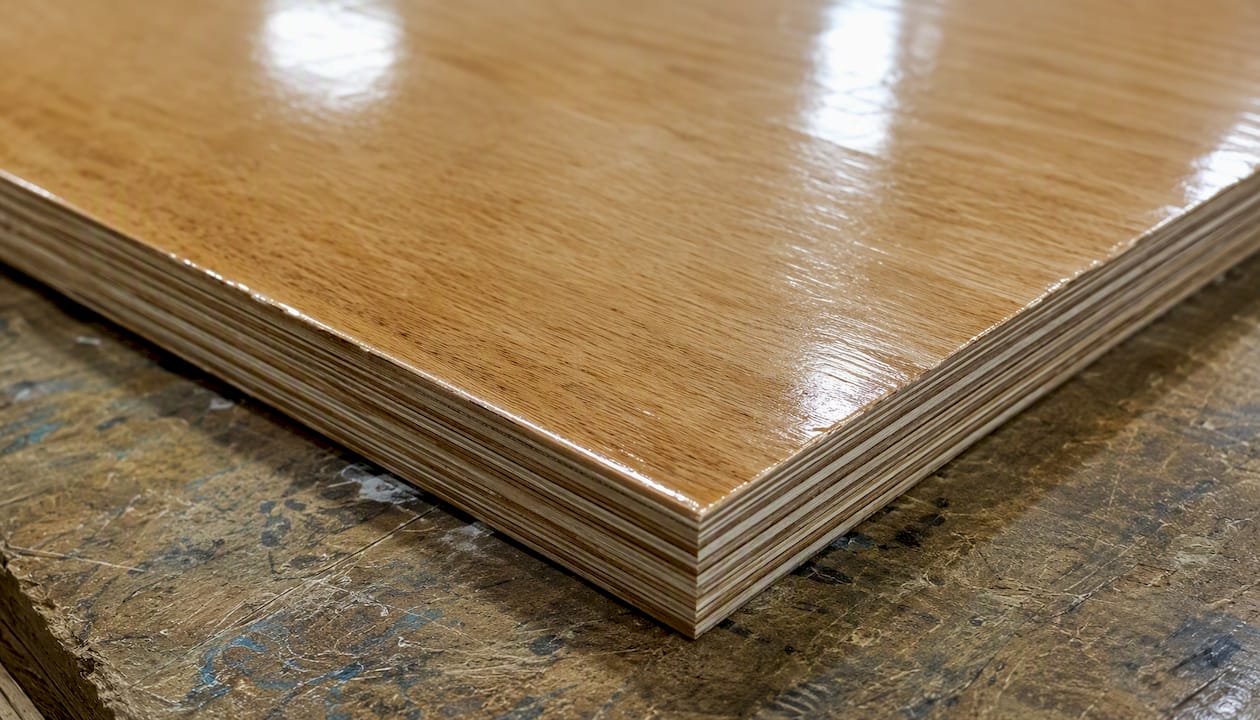
HDO is often confused with MDO, but the two serve opposite purposes. HDO’s phenolic film is harder and glossier, engineered to release from concrete. Standard exterior primers and paints bead off it. If a supplier hands you HDO when you asked for MDO, the panel edge stamp will tell you immediately.
When marine plywood is the better call:
- The sign will face direct water exposure (a marina, a dock, a waterfront property).
- You need a void-free core for routed or dimensional lettering.
- Weight matters and you want a lightweight Okoume panel with a premium aesthetic.
- The installation is hard to access for maintenance, so you want the best possible substrate from the start.
For Okoume marine plywood specifically, the proven finishing sequence is penetrating epoxy or CPES first, followed by 3–5 coats of UV-resistant topcoat. Properly executed, that system can deliver multi-year outdoor service even in coastal environments. The trade-off is the cost and finishing time.
Pro Tip: Always buy APA- or mill-stamped panels. The stamp on the panel edge confirms the overlay type, the veneer grade, and the adhesive specification. A panel without a stamp is an unknown quantity, regardless of what the bin label says.
How to finish a plywood sign for maximum outdoor life
A good substrate fails fast with a poor finish system. Follow this sequence and you will get the most out of whichever panel you choose.
- Inspect and prep the panel. Check for voids, delamination, or surface defects. Fill any voids with exterior-grade wood filler and let it cure fully. For MDO, a light scuff with 120-grit is all the surface prep the face needs.
- Round or chamfer all edges. A router with a 1/8" roundover bit or a sanding block removes the sharp 90-degree edge that paint bridges poorly. Flat edges crack and peel first.
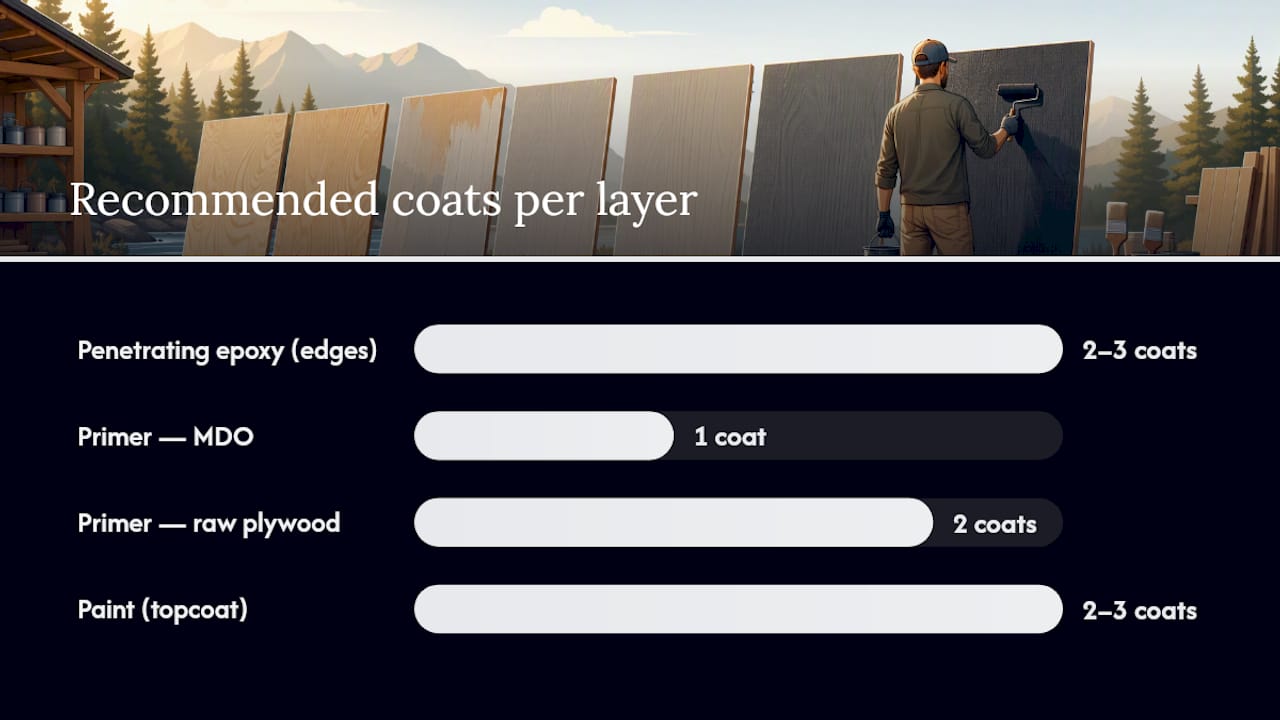
- Seal all edges and end grain with penetrating epoxy or CPES. Edges absorb moisture far faster than faces, and that moisture is what starts delamination. Apply two to three coats of penetrating marine epoxy, letting each coat absorb before the next. This single step has more impact on sign longevity than any other.
- Apply exterior primer. Use an alkyd or acrylic exterior primer compatible with your topcoat. One coat on MDO is usually enough; raw plywood may need two. Let it cure per the manufacturer’s spec before sanding lightly with 220-grit.
- Apply 2–3 thin coats of exterior paint. Acrylic latex or marine enamel both work well. Thin coats bond better and flex more than thick ones. The recommended workflow is scuff sand between coats with 220-grit and allow full cure between applications.
- Apply 2 coats of UV-resistant clear topcoat. Exterior polyurethane or spar varnish protects the paint layer from UV degradation. For marine environments or signs in full sun, a marine epoxy base with a UV-stable topcoat is worth the extra cost.
- Allow full cure before mounting. Most exterior paints reach handling strength in 24 hours but need 7–14 days for full hardness. Mounting too early risks denting and adhesion failure at fastener points.
Materials checklist:
- Penetrating marine epoxy or CPES (for edges and end grain)
- Exterior acrylic or alkyd primer
- Exterior acrylic latex or marine enamel (sign paint)
- UV-stable clear topcoat (exterior polyurethane or spar varnish)
- 120-grit and 220-grit sandpaper
- Stainless or hot-dipped galvanized fasteners
Pro Tip: Thin coats always outperform thick ones. A thick coat traps solvent, skins over before it cures through, and cracks under UV stress. Two thin coats take the same time and last twice as long. Follow the manufacturer’s recoat window exactly.
Thickness, mounting, and fastener rules that prevent warping
Panel thickness is not just a structural question. Thin panels flex in wind, and flex cracks paint. The rule of thumb: 1/2" for signs up to 2×3 feet, 3/4" for anything larger or any sign spanning more than 3 feet between supports. For very large signs (4×8 and up), 3/4" MDO with a frame or cross-battens on the back is the standard approach.
Backing and stiffening:
- Attach 1×3 or 1×4 pine or cedar battens across the back, spaced every 16–24 inches, to reduce flex on large panels.
- For freestanding signs, a welded steel or aluminum frame is more reliable than wood battens alone.
- Two-sided signs need a center spacer or frame to keep the faces parallel and prevent cupping.
Fastener and mounting checklist:
- Use stainless steel or hot-dipped galvanized screws only. Standard zinc-plated screws rust within a season and stain the sign face.
- Pre-drill and countersink every hole. Forcing screws splits the overlay and creates a moisture entry point.
- Fill countersunk holes with exterior wood filler or a dab of sealant before painting.
- Use 1/4"–1/2" rubber spacers or standoffs between the sign back and the mounting surface. A sign mounted flush against a wall traps moisture and rots from behind. The outdoor signage installation guide covers spacer placement in detail.
- Seal fastener heads with a dab of exterior sealant or matching paint after installation.
- Never mount a sign so the bottom edge sits in standing water or contacts soil directly.
When plywood isn’t the right substrate
Plywood is not always the answer. For some projects, the maintenance demands or performance requirements push you toward a different material entirely. Here is a quick breakdown of the main alternatives and when they make sense.
Cellular PVC board (such as Azek or Versatex) is paintable, lightweight, and does not absorb moisture. It will not rot, warp, or delaminate. The trade-off is cost and the fact that it does not route as cleanly as HDU for dimensional work. For flat painted signs that need to last with minimal upkeep, it is a strong competitor to MDO.
HDU (High-Density Urethane) is the professional’s choice for routed dimensional signs. It machines cleanly, holds crisp edges, and takes paint well. It is more expensive than plywood and not a structural panel, but for carved or dimensional lettering it has no equal among common sign substrates. You can explore the full range of sign materials to see how HDU fits different project types.
Aluminum composite panel (ACP) is two thin aluminum skins bonded to a polyethylene core. It is flat, rigid, lightweight, and essentially maintenance-free. Paint and vinyl graphics both adhere well. The upfront cost is higher than plywood, but for long-run or hard-to-access installations, ACP’s near-zero maintenance often justifies the price difference over a 10-year horizon.
Cedar or rot-resistant lumber suits rustic or natural-aesthetic signs. Cedar resists rot better than most species, but it still needs sealing, still checks and cracks over time, and still requires periodic refinishing. For a painted sign, MDO will outlast cedar with less effort.
Pro Tip: If the sign is in a hard-to-reach location or you cannot commit to annual inspections, skip plywood entirely. ACP or cellular PVC will forgive neglect in a way that MDO cannot.
How long will a painted plywood sign last?
Lifespan depends heavily on finish quality, exposure, and maintenance frequency. The table below gives realistic ranges; treat them as planning benchmarks, not guarantees.
| Material + Finish System | Expected Lifespan | Maintenance Frequency |
|---|---|---|
| MDO + primer + exterior paint + UV topcoat | 5–10 years | Inspect annually; touch up every 1–3 years |
| Marine plywood (Okoume) + epoxy + UV topcoat | 10 years | Inspect annually; recoat every 3–5 years |
| Phenolic film-faced plywood | long-lasting | Low; inspect regularly |
| ACX/CDX + primer + exterior paint | few years | Inspect regularly; touch up as needed |
Properly finished MDO commonly delivers 5–10 years of outdoor service with a standard primer-paint-topcoat system and annual inspections. Marine plywood with a full epoxy and UV-topcoat system can push well beyond that, particularly in sheltered installations.
Maintenance schedule:
- Annually: Visual check for paint peeling, soft spots, or edge cracking. Probe edges and screw holes with a fingernail; soft material means moisture has entered.
- Every 1–3 years: Touch up paint and topcoat on any worn areas. Re-seal edges if cracking appears.
- At first sign of delamination: Address it immediately. Delamination at a seam or screw hole spreads fast once moisture gets inside the core.
For a detailed outdoor sign maintenance schedule, including what to look for at each inspection, the Customsignstoday maintenance guide covers the full checklist.
No wood sign is truly set-and-forget. The ones that last 10+ years get there because someone checked them every year and caught edge failures before they spread.
The mistakes that kill plywood signs early
The single most common failure pattern is sealing the faces and ignoring the edges. A sign can have three coats of premium exterior paint on both faces and still delaminate within two years if the edges were left bare. End grain and cut edges absorb moisture at a rate several times higher than the face, and once water gets into the core, the glue lines fail from the inside out. No amount of face paint fixes that.
Three things professional signmakers do that most DIYers skip:
- Seal edges before priming, not after. Penetrating epoxy on raw edges, two to three coats, before any primer touches the panel. This is the step that separates a 3-year sign from a 10-year sign.
- Create an air gap at mounting. Rubber spacers or standoffs keep the back of the sign from sitting against a wall and trapping condensation. A 1/4" gap makes a measurable difference in how long the back face stays dry.
- Test your finish system on a scrap panel first. Different primer and topcoat combinations have compatibility issues. Running a test on a scrap piece of MDO before committing to a full sign costs nothing and catches adhesion failures before they happen on the real panel.
When buying panels, ask the supplier whether the MDO is kraft-overlay paint-grade and look for the APA stamp on the edge. A panel without that stamp may be a different overlay type entirely, and you won’t know until the paint starts peeling.
When a professional sign is the smarter call
DIY plywood signs make sense for short runs, budget projects, and situations where you can commit to annual maintenance. But for permanent exterior installations, complex multi-panel systems, or signs in high-traffic commercial locations, the math often favors professional fabrication.

Customsignstoday builds exterior signs using materials selected for the specific exposure and lifespan requirement of each project, including ACP, HDU, and properly finished MDO, with edge and seal systems applied before the sign leaves the shop. There is no guesswork about whether the primer is compatible with the topcoat, and no risk of a missed edge coat showing up as delamination two winters later. For businesses that need a sign to perform for years without a maintenance ladder and a paint brush, that reliability has a real dollar value. Browse the custom sign services or check the exterior sign options to see what fits your project, then request a quote to get a specific recommendation and price.
Sources
- Apawood
- What Is MDO Plywood? Properties, Uses & Grades | Vinawood
- Finish Okoume Plywood for Outdoor Signs
- How To Protect Plywood Outdoors: Complete Guide 2026
- Diy Outdoor Sign Painting: Plywood Techniques For Durable, Vibrant Results | CyPaint