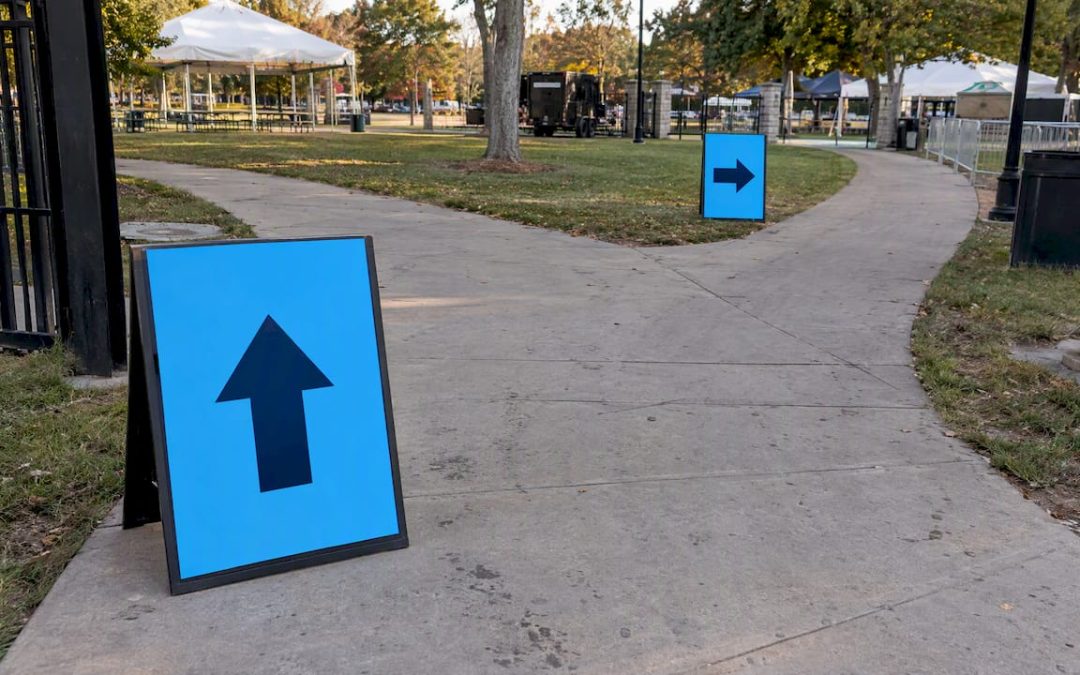
Good directional event signage does one job: it gets people to the right place without anyone having to stop and ask. You get there by mapping every decision point on your site, choosing sign types that fit each point, writing the shortest possible message in large high-contrast type, and checking wind, accessibility and fire-safety rules before anything goes to print. This guide walks through that process in order, so you can brief a sign shop with confidence.
TL;DR
- Walk the attendee route first and put a sign at every decision point: parking, entrance, forks, restrooms, exits.
- Keep messages to a short headline, an arrow and an icon. Crowded signs cause people to stop and read, which bottlenecks the flow.
- Size letters by distance: at least 1 inch of letter height for every 10 feet of viewing distance.
- Outdoors, plan for wind (mesh banners, proper ballast) and confirm accessibility and fire-code requirements with your local authority well ahead of the event.
- Order early, with the venue map, quantities and install locations in hand, so design, production and delivery fit your timeline.
Table of Contents
- What directional event signage actually has to do
- Start with a route walk, not a design
- Choose the right sign type for each location
- Write less: message and type rules that move crowds
- Wind, weather and the outdoor reality
- Accessibility and fire-safety checks before you print
- Our perspective: what we see go wrong
- How to brief and order your event signs
- Get your event signage made by us
- FAQ
- Sources
What directional event signage actually has to do
At an event, attendees are in an unfamiliar place, often in a hurry and usually in a crowd. Directional signs replace the staff member you cannot afford to station at every corner. They answer three questions in order: where am I, where do I need to go, and which way.
That is different from branding signage. A sponsor banner can be admired. A directional sign is read in two seconds while someone is walking, so it has to be judged by a different standard: does it move people, or does it make them pause?
The signs involved usually fall into a few families:
- Arrival and parking signs that guide vehicles and drop-offs.
- Entrance and registration signs that tell people which line or door is theirs.
- Wayfinding signs at corridors, forks and stairs.
- Zone and room identifiers for stages, vendor areas, workshops or food.
- Safety and accessibility signs for exits, accessible routes and restrooms.
If you want a deeper look at the categories, our guide to types of directional signage for businesses covers each one, and why directional signs matter for event success explains the attendee experience side.
Start with a route walk, not a design
The most common mistake is ordering signs by the number of rooms or tents. Order them by decisions instead.
Map the decision points
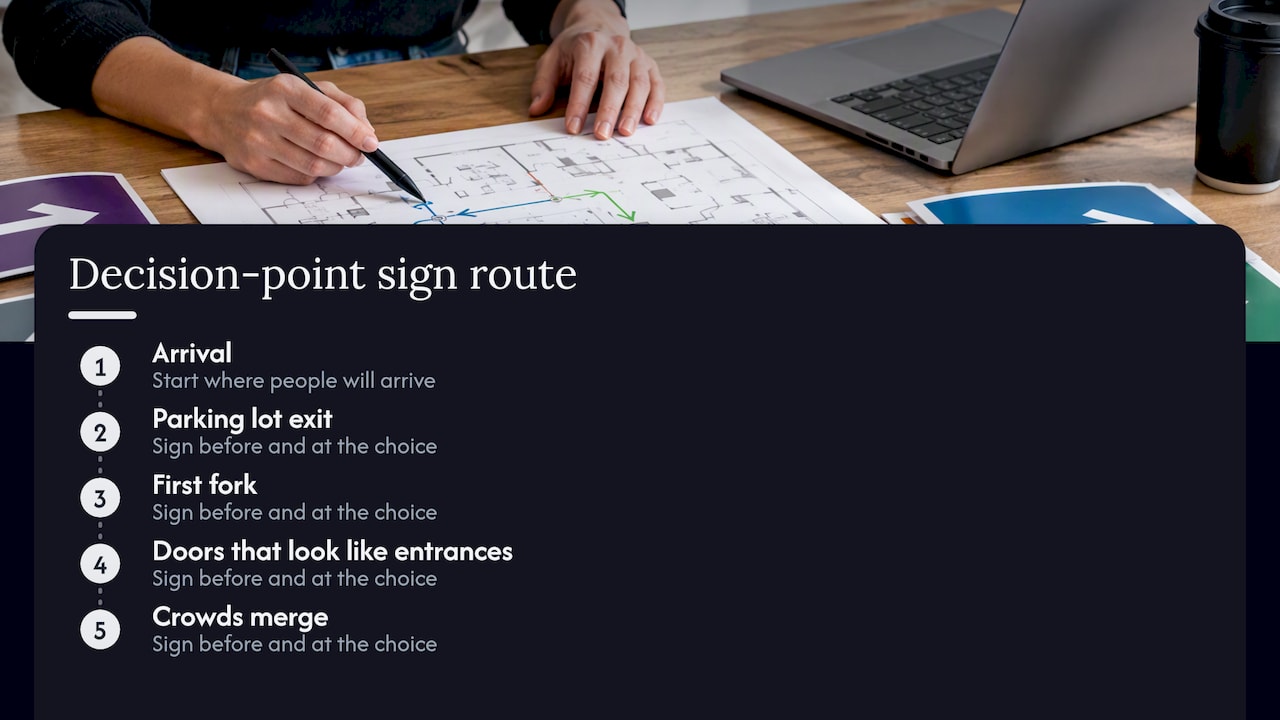
Get the site plan and walk it as a first-time guest, from the point where people will arrive. Mark every place where someone could reasonably choose wrong: the parking lot exit, the first fork, the doors that look like entrances but are not, the spot where two crowds merge. Each mark needs a sign, and usually it needs one before the point (to prepare the choice) and one at it (to confirm it).
Walk it twice
Walk once in daylight and once at the hour the event will end, if that is after dark. A sign that works at noon can vanish in low light. If you cannot visit in person, ask the venue for photos from eye level at each decision point, not just the floor plan.
Count and list
Build a simple sign schedule: location, sign type, message, direction of arrow, mounting method, indoor or outdoor, and who installs it. This single sheet is what you hand to your sign provider, and it is the difference between a quote that is accurate and one that changes three times.
Choose the right sign type for each location
| Location | Common sign type | Why it works |
|---|---|---|
| Parking lots and driveways | Large A-frame and directional signs or post-mounted panels | Visible from a moving car, quick to reposition |
| Open outdoor fields | Feather banners and mesh banners | Tall, visible over crowds, mesh lets wind pass |
| Registration and check-in | Retractable banners | Fast to set up, easy to move between events |
| Building interiors | Wall-mounted and hanging signs | Stay out of the walking path at head height |
| Floors and walls | Vinyl decals and wall graphics | Guide people along a route at ground or eye level |
| Shuttle and staff vehicles | Magnets and vehicle lettering | Identify the transport people are looking for |
Your own materials will depend on how long the signs stay up. A one-day festival can use lighter substrates. A conference that runs for a week or a recurring annual event usually justifies sturdier signs you can reuse.
For the options we produce, see our pages on banners, exterior signs, interior signs and vinyl graphics and decals. If you are comparing formats for an outdoor layout, our outdoor event signage comparison and outdoor event signage ideas give more examples.
Write less: message and type rules that move crowds
Signage specialists who plan queues and event spaces put it plainly: less is more. According to a planning guide on signage in queues, overloading signs with information makes visitors stop to read, which creates bottlenecks, while short headlines and icons trigger immediate movement.
Practical rules that follow from that:
- One message per sign. “Registration” with an arrow beats “Registration, badge pickup, and press check-in, please have ID ready.”
- Arrow first. The arrow is the instruction. Put it where the eye lands first, and make it as large as the words.
- Use icons for universal functions. Restrooms, food, first aid, parking and exits are understood faster as symbols.
- Choose high-contrast, sans-serif type. Decorative fonts slow reading. The same guide recommends clean, high-contrast lettering that stays readable in busy or low-light settings.
- Be consistent. Use the same color for the same function everywhere. If green means “workshops” on the first sign, it must mean that on the last.
Size the letters by distance
A widely used rule of thumb, again from the same signage planning guide, is at least 1 inch of letter height for every 10 feet of viewing distance. A sign meant to be read from 50 feet needs letters of at least 5 inches. If people will be moving, or the sign sits behind a crowd, go larger. When in doubt, cut words rather than shrink letters.
Wind, weather and the outdoor reality
Outdoor events are where good plans fail, and wind is the usual reason. The ANSI standard for event weather and wind planning is cited by safety bodies for the point that organizers should not rely only on consumer weather apps, and should monitor conditions for their specific site. Wind is described there as a leading cause of structural failure for temporary event signs and marquees.
What that means when you order:
- Use mesh for large banners in exposed spots. A special-event guide from a US event district notes that permeable materials help prevent the sail effect that topples structures.
- Expect engineering review for overhead signage. The same guide says large or high-risk overhead signage and truss installations typically need a structural engineer’s certification, and that you should confirm whether your jurisdiction requires plans about 3 weeks before move-in.
- Ballast and anchoring are part of the sign. Specify bases, sandbags or stakes (where the surface permits) when you brief the order.
- Plan a wind trigger. Decide in advance at what conditions feather flags and banners come down, and who makes the call.
For materials and finishes that last outdoors, see our notes on weatherproofing outdoor signs and our outdoor signage installation guide.
Accessibility and fire-safety checks before you print
Temporary does not mean exempt. These rules vary by city and county, so treat the points below as the reasons to call your local authority, not as a replacement for them.
Accessible routes
An event permit administrative instruction from the City of Santa Monica states that if part of an event site is inaccessible, an alternative route or area must be provided, with clear signage at inaccessible entry points and decision points directing people to the nearest accessible feature. It also notes that accessible routes are generally at least 36 inches wide. Federal guidance for local governments says the same in plainer terms: when a facility is not fully accessible, signs should direct the public to accessible features.
In practice: include the accessible route on your sign schedule from day one, use the international symbol of accessibility with arrows, and keep signs from narrowing the path. Permanent room identification signs have tactile and Braille requirements, so if your event uses a permanent venue, ask the venue what is already in place. If your event needs compliant permanent signs, our ADA signs page is the place to start.
Exits and tents
Guidance from Mason County’s special events policy says that assembly tents with more than one required exit, occupied after daylight, need illuminated exit signs and emergency lights. It also notes that fire officials may need to review floor plans roughly 3 weeks before an event. Exit paths and hydrants must stay unobstructed, which means your directional signs and banners cannot block them.
A good habit: share your sign schedule with the fire marshal when you submit your site plan, so any placement conflict is caught on paper rather than on the day.
Charging stations and other special features
If your venue includes electric vehicle charging or other utility zones, those areas need their own clear signing. Resources on EV charging signage planning can help facility teams think through how pedestals and their markings fit into a site.
Our perspective: what we see go wrong
Most of the event sign problems we are asked to fix were decided before any artwork existed. The organizer ordered “twelve directional signs” because that sounded like enough, then discovered on site that three decision points had nothing and two signs faced the wrong way.
Our advice is to treat signage as part of the event layout, not an add-on. Bring us the site plan, the attendee route and the dates. We handle consultation, design and fabrication around your brand and the environment, including compliance questions and installation guidance, and we serve local and nationwide clients. We would rather spend an hour on the route up front than rush a reprint the week of your event.
Two habits pay off every time. First, build a reusable set: the same sign family in the same colors, so next year you reorder only what wore out. Second, keep the message short enough that a person walking at normal pace can take it in without slowing. If a sign needs explaining, it needs rewriting.
— Yossi
How to brief and order your event signs
Here is the sequence that keeps timelines calm.
- Fix the site plan and dates. Get the venue layout, load-in time and teardown time.
- Walk the route and build the sign schedule described above.
- Check permits and codes. Ask your local fire marshal and permitting office what applies, and allow for the roughly 3-week review windows some jurisdictions use.
- Send the schedule for a quote. Include sizes, quantities, indoor or outdoor, mounting method and your brand files.
- Approve proofs carefully. Check spelling, arrow direction and contrast at the real viewing distance.
- Plan install and removal. Decide who places each sign, in what order, and who collects them afterward.
- Keep spares. A few blank-ready or common signs (parking, restrooms, exit) save the day when something blows away or goes missing.
If your directional signs also serve customers at a permanent location, our guide on creating directional signs for customer guidance and these wayfinding sign examples show how to carry the same system beyond the event.
Get your event signage made by us
We produce the full set an event needs: directional and A-frame signs, exterior and interior signs, feather, retractable and mesh banners, vinyl graphics and decals, and vehicle lettering for shuttles and staff cars. Send us your site plan and sign list through our custom signs page and request a free quote. Because we customize size, materials and design, the set can match your brand and your venue instead of a generic template.
FAQ
How many directional signs does an event need?
There is no fixed number. Count decision points on the attendee route, then add one approach sign before each and a confirming sign at each. Large or multi-building venues need far more than a single-room event, so base the quantity on your route walk.
What size should event directional signs be?
Start from viewing distance. A common guideline is at least 1 inch of letter height per 10 feet of distance, so a sign read from 30 feet needs letters of at least 3 inches. Go larger for moving crowds, vehicles or low light.
Are temporary event signs required to meet ADA rules?
Temporary events are not automatically exempt. Local event permit guidance, such as Santa Monica’s, calls for clear signage that directs people to accessible routes when part of a site is inaccessible. Confirm specifics with your city’s permitting office or the venue before you finalize the sign schedule.
Which materials hold up best outdoors in wind?
Mesh banners let wind pass through and reduce the sail effect that can topple structures, so they suit exposed locations. Pair them with proper anchoring and a plan for taking signs down in high wind. Overhead or truss-mounted signage may also need an engineer’s sign-off in your jurisdiction.
How early should I order event signage?
Order as soon as the site plan and dates are fixed, and well before any permit or fire review deadlines, which can be about 3 weeks in some jurisdictions. That leaves room for proofs, production, delivery and a second look at placement.
Sources
- Signage in queues planning guide
- ANSI ES1.7-2021 event weather standard
- Special Event and Convention Planning Guide
- Santa Monica event permit administrative instruction
- ADA Guide for Small Towns
- Mason County special events policy
- EV charging signage resource