
{
“@type”: “Article”,
“image”: {
“url”: “https://csuxjmfbwmkxiegfpljm.supabase.co/storage/v1/object/public/blog-images/organization-6408/1777629230285_Business-owner-planning-signage-strategy-in-office.jpeg”,
“@type”: “ImageObject”,
“caption”: “Business owner planning signage strategy in office”
},
“author”: {
“url”: “https://customsignstoday.us”,
“name”: “Customsignstoday”,
“@type”: “Organization”
},
“@context”: “https://schema.org”,
“headline”: “Build business success with a smart signage strategy”,
“publisher”: {
“url”: “https://customsignstoday.us”,
“name”: “Customsignstoday”,
“@type”: “Organization”
},
“inLanguage”: “en-US”,
“articleBody”: “Discover what a business signage strategy is and how it can boost your revenue. Unlock success through smarter signage today!”,
“description”: “Discover what a business signage strategy is and how it can boost your revenue. Unlock success through smarter signage today!”,
“datePublished”: “2026-05-01T10:01:36.154Z”
}
TL;DR:
- Signage should be part of a deliberate, cohesive strategy to boost visibility and sales.
- Digital signage attracts significantly more views than static signs, enhancing customer engagement.
- Regular planning, design, placement, maintenance, and measurement are crucial for effective signage success.
Your signs are working harder than you think — or not working nearly hard enough. Most business owners treat signage as an afterthought, a box to check before the grand opening, never revisiting it again. That’s a costly mistake. Research shows that digital signage attracts 400% more views than static signs, which means the difference between a good sign and a great one isn’t just aesthetic — it’s revenue. A thoughtful business signage strategy ties your visual presence directly to customer behavior, brand recognition, and sales growth.
Table of Contents
- What is a business signage strategy?
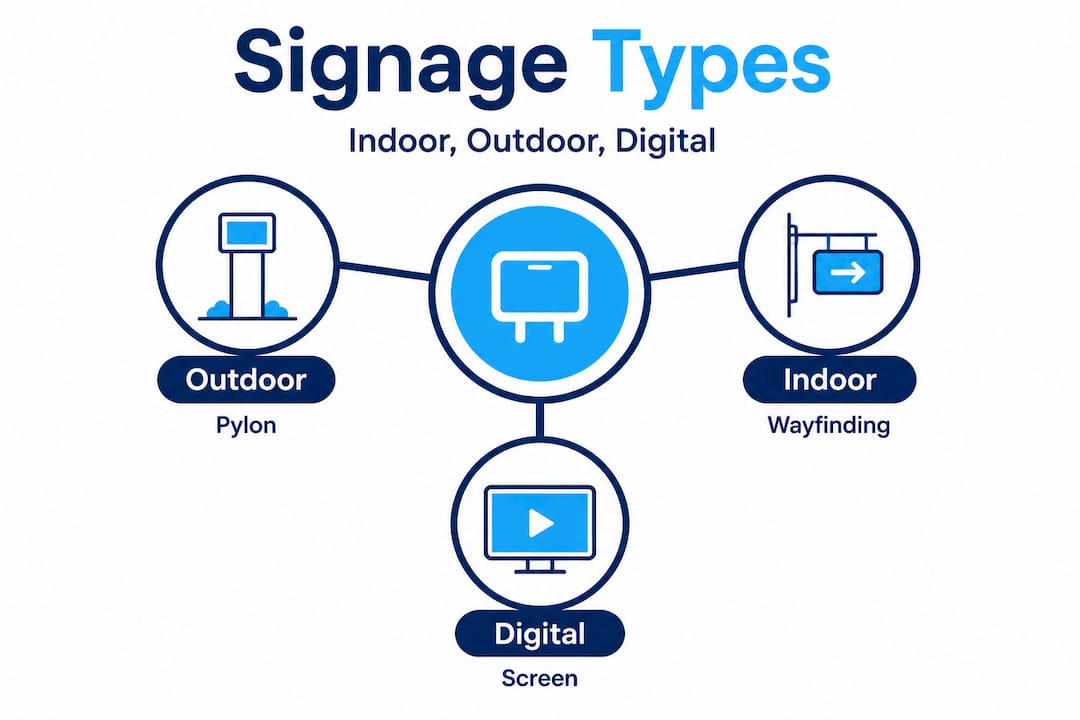
- Types of business signage: Indoor, outdoor, and digital
- Crafting a winning signage plan: Key steps and best practices
- Measuring success: How to evaluate your signage strategy
- Why most businesses underestimate signage strategy
- Connect your signage strategy to real results
- Frequently asked questions
Key Takeaways
| Point | Details |
|---|---|
| Strategy drives results | A well-planned signage strategy directly boosts visibility and sales. |
| Signage types matter | Choosing between indoor, outdoor, and digital can maximize impact for your business. |
| Step-by-step planning | Following a clear process ensures your signs align with brand and customer needs. |
| Continuous measurement | Regularly tracking signage effectiveness helps refine your strategy for ongoing success. |
What is a business signage strategy?
Having set the stage, let’s clarify what a business signage strategy actually entails. Many business owners confuse “having signs” with “having a signage strategy.” They’re not the same thing.
A business signage strategy is the deliberate, coordinated approach you take to plan, design, place, and maintain signs in a way that aligns with your branding goals, improves visibility, guides customers, and drives sales. The word “deliberate” carries all the weight here. Without intent, signs become visual clutter. With strategy, they become a 24/7 sales force working for your business.
Think of it this way: your signage is often the first impression a potential customer gets of your business. Before they speak to an employee, read your website, or see an ad, they see your sign. That first impression needs to communicate trust, clarity, and brand identity all at once.
Here are the core components every effective signage strategy should cover:
- Planning: Identifying where signs are needed, what purpose each sign serves, and which customer journey stages they support
- Design: Choosing colors, fonts, materials, and messaging that match your brand identity and speak to your target audience
- Placement: Positioning signs where they get maximum exposure and deliver the right message at the right moment
- Maintenance: Keeping signs clean, updated, and structurally sound so they always reflect your brand positively
“A sign that’s faded, broken, or out of date sends a louder message than no sign at all — it tells customers your business doesn’t pay attention to details.”
Branding with custom signage goes far deeper than slapping a logo on a board. It’s about creating a visual ecosystem that guides customers from the street to the checkout, reinforcing who you are at every step.
Types of business signage: Indoor, outdoor, and digital
Now that we know what signage strategy means, let’s explore the main types of signage available. Each category serves a distinct purpose, and a strong strategy uses all three in a coordinated way.
The primary signage types break down into outdoor, indoor, and digital, each with specific subtypes and use cases that serve different stages of the customer experience.
| Signage Type | Examples | Primary Purpose |
|---|---|---|
| Outdoor | Pylon signs, monument signs, channel letters, banners | Attract attention, build awareness, drive foot traffic |
| Indoor | Wayfinding signs, wall graphics, promotional displays | Guide customers, reinforce branding, encourage purchases |
| Digital | LED displays, digital menu boards, interactive kiosks | Engage attention, deliver dynamic content, increase views |
Outdoor signage is your first handshake with the public. A well-placed pylon sign can be seen from hundreds of feet away, pulling in passing traffic before a customer even knows they need your product. Monument signs convey permanence and credibility. Channel letters, the three-dimensional lettering you see on most storefronts, make your brand name highly legible from a distance. Smart outdoor signage for business is one of the highest-return investments a brick-and-mortar location can make.

Indoor signage takes over once a customer walks through the door. Wayfinding signs reduce frustration by helping people navigate your space quickly. Promotional displays highlight sales, new products, or services. Wall graphics and murals create an atmosphere that reinforces your brand story. Good effective office signage solutions can transform a plain workplace into an environment that impresses clients and energizes staff.
Digital signage is where the data gets genuinely surprising. According to Intel research, digital displays attract up to 400% more views than their static counterparts. This is not just about novelty. Dynamic content, meaning content that changes, moves, or responds to time of day or audience, holds attention in a way that a static poster cannot. Digital menu boards at restaurants have been shown to increase average order values because customers engage longer with the display.
Here’s a quick breakdown of what makes digital signage so effective:
- Movement naturally draws the human eye, even in busy environments
- Content can be updated instantly without printing or installation costs
- Scheduling allows different messages for morning versus evening audiences
- Analytics integration lets you track which messages perform best
The takeaway is that no single type of signage does the whole job. Outdoor signs bring people in, indoor signs guide and persuade, and digital signs capture and hold attention in ways that static media simply cannot match.
Crafting a winning signage plan: Key steps and best practices
Having seen the different signage types, let’s move to the actionable steps for creating a strategy that actually moves the needle for your business.
A strong signage strategy doesn’t happen by accident. It follows a clear process, and skipping steps is where most businesses lose money and opportunity.
-
Audit your current signage. Walk your property inside and out with fresh eyes. Better yet, have someone unfamiliar with your business do it. Note every sign, its condition, its purpose, and whether it’s achieving that purpose. This baseline tells you exactly what you’re working with.
-
Define your signage goals. Are you trying to increase foot traffic from the street? Improve customer navigation inside your store? Promote a specific product line? Your goals shape every decision that follows, from sign type to placement to messaging.
-
Map your customer journey. Think about every touchpoint a customer has with your business, from spotting you from a highway to finding the restroom. Each moment is a signage opportunity. Map it out so nothing falls through the cracks.
-
Develop a cohesive design system. Your signs should look like they belong to the same family. That means consistent use of your brand colors, fonts, logo, and tone of voice. Good signage design tips will tell you that simplicity wins every time. One clear message per sign, maximum contrast between text and background, and legibility from the expected viewing distance are non-negotiable.
-
Plan placement strategically. A great sign in the wrong location is a waste of money. Outdoor signs should be visible from the direction traffic flows. Indoor signs should appear at natural decision points, before turns, at the entrance to departments, and near the checkout. Think about sightlines and how customers actually move through your space.
-
Work with professionals for design and production. Amateur signage looks amateur. Poor font choices, wrong color contrasts, or low-resolution printing all undermine the credibility you’re trying to build. The impact of great sign design on customer perception is well documented, and it’s always worth investing in quality.
-
Follow a structured installation process. Placement height, angle, lighting, and mounting all affect how effective your sign is in the real world. The signage installation process matters just as much as the design itself. A sign installed at the wrong angle can catch glare and become completely unreadable.
-
Schedule regular maintenance checks. Signs endure weather, UV exposure, and physical wear. Build quarterly inspections into your operations calendar so small issues don’t become expensive problems.
Pro Tip: Before finalizing outdoor sign placement, take a photo from the driver’s perspective while approaching your location at normal traffic speed. If you can’t read the sign clearly in that photo, your customers can’t either.
Common pitfalls to avoid include using too much text (seven words or fewer is a reliable rule for outdoor signs), choosing trendy fonts over readable ones, ignoring local permit requirements, and failing to light signs for nighttime visibility. Each of these mistakes is more common than you’d expect, and each one costs you customers.
Measuring success: How to evaluate your signage strategy
Finally, a great signage plan needs continual measurement to ensure business goals are met. Too many businesses install signs and never ask whether they’re working.
A signage strategy enhances visibility and drives sales, but you need data to know by how much. Here are the most practical metrics for tracking signage effectiveness:
| Metric | What it measures | How to track it |
|---|---|---|
| Foot traffic volume | Number of people entering your location | Door counters, POS data, Google foot traffic insights |
| Customer conversion rate | Percentage of visitors who make a purchase | POS transaction data vs. foot traffic counts |
| Average transaction value | How much each customer spends per visit | POS reporting over time |
| New vs. returning customers | Whether signage attracts first-time visitors | Loyalty program data, customer surveys |
| Brand recall rate | Whether customers remember your business | Simple exit surveys or follow-up emails |
Signs that your signage strategy is working include steady increases in walk-in traffic without a corresponding spike in paid advertising, higher conversion rates at specific in-store displays, and positive customer comments about finding your location easily or noticing a particular sign.
Signs your strategy needs adjustment include low foot traffic despite high-visibility location, customers frequently asking for directions inside your store, or promotional signs that don’t correlate with any uptick in featured product sales.
Here’s how to build a simple improvement loop:
- Test one change at a time. Replace one sign or adjust one placement at a time, then measure the impact over 30 to 60 days before changing anything else.
- Gather direct customer feedback. Ask customers how they found you, what they noticed first, and whether they could navigate your space easily. The answers often reveal signage gaps you wouldn’t find in data alone.
- Refresh seasonal and promotional content regularly. Creative signage ideas for seasonal promotions keep your business looking active and relevant.
- Benchmark against competitors. Visit similar businesses and observe their signage objectively. What do they do better? What gaps do you see that you could fill? Understanding branding signs from a competitive lens often reveals overlooked opportunities.
The goal is not perfection on the first attempt. It’s a continual refinement process that gets smarter with every round of data you collect.
Why most businesses underestimate signage strategy
Here’s the uncomfortable truth that most marketing articles won’t say directly: businesses underestimate signage because it feels too simple. It doesn’t have the algorithmic complexity of paid digital advertising or the content machine demands of social media. So it gets underfunded, underthought, and undermanaged.
But that simplicity is precisely what makes signage so powerful. A well-placed sign works every single hour your business operates, without a recurring ad spend, without clicks, and without an algorithm deciding who sees it. It doesn’t go down when the internet does. It doesn’t get skipped like a YouTube ad. It just sits there, doing its job, communicating your brand to everyone who passes.
The businesses that genuinely win with signage don’t treat it as a one-time expense. They treat it as a living part of their marketing system. They update seasonal signage. They test new placements. They invest in materials that hold up over time rather than cheap options that look faded within a year.
We’ve also seen businesses pour thousands of dollars into digital advertising while their physical storefront sign is broken, faded, or missing entirely. Think about the contradiction there: you’re driving traffic online to a location that fails its first impression in person. The top signage design tips consistently point to the same principle: consistency and quality across every visual touchpoint, physical and digital, is what builds lasting brand trust.
The businesses that get this right don’t separate their physical signage from their marketing strategy. They integrate it. And that integration is where the real competitive advantage lives.
Connect your signage strategy to real results
Ready to move from planning to execution? At Custom Signs Today, we work with business owners and marketing managers who know what they want their brand to communicate and need a production partner who can deliver it at the right quality and scale.
Whether you need exterior lightbox signs that command attention after dark, guidance on building your signage approach through our signage event guide, or a full walkthrough of the production process with our custom signage step-by-step resource, we have the tools and expertise to bring your strategy to life. Get a free quote today and see what the right signage can do for your brand visibility and bottom line.
Frequently asked questions
How does a business signage strategy help with branding?
A strong signage strategy aligns visual elements with branding goals, reinforcing your identity at every customer touchpoint from the street to the checkout counter.
What makes digital signage more effective than static signs?
Digital signage attracts 400% more views than static displays, largely because movement and dynamic content capture attention in ways that printed signs cannot.
What should be included in a successful signage plan?
A successful plan covers design, placement, maintenance, and alignment with your branding objectives, along with a regular review cycle to keep everything current and effective.
How can I measure my signage strategy’s effectiveness?
Track metrics like foot traffic volume, conversion rates, and average transaction value before and after any signage change to understand its direct impact on visibility and sales.