
TL;DR:
- Well-designed signage attracts customers, builds trust, and can boost sales by up to 16 percent.
- Exterior signs generate first impressions and should be highly visible and legible from a distance.
- Interior signs guide customer flow, reinforce branding, and enhance the overall customer experience.
Signage is one of the most underrated business tools you have. A well-placed sign does not just mark your location — it pulls people in, builds trust, and sets the tone before a single word is spoken. 33-36% of consumers say sign quality influences whether they enter a business, and exterior upgrades alone can drive a 10-16% sales increase. Yet most business owners treat signage as an afterthought, lumping exterior and interior signs into one vague category. This guide breaks down exactly what each type does, how they differ, and how to use both strategically to grow your brand.
Table of Contents
- What is exterior signage? Definition, functions, and examples
- Understanding interior signage: Roles, styles, and impact
- Exterior vs. interior signage: Key differences and strategic uses
- Practical considerations: Choosing and optimizing signage for your business or event
- The hidden pitfalls of signage: What most business owners miss
- Bringing your signage strategy to life with professional solutions
- Frequently asked questions
Key Takeaways
| Point | Details |
|---|---|
| Exterior signage drives traffic | Well-designed exterior signs can significantly increase sales and attract new customers. |
| Interior signage shapes experience | Interior signs improve navigation, support branding, and influence purchase decisions inside your space. |
| Strategic mix is crucial | Combining exterior and interior signage ensures consistency and maximizes impact for your brand. |
| Quality and placement matter | Effective signage requires attention to materials, legibility, lighting, and minimizing visual clutter. |
What is exterior signage? Definition, functions, and examples
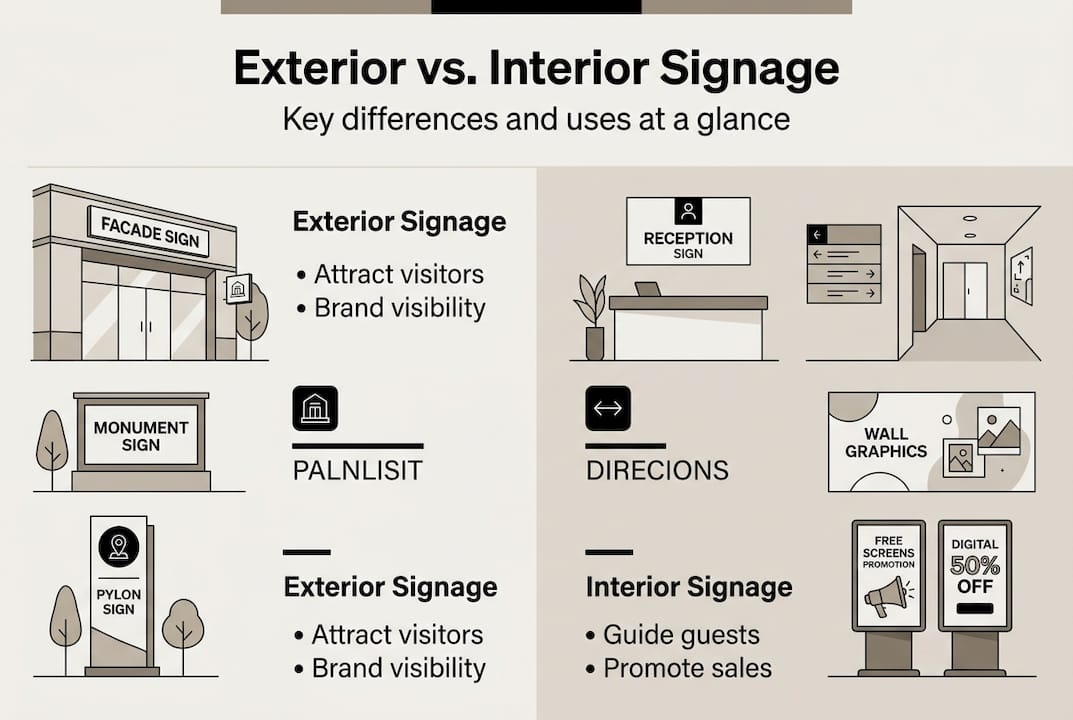
Exterior signage is any visual communication element placed on the outside of a building, property, or event space. Its job is simple but powerful: attract attention, communicate your brand identity, and create a strong first impression before a customer ever walks through your door.
Think of exterior signage as your business’s handshake with the world. It works around the clock, reaching foot traffic, passing drivers, and first-time visitors who may know nothing about you. When done right, it converts strangers into customers before any conversation happens.
Common types of exterior signage include:
- Storefront signs — channel letters, flat panels, or illuminated signs mounted above or beside an entrance
- Monument signs — freestanding ground-level signs, often used at property entrances or in commercial complexes
- Banners and flags — flexible, cost-effective options for promotions, grand openings, or events
- Lightbox signs — internally lit signs that stay visible day and night
- Window graphics and decals — applied directly to glass for branding or promotional messaging
- Directional and wayfinding signs — guide visitors to parking, entrances, or specific areas on large properties
For new businesses or locations with high foot and vehicle traffic, exterior signage is often prioritized first because it directly impacts whether potential customers stop or keep moving. The stakes are high. Exterior upgrades yield a 10-16% sales increase on average, making it one of the highest-return investments a business can make.
When planning your exterior signage, placement and legibility matter as much as design. A sign that looks great up close but cannot be read from the street is a missed opportunity. You can learn more about placement strategy in this outdoor signage installation guide, and explore material and format options in our exterior signs guide.
If you are just starting out or revisiting your approach, the exterior signage basics resource covers foundational decisions like size, mounting, and zoning considerations.
Pro Tip: Use the 30-foot-per-inch rule for outdoor legibility. For every inch of letter height, your sign should be readable from 30 feet away. A 4-inch letter is readable at 120 feet. Avoid visual clutter by limiting your sign to one primary message and no more than two font styles.
Understanding interior signage: Roles, styles, and impact
Interior signage refers to all visual communication elements placed inside a building or venue. While exterior signs bring people in, interior signs shape what happens once they arrive. They guide behavior, reinforce your brand, support compliance, and influence purchasing decisions.
For businesses with established foot traffic, interior signage is prioritized to improve the customer experience and maximize the value of every visit. A well-signed interior keeps customers oriented, comfortable, and more likely to spend.
Key types of interior signage include:
- Wayfinding signs — directories, floor maps, and arrows that help visitors navigate your space
- ADA-compliant signs — tactile and Braille signs required by law in accessible facilities
- Reception and lobby signs — branded dimensional letters or panels that reinforce identity at the point of entry
- Digital signs — screens displaying dynamic content like promotions, menus, or announcements
- Safety and regulatory signs — emergency exits, fire safety, and occupancy notices
- Promotional and retail signs — point-of-purchase displays, sale banners, and product callouts
The numbers back this up. Interior digital signage delivers an 8% average sales lift, making it one of the most measurable tools for retail and hospitality businesses. That is not a trivial number when you consider it compounds across every customer interaction.
Designing interior signage requires a different mindset than exterior work. You need to account for your floor plan, ceiling height, ambient lighting, and traffic flow patterns. A sign placed in a poorly lit corner or behind a display rack might as well not exist. Explore practical layout strategies in this interior signage step-by-step guide, or browse format options in our interior signs guide.

For a deeper look at how different sign types serve different functions inside your space, the interior signage types resource breaks it down clearly. You can also find curated recommendations in our indoor signage solutions collection.
Pro Tip: Walk your space as a first-time visitor before finalizing sign placement. Stand at every entry point and natural pause point. If a sign is not immediately visible from those positions under your normal lighting conditions, move it.
Exterior vs. interior signage: Key differences and strategic uses
Understanding both categories is essential, but how do they compare and work together for maximum impact?
| Feature | Exterior signage | Interior signage |
|---|---|---|
| Primary goal | Attract and convert new visitors | Guide and retain existing visitors |
| Audience | Passersby, drivers, first-time visitors | Customers already inside your space |
| Key design factor | Legibility from distance, weather resistance | Lighting, floor plan alignment, brand tone |
| Common formats | Channel letters, monument signs, banners | Wayfinding, ADA, digital, promotional |
| Biggest risk | Visual clutter, poor placement | Poor lighting, ignored traffic flow |
| Measured impact | 10-16% sales increase | 8% average sales lift (digital) |
Neither type works in isolation. Consistency across customer touchpoints — from the street to the checkout counter — is what builds a brand that people remember and trust.
Here is how to integrate both types effectively:
- Audit your current signage. Walk your property from the outside in. Note where you have gaps in visibility, branding, or navigation.
- Prioritize based on your traffic stage. New location or low foot traffic? Start with exterior. Established traffic with high churn? Focus on interior experience.
- Align visual identity. Use consistent colors, fonts, and logo treatment across both exterior and interior signs.
- Address legibility and lighting at every stage. Exterior signs need distance legibility and weather durability. Interior signs need to work under your specific lighting conditions.
- Test before you commit. Mock up sign placement with temporary materials before installing permanent fixtures.
“33-36% of consumers say they have entered a store they had never visited before based on the quality of its sign.” — Sign Research Foundation
This is why branding with outdoor signs is not just about aesthetics. It is a direct driver of foot traffic and first impressions.
Practical considerations: Choosing and optimizing signage for your business or event
To move from theory to actionable results, here is how to choose and optimize signage for your specific needs.
Start with a simple checklist before ordering or installing any sign:
- What is the primary goal of this sign? (attract, guide, inform, sell)
- Who is the intended audience and where will they be standing?
- What are the lighting conditions at that location throughout the day?
- What materials are appropriate for the environment (indoor, outdoor, high humidity, direct sun)?
- Are there local zoning or ADA compliance requirements to meet?
Here is a quick reference for the data that should inform your signage investment decisions:
| Metric | Finding | Source |
|---|---|---|
| Exterior sign upgrade impact | 10-16% sales increase | Sign Research Foundation |
| Consumer entry due to sign quality | 33-36% of shoppers | Sign Research Foundation |
| Interior digital signage sales lift | 8% average increase | Sign Research Foundation |
Materials and mounting choices matter more than most people realize. Outdoor signs need UV-resistant inks, weather-rated substrates, and secure mounting hardware. Indoor signs can use lighter materials but must account for glare, especially under fluorescent or direct LED lighting. Legibility rules like 30ft/inch apply outdoors, while indoor saliency depends heavily on floor plans and ambient light levels.
For events, temporary signage like banners and directional signs should be placed at every decision point where attendees might pause or feel uncertain. Explore the full business signage installation process for a step-by-step approach, and consider directional door signs for guiding visitors through complex layouts.
Pro Tip: During your site walkthrough, test your signage from every angle a visitor might approach. Crouch down, look from across the room, and check visibility from a moving vehicle if applicable. What looks obvious to you may be invisible to someone seeing it for the first time.
The hidden pitfalls of signage: What most business owners miss
Here is the uncomfortable reality: most businesses get the big decisions right and the small ones completely wrong. They invest in a quality sign, then mount it in a spot that gets washed out by afternoon glare. They design a beautiful interior layout, then ignore the fact that half their signs are blocked by seasonal displays.
Visual clutter and glare reduce exterior efficacy, and indoor saliency drops sharply when floor plans and lighting are not factored into sign placement. These are not edge cases. They are the norm.
The fix is not expensive. It is intentional. Audit your signage twice a year, not just when something breaks. Ask new customers how they found you and whether anything confused them inside. Watch where people hesitate or look around for direction — those are your signage gaps.
We have seen businesses spend thousands on a stunning lobby sign, then lose customers at the back of the store because there was no interior signage compliance for restrooms or exits. Signage strategy is not a one-time project. It is an ongoing practice that rewards attention to detail.
Bringing your signage strategy to life with professional solutions
Ready to put these strategies into practice? The difference between a signage plan that sits in a document and one that actually drives results is professional execution.
At Custom Signs Today, we help businesses and event organizers design, produce, and install signage that works from the curb to the checkout counter. Whether you need exterior lightbox signs that stay visible after dark, fully custom signs tailored to your brand identity, or face change signs that let you update messaging without replacing the whole unit, we have the solutions to match your goals. Request a free quote today and let us help you build a signage system that converts.
Frequently asked questions
How do exterior signs affect customer traffic and sales?
Exterior signs can increase sales by 10-16% and influence up to 36% of customers to enter a business based on sign quality alone. They are one of the highest-return visibility investments available to local businesses.
What types of interior signage make the biggest impact?
Interior digital signage delivers an 8% average sales lift, while wayfinding, ADA-compliant, and promotional signs improve navigation and customer experience throughout your space.
How can I avoid common signage mistakes?
Test legibility from every relevant angle, eliminate visual clutter, and always account for lighting and placement conditions before finalizing your sign locations.
Do I need both exterior and interior signage for consistency?
Yes. Both sign types work together to create a cohesive brand experience across every customer touchpoint, from the street to the sales floor.