TL;DR:
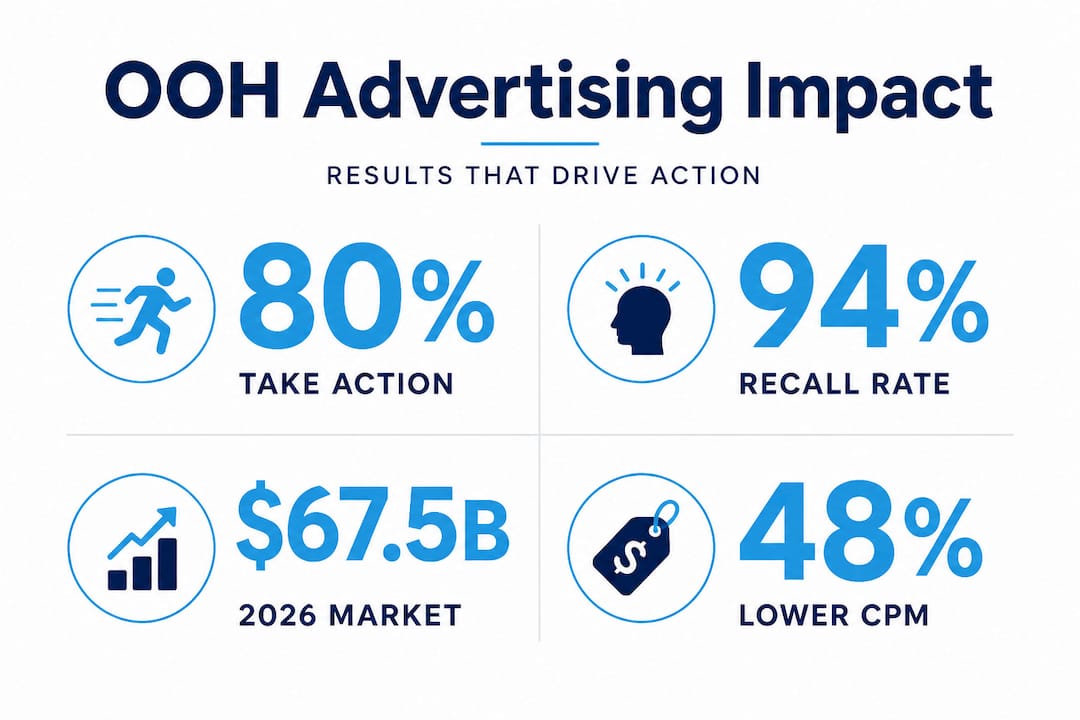
- Outdoor advertising consistently outperforms digital channels in brand recall, cost-efficiency, and consumer action rates.
- Strategic placement, clear messaging, and sustained repetition are essential for maximizing return on investment from OOH campaigns.
Brands spend billions chasing clicks, yet outdoor advertising (OOH) consistently delivers results that digital campaigns struggle to match. OOH boosts brand awareness by 47%, earns $5.97 in media value for every $1 spent, and generates a 94% recall rate compared to just 37% for online ads. While marketers debate ad spend allocation, smart business owners and event planners are quietly winning attention on streets, transit systems, and event venues. This article gives you a clear, practical roadmap for using outdoor advertising to build genuine brand visibility and drive real customer engagement.
Table of Contents
- What is outdoor advertising (OOH)? Defining the basics
- Why outdoor advertising works: Science and statistics
- Types of outdoor advertising: Choosing what fits your goals
- Maximizing ROI: Best practices and real-world results
- Why the ‘old-school’ approach beats digital for lasting brand impact
- Ready to amplify your message? Explore custom OOH solutions
- Frequently asked questions
Key Takeaways
| Point | Details |
|---|---|
| OOH drives action | Outdoor advertising motivates 80 percent of consumers to take action after seeing an ad. |
| Boosts brand recall | OOH leads to 94 percent brand recall—over double most online ads. |
| Cost-effective reach | OOH delivers strong ROI with a lower cost per thousand than TV or digital. |
| Choose the right format | Matching your OOH strategy to your goals ensures maximum impact. |
| Premium placements matter | Prioritizing prime locations outperforms programmatic or remnant ad buys. |
What is outdoor advertising (OOH)? Defining the basics
Outdoor advertising, often called out-of-home advertising or OOH, covers any visual marketing message people encounter while outside their homes. It is not just billboards on highways. The category is broad, and understanding its full scope helps you use it more strategically.
The main formats include:
- Billboards and large-format signs placed along roads and highways for mass reach
- Transit advertising on buses, subway stations, taxi wraps, and airport corridors
- Street furniture ads on bus shelters, benches, and kiosks in pedestrian-heavy areas
- Event signage including banners, directional signs, and branded displays at live events
- Digital OOH (DOOH) using LED screens that rotate multiple advertisers or show dynamic content
- Building-mounted signs and murals that serve as permanent brand landmarks in a neighborhood
According to research on what outdoor advertising actually delivers, it enhances brand visibility through captive audiences, contextual placement, repetition, mass reach, and constant visibility. Those five factors are the foundation of why OOH punches above its weight.
Who benefits most? Local retailers, restaurants, real estate agents, healthcare providers, event organizers, and regional service businesses all see outsized returns. If your customers move through a defined geographic area, outdoor advertising can intercept them at exactly the right moment. Reading up on exterior signage basics is a smart first step for businesses ready to plant a physical flag in their community.
The biggest misconception is that OOH is outdated. In reality, the category is growing fast, and the formats have never been more creative or measurable.
Why outdoor advertising works: Science and statistics
With a solid understanding of what OOH advertising involves, it’s time to look at why it truly works better than many expect, according to the numbers.
The core reason OOH outperforms many digital channels comes down to human behavior. People can skip a YouTube ad, scroll past a Facebook post, or use an ad blocker. They cannot scroll past a billboard. The message exists in the physical world, and the brain processes it whether the viewer intends to engage or not.
Here is how the data compares across major advertising channels:
| Metric | OOH | TV | Digital (Online) |
|---|---|---|---|
| Brand recall rate | 94% | ~55% | 37% |
| CPM (cost per thousand impressions) | 48% lower than TV | Baseline | Varies widely |
| Earned media return | $5.97 per $1 | $1.50 per $1 | ~$2.00 per $1 |
| Consumer action rate after exposure | 80% | ~45% | ~35% |
“Outdoor advertising is the last mass medium. It reaches people when they are most receptive—outside, moving, and actively experiencing the world around them.”
The complete guide to outdoor signs breaks this down practically, but the summary is straightforward: OOH reaches more people, sticks in memory longer, and costs significantly less per impression than television.
Here is how the process works when OOH converts a viewer into a customer:
- Exposure happens passively as someone drives, walks, or commutes through your signage area
- Recognition builds through repeated exposure over days and weeks
- Recall is triggered later at the point of purchase or when the consumer searches online
- Action follows, whether that is visiting your store, scanning a QR code, or searching your brand name
This sequence is why outdoor signage tips consistently emphasize placement and repetition over flashy creative. The mechanics of OOH work best when the message is seen consistently over time by the same audience.
For event planners specifically, this means signage placed along venue approaches and at key decision points creates a breadcrumb trail that guides attendees while reinforcing the brand experience before they even walk through the door.
Types of outdoor advertising: Choosing what fits your goals
We’ve covered why OOH is so effective. Next, let’s get specific about the formats you can choose and how to pick the right one for your goals.
Not every format fits every objective. Here is a quick comparison to help you align format with goal:
| Format | Best for | Limitation | Ideal audience |
|---|---|---|---|
| Highway billboards | Mass brand awareness | Limited dwell time | Commuters, regional shoppers |
| Transit wraps | Urban reach, frequency | Higher production cost | City dwellers, young professionals |
| Event signage | Directional, experiential | Temporary duration | Event attendees, sponsors |
| Street furniture | Pedestrian engagement | Smaller display area | Local foot traffic |
| Digital OOH (DOOH) | Dynamic, rotating messages | Shared with other ads | High-traffic urban areas |
| Building-mounted signs | Long-term brand presence | Permit requirements | Neighborhood communities |
Research on larger ads outperforming smaller formats shows that bigger ads achieve 8.4x higher engagement, which makes the case for investing in premium, large-format placements when your budget allows. That is not a small difference. It means a well-placed, oversized banner can outperform eight smaller signs for the same visual real estate cost.
Key considerations for event planners and local businesses:
- For events, prioritize directional signs at key decision points, entrance banners for first impressions, and sponsor recognition boards. Review this event signage comparison to understand which formats hold up best outdoors.
- For local businesses, building-mounted signs and curbside banners create consistent impressions with the same daily commuters, which builds recognition over time.
- For brand launches, transit wraps and billboard clusters in target neighborhoods create the perception of being everywhere at once.
Pro Tip: If your budget is tight, focus on one premium, high-traffic location rather than spreading money across multiple lower-visibility spots. Frequency beats coverage when it comes to brand recall.
The guide to outdoor event signage offers specific layout and material advice for events ranging from trade shows to outdoor festivals, covering everything from weather-resistant materials to mounting options.
Maximizing ROI: Best practices and real-world results
Having identified the right types of OOH for your needs, here’s how to get measurable results from your investment.
The gap between average and excellent OOH campaigns comes down to three variables: design clarity, strategic placement, and sustained repetition. Let’s break down exactly how to get each right.
1. Lead with one clear message
Viewers have roughly three seconds to absorb a billboard or large sign while moving. One message, one visual, one call to action. Brands that cram in phone numbers, websites, taglines, and multiple product claims reduce recall dramatically. Strip it down.
2. Choose placement based on your customer’s journey, not just traffic counts
A sign near your store is worth more than a sign across town with higher impressions. Context matters. A restaurant sign near a highway exit beats a billboard in a distant neighborhood with more daily traffic, because the viewer is already making a real-time decision about where to eat.
3. Commit to a duration that allows repetition to work
OOH needs time to build awareness. Short bursts of one or two weeks work for events and promotions. Brand-building campaigns need a minimum of four to eight weeks to create meaningful recall. Follow the signage installation guide to make sure your physical signs are set up correctly from the start so they last through the campaign period.
4. Maintain your signs professionally
A faded, torn, or damaged sign signals the opposite of brand confidence. Following a sign maintenance routine protects your investment and keeps your brand looking sharp throughout the campaign.
5. Amplify with a digital cross-channel component
OOH works even better when paired with digital. A consumer who sees your billboard, then later encounters your Facebook ad, is far more likely to convert. OOH primes the brain; digital closes the sale.
The numbers from real campaigns are persuasive. Heineken’s OOH campaign drove $3.8 million in incremental sales with a 4.3x sales lift, while Wind Creek Casino achieved a 438% increase in visitation through a targeted OOH push. These are not outliers. They reflect what happens when placement, message, and timing align.
The broader market reflects this momentum. The OOH market is growing to $67.5 billion by 2033 at a 5.9% compound annual growth rate, driven by digital screens, programmatic buying, and increasing urbanization. For business owners and marketers, this growth signals a window of opportunity before premium placements become even more competitive and expensive.
Pro Tip: When comparing placements, always ask for total weekly impressions alongside the demographic breakdown for that location. A placement with 200,000 weekly impressions of your exact target customer beats one with 500,000 generic impressions every time.
Statistic to bookmark: 80% of consumers report taking action after seeing an OOH ad. That action might be a search, a store visit, or telling a friend. That is not passive exposure. That is marketing that moves people.
Why the ‘old-school’ approach beats digital for lasting brand impact
Here is the uncomfortable truth that most digital marketing advocates skip over: not every brand problem is a digital problem, and not every solution lives on a screen.
We talk to business owners regularly who have spent years optimizing their Google Ads, chasing lower cost-per-click numbers, and A/B testing landing pages. Their digital metrics look clean. Their brand recognition in the local community is still nearly zero. Why? Because digital advertising exists inside a screen. It disappears the moment someone puts their phone down.
A well-placed physical sign exists in the world 24 hours a day. It does not get blocked. It does not lose relevance because an algorithm changed. It does not disappear when your ad budget runs out for the month. It is simply there, building familiarity every single day.
The research on static OOH’s advantages supports this directly. Static outdoor advertising offers lower cost, consistent repetition, and reliable space ownership for brand building in ways that digital and programmatic OOH cannot always match. When you own a premium static location, that space works for you exclusively, day and night.
The trap we see businesses fall into is chasing programmatic OOH remnant inventory, meaning the unsold digital screen time bought at a discount through automated platforms. It sounds efficient. The reality is your message rotates with dozens of other advertisers, your brand may appear at 2 a.m. when nobody is looking, and you have no consistent presence in any single location.
Contrast that with a well-chosen, static, premium placement where your brand owns that visual real estate entirely. The same commuters see your message Monday through Friday for six weeks. That is how recognition becomes preference, and preference becomes purchase.
Check out the outdoor signage options to see how static and digital formats compare in real business contexts. The answer is rarely all-digital or all-static. It is about knowing which format owns the outcome you actually need.
Ready to amplify your message? Explore custom OOH solutions
With these insights and strategies, you’re set up for OOH success. The next step is turning your strategy into physical signage that actually works in the real world.
At Custom Signs Today, we help businesses, event organizers, and marketing teams produce high-quality outdoor signage built for visibility and durability. Whether you need a complete strategy from the custom signage guide, want to refresh your storefront with face change signs, or need weather-resistant custom vinyl decals for vehicles and outdoor surfaces, we have the solutions to match your goals and your budget. Request a free quote today and see how a single, well-executed outdoor sign can change how your community sees your brand.
Frequently asked questions
How does outdoor advertising compare to digital in terms of ROI?
Outdoor advertising delivers a CPM 48% lower than TV and a 94% recall rate versus 37% online, generating $5.97 in earned media per $1 spent, which makes it one of the most cost-efficient channels available.
What are the most effective types of outdoor advertising for local businesses?
Billboards, building-mounted signs, and event signage are particularly powerful because they offer mass reach and repetition to the exact local audiences who are most likely to become customers.
Can outdoor advertising support short-term events as well as long-term branding?
Absolutely. OOH is flexible enough to drive event attendance over a single weekend and build sustained brand recognition over months, because it suits both short-term and long-term exposure objectives depending on format and placement.
Is bigger always better in outdoor advertising?
Larger formats offer a significant advantage, with research showing larger ads generate 8.4x more engagement than smaller ones, making size one of the most important creative decisions in any outdoor campaign.
Recommended
- Boost your brand in 2026 with effective signage –
- Top signage trends 2026: boost brand impact with AI displays –
- Best Outdoor Event Signage – Expert Comparison 2025 –
- 7 Key Advantages of Outdoor Signs for Retail Success –
- Top Ways Businesses Use Logo Projectors to Stand Out in 2026 – The Logo Light Store
- How to engage audiences with signage: proven strategies for 2026