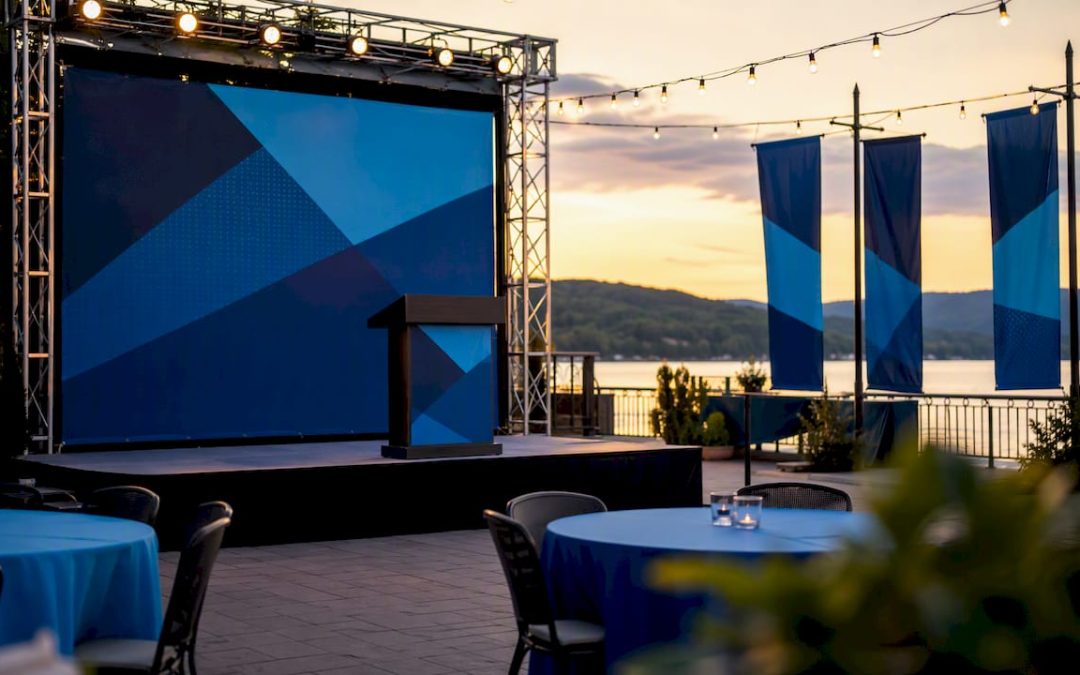
The highest-ROI sponsorship signage formats are entrance displays, stage backdrops, digital loops, step-and-repeat photo walls, branded lounges, tabletop placements, and outdoor flags. These seven formats appear across virtually every event type because they combine dwell time, photo potential, and repeatable impressions in a single footprint.
Here is the shortlist with a one-line rationale for each:
- Entrance displays: Every attendee passes through once, making this the guaranteed impression.
- Stage backdrops: Camera-facing placement means every photo and livestream frame carries sponsor branding.
- Digital loops: One screen sells to multiple sponsors simultaneously and delivers measurable play counts.
- Step-and-repeat photo walls: Attendee selfies extend sponsor reach to social feeds well after the event ends.
- Branded lounges: High dwell time turns a seating area into extended brand exposure.
- Tabletop placements: Table tents and runners deliver repeated impressions throughout meals and sessions.
- Outdoor flags and pole banners: Reach attendees before they enter and reinforce branding in parking areas.
Global sponsorship spending reached an estimated $97.4 billion in 2023, which tells you how seriously brands take the visibility these placements deliver. Customsignstoday produces all of these formats, from large-format vinyl backdrops to custom vinyl signs and decals built for event use.
Key Takeaways
The most effective sponsorship signage strategy pairs high-visibility placements with production-grade materials and a clear tier-to-placement map that sponsors can see before the event.
| Point | Details |
|---|---|
| Tier-to-placement mapping | Assign Platinum to stage and entrance, Gold to lounges and lanyards, Silver to tabletop and digital loops. |
| Digital loops multiply inventory | A single screen can carry multiple sponsors by rotation and deliver measurable play counts per tier. |
| Photo-op placement height | Position primary logos 5–6 ft from the ground and use matte materials to prevent flash washout. |
| Production checklist | Collect vector files at 300 dpi minimum, confirm bleed specs, and run a digital QA 30 minutes before doors open. |
| Customsignstoday | Produces large-format backdrops, vehicle wraps, face-change signs, and custom decals with proof approval before every print run. |
Table of Contents
- High-impact indoor signage: what works and where to put it
- Outdoor and large-format sponsorship signage that survives the elements
- Tabletop and printed placements that deliver repeated impressions
- Digital and interactive sponsorship signage that multiplies your inventory
- Photo-op and experiential signage that earns social shares
- Mapping signage to sponsorship tiers and what goes on a banner
- Production and technical checklist before anything goes to print
- Post-event recognition and repurposing signage
- What most planners get wrong about sponsorship signage
- Customsignstoday delivers sponsor-ready signage from fabrication to installation
- Sources
High-impact indoor signage: what works and where to put it
Indoor sponsorship signage examples span a wide range of formats, and the right choice depends on the venue, the sponsor tier, and how much foot traffic a specific zone receives.
Stage backdrops and pipe-and-drape banners are the workhorses of indoor events. A fabric tension backdrop at 8 ft × 20 ft gives you a wrinkle-free surface that photographs cleanly under stage lighting. Fabric also ships flat and installs without tools, which matters when load-in windows are tight.
Hanging banners work well in convention halls and arenas where floor space is scarce. Suspend them above registration desks, food stations, or session entrances. Double-sided printing doubles the impression count for the same fabrication cost.
Lectern and podium wraps are underused. A vinyl wrap on the speaker podium puts the sponsor logo directly in every press photo taken from the audience. Size it so the logo fills roughly 60% of the panel face.
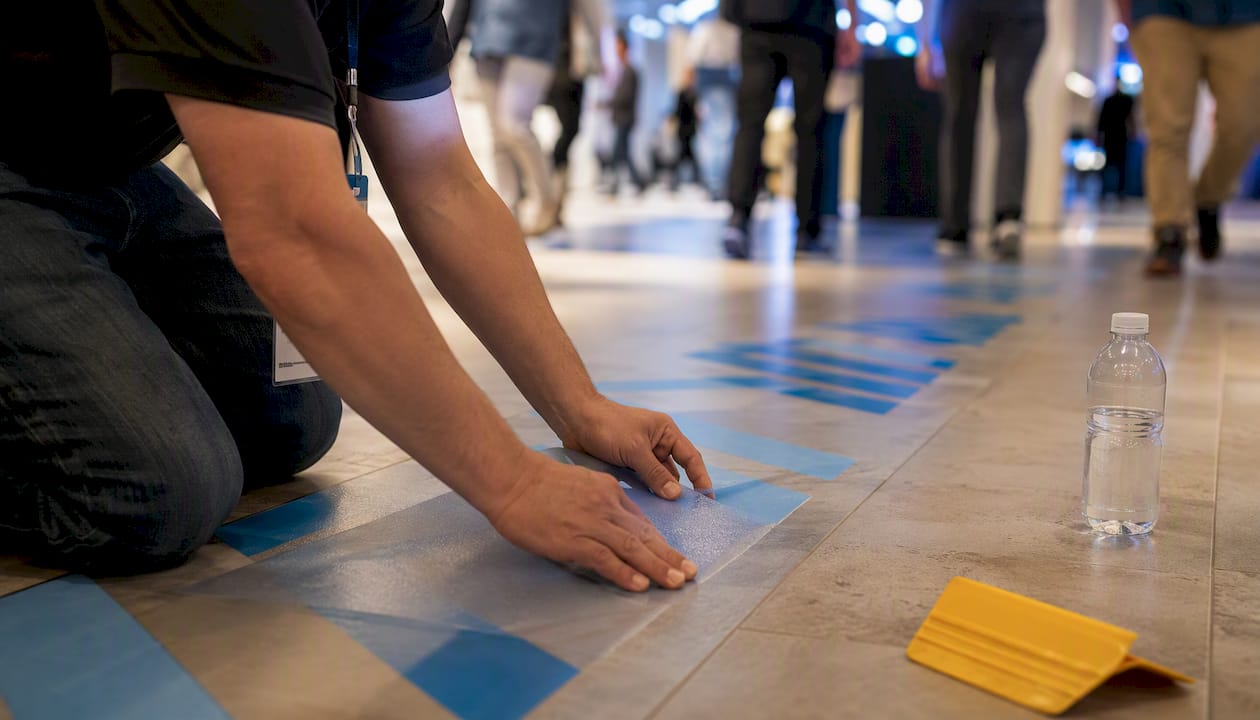
Floor graphics are a natural fit for high-traffic corridors and elevator lobbies. Laminated anti-slip vinyl holds up through a full day of foot traffic and peels cleanly from most hard floors. Place them at decision points where attendees slow down or stop.
Wall and window decals let you brand otherwise dead surfaces. Frosted window vinyl on a glass partition creates a sponsor presence without blocking sightlines. For a quick visual mockup to share with sponsors, photograph the raw space and overlay a scaled logo in PowerPoint or Canva before fabricating anything.
The general rule: favor fabric for stage-facing placements, rigid boards for directional or informational signs, and custom vinyl decals for surfaces where adhesive application is practical and removal is required post-event.
Outdoor and large-format sponsorship signage that survives the elements
Outdoor formats reach attendees before they ever walk through the door, which is why effective signage for sponsors at outdoor venues often starts at the parking lot perimeter.
- Pole banners and street banners: Best for lining venue entrances and pedestrian paths. Use 13 oz. scrim vinyl for wind resistance; add wind slits if the banner exceeds 4 ft wide.
- Feather flags: Lightweight and portable, ideal for sponsor branding at festival zones, sponsor villages, or sponsor-branded food courts. They pack into a carry bag and set up in under two minutes.
- Inflatable arches: High-visibility format for race finish lines, festival entrances, and outdoor activations. Requires a power source and a clear overhead footprint.
- Vehicle wraps: Sponsor-branded shuttle buses or golf carts carry the logo across the entire venue footprint throughout the day.
- Mesh fence wraps: Printed on perforated vinyl, these let wind pass through while covering chain-link fencing with full-color sponsor graphics. A standard 9 oz. mesh holds up in winds up to 35 mph.
- Yard signs and A-frames: Low-cost directional placements that work well for parking zones, sponsor booth markers, and wayfinding.
A few practical notes on outdoor durability: UV-resistant inks extend the life of outdoor prints significantly, especially for multi-day events. Grommets every 18–24 inches on banner edges reduce tearing under wind load. For any placement near a public road or sidewalk, check local municipal permit requirements before installation. Some jurisdictions require a temporary sign permit for anything over a specific square footage. The outdoor signage installation guide from Customsignstoday covers anchor types and wind-load considerations in detail.
Tabletop and printed placements that deliver repeated impressions
Tabletop sponsorship signage is easy to underestimate. A table tent sitting in front of a guest for 90 minutes during a gala dinner delivers more total viewing time than a banner they walk past once.
Table tents are the most common format: a folded card (typically 4 in × 6 in or 5 in × 7 in) placed at each seat. Keep the sponsor logo at least 0.5 inches from any edge, and size it so it reads clearly from arm’s length. Pair the logo with a short sponsor message or QR code to add a conversion layer.
Table runners work especially well at seated dinners and award ceremonies. A full-length runner in the sponsor’s brand colors, with a repeated logo pattern, turns every table into a branded surface without requiring individual placement at each seat.
Lanyards and badge holders are high-frequency items. Every attendee wears one for the full event duration, and the sponsor logo travels with them through every session, photo, and networking conversation. Sponsor banners and printed materials should include the event name, date, and theme colors alongside the sponsor logo to reinforce recognition and recall.
Branded programs and menus give sponsors a placement that attendees actively read. A quarter-page sponsor ad in a printed program reaches a captive audience during the moments before a keynote or performance.
To avoid logo clutter across all printed materials, establish a clear hierarchy before production: one primary sponsor per surface, with secondary sponsors grouped in a smaller footer band. Mixing six logos of equal size on a table tent reads as noise, not sponsorship.
Digital and interactive sponsorship signage that multiplies your inventory
Digital formats solve a problem static signs cannot: a single 55-inch lobby screen can carry six Platinum sponsors at 10 seconds each and report play counts back to organizers. That measurability is what makes digital loops increasingly attractive to sponsors who want proof of impressions.
Digital loops are the baseline. Schedule sponsor slides in rotation, allocating screen time by tier. A workable rule: Platinum sponsors receive 35–45% of total rotation, Gold sponsors 20–25%, and Silver sponsors fill the remainder. Build this timing formula into sponsor contracts so expectations are set before the event.
Social media walls aggregate event hashtag posts in real time and display them on a large screen. Sponsors get logo placement on the frame surrounding the feed, and the content refreshes constantly, keeping the display engaging.
Touch kiosks let attendees interact with sponsor content directly — product demos, contest entries, or lead-capture forms. QR codes on physical signage can drive the same interactions without the hardware cost.
Projection mapping on architectural surfaces (walls, floors, ceilings) creates a sponsor moment that attendees photograph and share. It requires a dark environment and a projector with sufficient throw distance, but the visual impact is hard to match with any static format.
For technical requirements: request sponsor content files in MP4 (H.264, 1920×1080) for video and PNG at 300 dpi for static slides. Confirm power outlets and network connectivity at each digital placement location during your venue walkthrough, not the morning of the event.
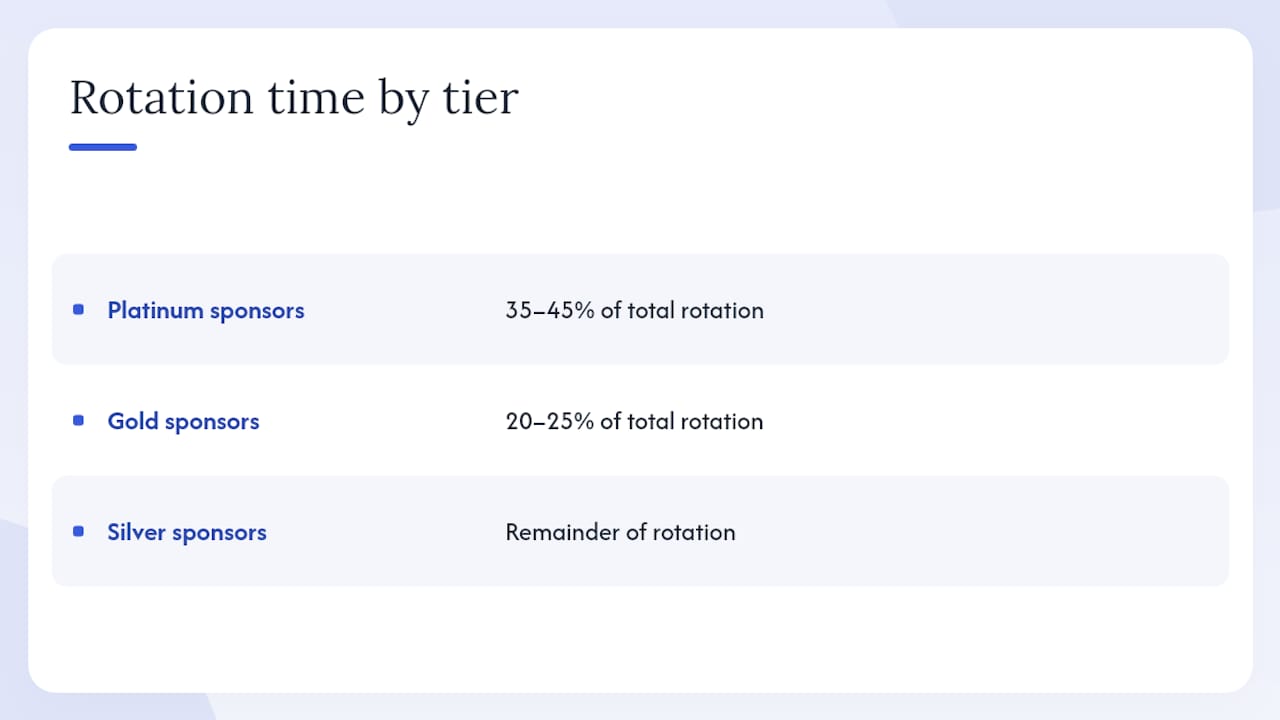
Photo-op and experiential signage that earns social shares
Photo-op signage is the format that keeps working after the event ends. Every attendee photo posted to Instagram or LinkedIn is an organic impression for the sponsor.
Step-and-repeat backdrops are the standard. The repeating logo pattern means the sponsor brand appears in the frame regardless of where the subject stands. Use matte fabric rather than glossy vinyl to prevent flash washout. Position the primary logo between five and six feet from the ground so it sits at face height in a standard portrait photo.
Selfie walls go further by adding props, lighting, or a themed set design that makes the photo itself worth sharing. The sponsor logo appears in the lower corner of the frame, not plastered across the entire background.
Branded activation booths work best when they offer something useful: a charging lounge with branded power strips, a hydration station with sponsor-branded cups, or a demo booth where attendees try a product. The interaction creates a memory; the signage creates the brand association.
Quick do/don’t rules for photo-op signage:
- Do place the event hashtag and social handle in the lower third of the backdrop.
- Do use non-reflective materials for any surface that will face a camera.
- Don’t crowd the backdrop with more than two sponsor logos at the primary tier.
- Don’t use dark backgrounds in low-light venues without supplemental lighting.
Pro Tip: Add a ring light or two LED panels flanking the photo-op area. Consistent lighting means every attendee photo looks good, which dramatically increases the share rate and the sponsor’s organic reach.
Interactive activations like photo booths and branded lounges consistently outperform static signs on engagement because attendees dwell longer and return voluntarily.
Mapping signage to sponsorship tiers and what goes on a banner
Sponsor fulfillment depends on a clear visibility hierarchy that ties each tier to specific placements. Without that map, you cannot price tiers accurately or prove value to sponsors after the event.
A practical tier-to-placement framework:
| Tier | Primary Placements | Logo Size Rule |
|---|---|---|
| Platinum | Stage backdrop, entrance display, digital loop (35–45% rotation) | Largest, solo or paired |
| Gold | Hanging banners, lounge branding, lanyard | Medium, grouped with one other |
| Silver | Tabletop tents, program ads, digital loop (20–25% rotation) | Standard, grouped in footer |
| Bronze | Yard signs, directional markers, program listing | Small, listed format |
Every sponsorship banner or sign should carry these elements: the sponsor logo (with adequate clearspace, minimum 10% of logo width on all sides), the event name and date, the sponsor’s tier designation if applicable, and a QR code or short URL for a conversion action. Personalizing banners with event identity and theme colors increases recognition and recall.
Legally, sponsorship signs are defined as any sign, display, or insignia used for sponsorship or promotional purposes. That definition is broad enough to cover everything from a vinyl banner to a digital slide, which is useful when drafting contract language with sponsors about what “signage” includes.
Share a placement map with sponsors before fabrication. A simple venue floor plan with color-coded zones showing each tier’s placements answers questions before they are asked and reduces last-minute change requests.
Production and technical checklist before anything goes to print
Sponsors value reliability as much as visibility, and a blurry logo or a crashed digital loop damages the sponsor relationship more than a missed placement would.
Artwork and file specs:
- Accepted file types: AI, EPS, PDF (vector preferred); PNG or TIFF at 300 dpi minimum for raster files
- Color profile: CMYK for print; RGB for digital displays
- Bleed: 0.125 inches on all sides for any bordered print
- Artwork deadline: 10 business days before the event for large-format prints; 5 days for tabletop items
Material recommendations:
- Indoor fabric: 8 oz. polyester tension fabric for backdrops; wrinkle-resistant and machine-washable
- Outdoor vinyl: 13 oz. scrim vinyl for banners; 9 oz. mesh for fence wraps
- Floor graphics: laminated anti-slip vinyl, minimum 3 mil laminate
- Rigid boards: 3mm Sintra PVC for lightweight indoor boards; aluminum composite for outdoor durability
Choosing the right substrate matters more than most planners realize. The sign materials comparison guide from Customsignstoday breaks down trade-offs by environment and budget.
Installation and testing timeline:
- 48 hours before: confirm all physical signage is fabricated and staged
- 24 hours before: complete venue installation and photograph every placement
- Morning of event: run digital loop QA (check file playback, timing, and audio if applicable)
- 30 minutes before doors open: final walkthrough to confirm nothing has shifted or been covered
Pro Tip: Request a signed proof acceptance from the sponsor before sending large-format files to print. It protects you from reprint costs and ensures the sponsor cannot dispute the final output.
Post-event recognition and repurposing signage
The event ends, but sponsor visibility does not have to. A few quick tactics extend the value of every signage investment.
Social media recap posts featuring event photos naturally include step-and-repeat backdrops and branded lounges in the frame. Tag sponsors in those posts and share the content with them directly so they can repost to their own audiences.
Sponsor thank-you pages on the event website and in post-event recap emails give sponsors a digital placement that lives beyond the event date. Include a photo of their signage in context, the estimated impression count from your placement map, and links to any social posts where their branding appeared.
Signage reuse is worth planning at the fabrication stage. A tension fabric backdrop with a modular frame can be reused at three or four events with a panel swap. Printed vinyl banners can be donated to nonprofit partners or repurposed as photo walls at smaller follow-up events. Proper maintenance extends the lifespan of outdoor signage significantly, making reuse practical rather than aspirational.
For sponsor recap templates, include three data points: estimated impressions by placement (based on attendance and dwell time), photo evidence of each placement in use, and links to social posts where the sponsor’s branding is visible. That package makes the renewal conversation straightforward.
What most planners get wrong about sponsorship signage
The conventional wisdom says more placements equal more sponsor value. In practice, the opposite is often true. Overcrowding a venue with signage from every tier dilutes the impact of every individual placement, including the Platinum sponsor who paid for exclusivity.
The planners who consistently retain sponsors year over year tend to do two things differently. First, they treat the production checklist as a sponsor deliverable, not an internal task. Sharing proof approvals and installation photos with sponsors before the event signals professionalism and builds trust that the placement will actually look the way it was sold. Second, they design signage with the camera frame in mind from the start, not as an afterthought. A backdrop that photographs well at the event generates social impressions for months. One that washes out under flash lighting generates nothing.
The other underrated move: build reuse into the fabrication spec. A modular tension fabric system costs more upfront than a one-time vinyl print, but it pays back across multiple events and gives sponsors continuity of branding across your event calendar.
Customsignstoday delivers sponsor-ready signage from fabrication to installation
Producing signage that actually holds up under event conditions, looks sharp in photos, and arrives on time requires a fabricator who understands the production timeline, not just the print specs. Customsignstoday handles the full range of sponsor signage formats: large-format vinyl backdrops, tension fabric displays, vehicle wraps for sponsor-branded shuttles, face-change signs for multi-event reuse, and custom decals for tabletop and indoor placements.
Every order goes through a proof approval process before production, so sponsors see exactly what they are getting before anything is cut or printed. Materials are selected for the environment: UV-resistant inks for outdoor placements, anti-slip laminate for floor graphics, wrinkle-resistant fabric for stage backdrops. If you are building a sponsor package for an upcoming event and need accurate pricing fast, request a custom quote and get a production-ready proposal that you can share directly with your sponsors.
Sources
- What Are the Best Sponsorship Signage Examples for Events?
- 5 ways to boost sponsor visibility at live events
- 10 Creative Ways to Display Sponsors at Your Next Event
- How to plan event signage that builds brand recall
- Sponsor Fulfillment in Live Events: Producing Visibility Without Overcrowding the Experience